
WHEN HISTORY TAKES THE WITNESS STAND: Constitutional Memory, Political Theatre, and the Tragic Imagination in K. K. Bonteh’s Shadows of Foumban
Abstract
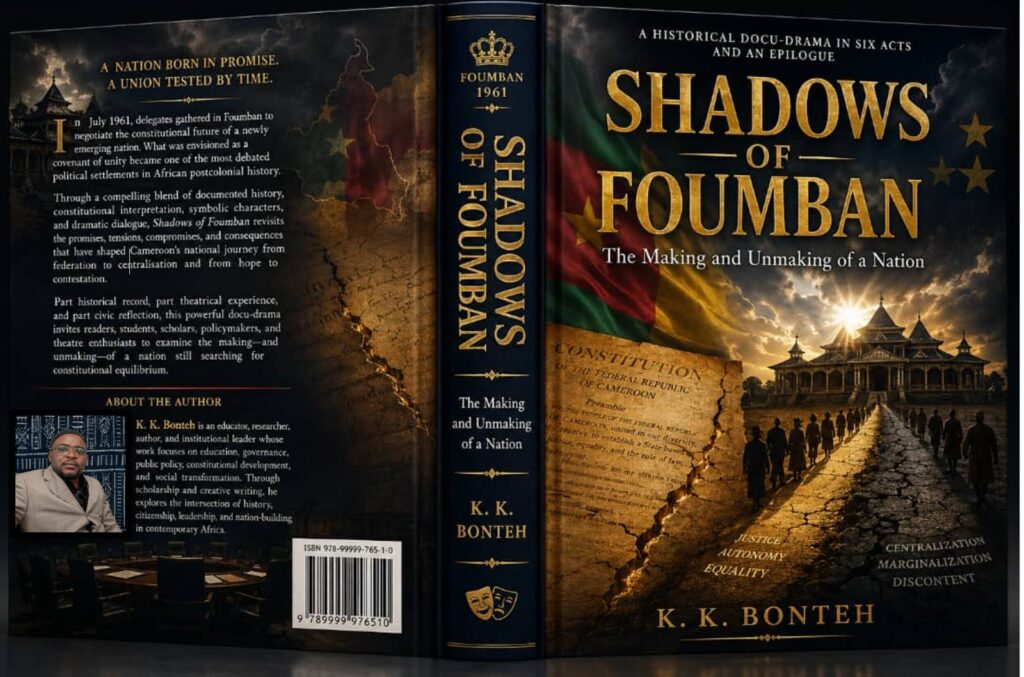
K. K. Bonteh’s Shadows of Foumban: The Making and Unmaking of a Nation represents a significant contribution to contemporary African political theatre by transforming constitutional history into dramatic literature. Situated at the intersection of historiography, constitutional discourse, memory studies, and performance, the play revisits the 1961 Foumban Constitutional Conference and the subsequent evolution of the Cameroonian state through a hybrid form that combines historical reconstruction, allegory, symbolism, and Shakespearean-inspired tragic structure. Through the personification of institutions such as the Constitution, the State, Memory, Justice, and Unity, Bonteh reimagines constitutional debates as theatrical encounters, thereby transforming legal and political questions into human and moral dilemmas. This review argues that Shadows of Foumban belongs within the broader tradition of political and historical drama exemplified by Shakespeare, Brecht, Soyinka, Ngũgĩ wa Thiong’o, and postcolonial African theatre. The play ultimately emerges as both a literary achievement and a civic intervention, inviting audiences to interrogate the relationship between constitutional promises, historical memory, and nation-building in postcolonial Africa.
Keywords: Political Theatre; Constitutional Drama; Foumban Conference; Cameroon; Postcolonial Literature; Historical Memory; Federalism; Nationhood; Docu-Drama; African Theatre.
When History Takes the Witness Stand
Few contemporary African dramatic works attempt the intellectual and artistic feat that K. K. Bonteh undertakes in Shadows of Foumban: The Making and Unmaking of a Nation. Emerging from the rich traditions of political theatre and historical drama, the play transforms one of the most consequential constitutional moments in modern Cameroonian history into a theatrical meditation on power, memory, legitimacy, and national identity. As Bonteh himself notes in the prefatory materials, the drama is conceived as a historical docu-drama grounded in constitutional records, political history, dramatic reconstruction, and allegorical representation.
The work recalls what Hayden White famously described as the narrative dimension of history, wherein historical events acquire meaning through their arrangement into coherent stories rather than through chronology alone (White, 1973). Bonteh’s achievement lies precisely in this transformation of constitutional history into dramatic narrative. The Foumban Conference becomes more than an event; it becomes a tragic stage upon which competing visions of nationhood contend for legitimacy.
Thematically, Shadows of Foumban belongs to the lineage of political theatre represented by William Shakespeare’s Julius Caesar and King Lear, Bertolt Brecht’s epic theatre, and Wole Soyinka’s exploration of power, ritual, and statehood in Death and the King’s Horseman. Like these works, Bonteh is less concerned with individual psychology than with the fate of institutions and societies. His protagonist is neither a king nor a hero but a nation itself—a nation struggling to reconcile unity and diversity, memory and authority, aspiration and reality.
One of the most remarkable features of the play is its use of allegorical personification. Characters such as The Constitution, Memory, Justice, Unity, and The State function in ways reminiscent of medieval morality plays while simultaneously drawing upon African performance traditions in which abstract principles frequently assume dramatic embodiment (Soyinka, 1976; Turner, 1982). The Constitution, in particular, emerges as a tragic figure whose lament—“I am being rewritten”—captures the vulnerability of legal covenants to political reinterpretation. Through this device, Bonteh humanises constitutional transformation and enables audiences to perceive legal change not merely as institutional procedure but as lived historical experience.
The Prologue, The Court of Origins, is among the strongest sections of the drama. By staging Germany, Britain, and France as disputing voices before the Tribunal of History, Bonteh situates Cameroon’s constitutional dilemmas within the broader context of colonial partition and imperial inheritance. The image of Cameroon as “a divided manuscript waiting to be written” constitutes one of the play’s most memorable metaphors. It recalls the postcolonial concerns found in Things Fall Apart (1958), A Grain of Wheat (1967), and other works that examine how colonial disruption continues to shape national destinies long after formal independence.
The Foumban Conference itself becomes the symbolic heart of the play. Here Bonteh dramatizes a constitutional encounter between two competing visions: federal autonomy and centralized unity. Rather than portraying one side as entirely virtuous and the other as entirely culpable, the play foregrounds ambiguity, imbalance, and differing expectations. This nuanced treatment aligns with scholarship on constitutional bargaining and federal formation, particularly the works of Daniel J. Elazar (1987) and Arend Lijphart (1999), both of whom emphasise the delicate balance required to sustain multinational political arrangements.
Particularly compelling is Bonteh’s recurrent emphasis on memory. The character of Memory functions as a moral archive, continually reminding audiences that historical events do not disappear once they are formally concluded. In this respect, the play resonates strongly with the memory studies of Pierre Nora (1989) and Paul Ricoeur (2004), who argue that collective memory remains central to the construction of identity and political legitimacy.
The later acts shift from constitutional optimism to constitutional anxiety. The transition from federalism to a unitary state, the tensions surrounding legal and educational systems, and the eventual emergence of the Anglophone crisis are dramatized not as inevitable outcomes but as consequences of competing interpretations of the constitutional covenant. In doing so, the play echoes broader postcolonial debates concerning nation-building in plural societies, debates that have also shaped countries such as Nigeria, Canada, Belgium, and India.
Perhaps the play’s greatest strength lies in its refusal to provide easy answers. The climactic Trial of the Constitution recalls both classical tragedy and Brechtian political theatre. Yet unlike conventional courtroom dramas, the proceedings culminate in what Bonteh terms a “Judgment Without Verdict.” This refusal of closure reflects the complexity of constitutional history itself. As Ricoeur (2004) observes, memory and history are rarely settled once and for all; they remain subjects of continual reinterpretation.
Ultimately, Shadows of Foumban is not simply a drama about Cameroon. It is a drama about the fragile relationship between constitutional text and political reality. It asks whether nations are sustained by documents alone or by the collective faith that citizens invest in those documents. In doing so, it transforms a specific constitutional episode into a universal meditation on nationhood.
The final inscription of the drama encapsulates its philosophical vision:
“A nation is not finished by ink, but by the memory of those who believe in it.”
Few contemporary African plays have articulated the tragedy, promise, and complexity of nation-building with such intellectual ambition and poetic force.
About the Author
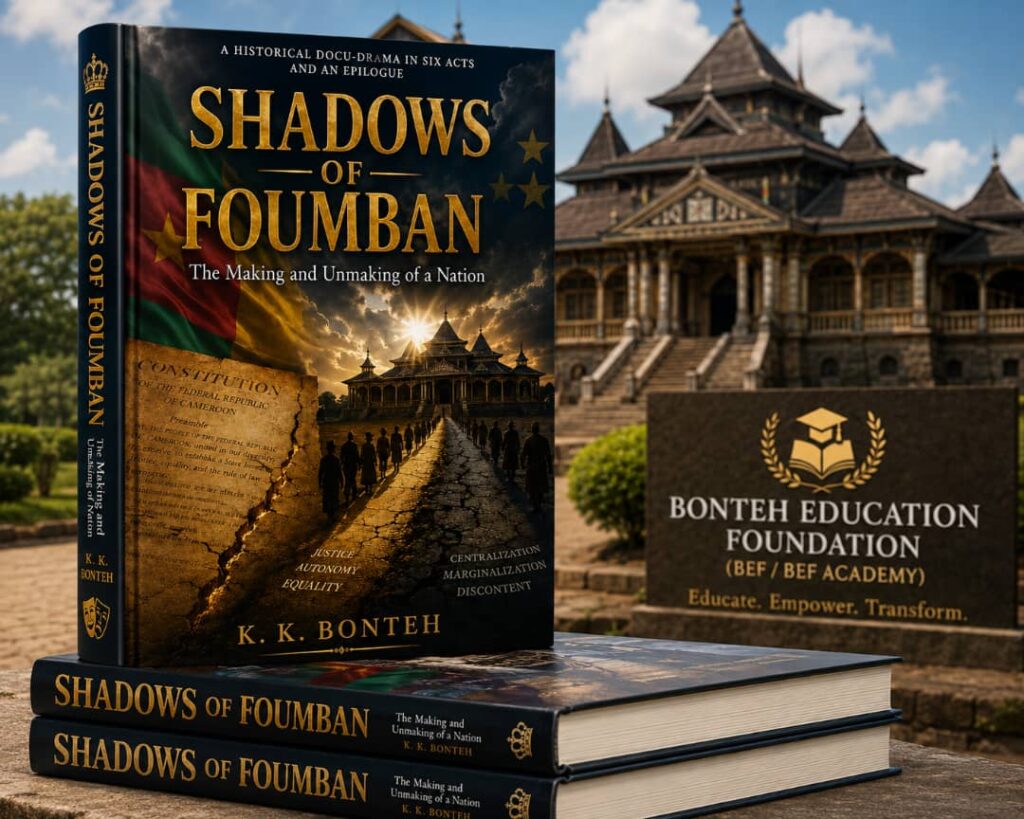
K. K. Bonteh is a Cameroonian educator, researcher, theatre practitioner, journalist, and author. He serves as Regional Pedagogic Inspector for the Teaching and Promotion of Bilingualism and is the Founder and Executive Director of the Bonteh Education Foundation (BEF) and BEF Academy. His scholarly interests include constitutional history, theatre and performance studies, educational innovation, bilingualism, peace-building, and the semiotics of indigenous performance traditions. Shadows of Foumban stands as one of his most ambitious literary contributions, combining historical inquiry, civic reflection, and dramatic artistry within a uniquely African constitutional theatre tradition.
Works Cited
Things Fall Apart. London: Heinemann, 1958.
Elazar, Daniel J. Exploring Federalism. Tuscaloosa: University of Alabama Press, 1987.
Lijphart, Arend. Patterns of Democracy. New Haven: Yale University Press, 1999.
Ngũgĩ wa Thiong’o. A Grain of Wheat. London: Heinemann, 1967.
Nora, Pierre. “Between Memory and History: Les Lieux de Mémoire.” Representations 26 (1989): 7–24.
Ricoeur, Paul. Memory, History, Forgetting. Chicago: University of Chicago Press, 2004.
Soyinka, Wole. Myth, Literature and the African World. Cambridge: Cambridge University Press, 1976.
Turner, Victor. From Ritual to Theatre: The Human Seriousness of Play. New York: Performing Arts Journal Publications, 1982.
White, Hayden. Metahistory: The Historical Imagination in Nineteenth-Century Europe. Baltimore: Johns Hopkins University Press, 1973.
Bonteh, K. K. Shadows of Foumban: The Making and Unmaking of a Nation: A Historical Docu-Drama in Six Acts and an Epilogue. Yaoundé: BEF Academy Publications, 2026.