
𝗜𝗡𝗧𝗥𝗢𝗗𝗨𝗖𝗧𝗜𝗢𝗡
𝗧𝗵𝗲 𝗣𝗼𝘄𝗲𝗿 𝗼𝗳 𝘁𝗵𝗲 𝗦𝗽𝗼𝗸𝗲𝗻 𝗪𝗼𝗿𝗱
1.1 The Human Origins of Storytelling
Before humanity carved symbols upon stone, pressed ink onto paper, or stored information in digital clouds, it spoke. The human voice was the first archive of memory, the first classroom of knowledge, the first theatre of imagination, and the first instrument through which communities interpreted the world around them. Across civilizations and continents, storytelling emerged as one of humanity’s earliest and most enduring cultural practices. Through stories, songs, chants, myths, and performances, societies transmitted their histories, values, beliefs, and collective experiences from one generation to another.
Storytelling is therefore not merely an artistic activity; it is a fundamental human instinct. As Walter J. Ong observes in Orality and Literacy (1982), oral cultures developed sophisticated mechanisms for preserving and transmitting knowledge long before the emergence of writing systems. In such societies, memory functioned as a living repository, and language became the principal means through which knowledge was organized, preserved, and communicated.
Throughout history, oral traditions have shaped civilizations. The Homeric epics of ancient Greece, the Vedic chants of India, the Dreaming narratives of Aboriginal Australia, the Norse sagas of Scandinavia, and the bardic traditions of the Celtic world all testify to humanity’s reliance on oral performance as a vehicle for preserving culture and knowledge. Africa belongs proudly within this global tradition of orality, possessing some of the most diverse, sophisticated, and resilient oral traditions in human history.
The story of humanity is, in many respects, the story of voices. Long before books existed, people remembered through speech. Long before libraries were built, knowledge lived within storytellers, elders, priests, musicians, and poets. The spoken word was not merely a medium of communication; it was a means of preserving civilization itself.
1.2 Africa and the Global Tradition of Orality
Africa occupies a unique position within the global history of oral culture. The continent’s extraordinary linguistic, ethnic, and cultural diversity has given rise to an equally rich diversity of oral traditions. From the griots of West Africa and the praise poets of Southern Africa to the storytellers of Central Africa and the oral historians of the Horn of Africa, oral literature has long served as the foundation upon which African societies have constructed their identities and transmitted their knowledge.
For centuries, oral traditions functioned as the principal means through which African communities explained their origins, preserved historical events, regulated social behaviour, maintained political authority, and communicated spiritual beliefs. In many societies, oral narratives served functions that written texts fulfilled elsewhere. As Jan Vansina (1985) argues in Oral Tradition as History, oral traditions constitute legitimate historical sources capable of preserving complex historical information across generations.
Contrary to colonial assumptions that equated literacy with civilization, African societies developed highly sophisticated oral systems that effectively preserved knowledge long before the widespread introduction of writing. These systems were not primitive substitutes for writing but distinct and dynamic forms of intellectual expression. Ruth Finnegan (1970) notes that African oral literature represents an elaborate artistic tradition whose complexity rivals many written literary systems.
The diversity of African oral traditions mirrors the diversity of the continent itself. Each community has developed unique forms of storytelling, praise poetry, songs, riddles, folktales, myths, legends, and epics that reflect local histories, environments, values, and worldviews. Yet beneath this diversity lies a shared recognition of the power of language to shape human experience and preserve collective memory.
1.3 Defining Oral Literature
Oral literature may be broadly defined as all forms of artistic verbal expression transmitted primarily through speech rather than writing. It encompasses narratives such as folktales, myths, legends, epics, and historical accounts, as well as non-narrative forms including proverbs, riddles, chants, songs, prayers, praise poetry, and ritual performances (Finnegan, 1970).
However, oral literature is much more than spoken text. Unlike written literature, which often exists independently of its creator, oral literature achieves its fullest expression through performance. Meaning emerges not only through words but also through gesture, tone, rhythm, music, movement, costume, audience interaction, and contextual circumstances.
Richard Bauman (1977) emphasizes that performance transforms ordinary speech into a special communicative event. In African oral traditions, performance often functions simultaneously as literature, theatre, ritual, music, education, and social interaction. The storyteller, griot, praise poet, or ritual performer becomes both artist and custodian of cultural memory.
The oral nature of these traditions does not diminish their literary value. Rather, it reveals alternative ways in which human societies organize and transmit knowledge. Oral literature challenges narrow definitions of literature that privilege written texts and invites us to recognize the rich diversity of human artistic expression
1.4 Oral Literature as Knowledge System and Cultural Memory
One of the most significant yet often overlooked dimensions of African oral literature is its role as an indigenous knowledge system. Embedded within stories, songs, proverbs, myths, and rituals are complex bodies of knowledge concerning governance, ethics, ecology, medicine, spirituality, agriculture, conflict resolution, and social organization.
African oral traditions function as repositories of collective wisdom accumulated over centuries of human experience. Proverbs encapsulate philosophical insights; folktales transmit ethical values; myths explain cosmological beliefs; praise poems preserve genealogies; and ritual narratives encode spiritual knowledge. Through these forms, communities construct and communicate understandings of reality.
Ngũgĩ wa Thiong’o (1986) reminds us that language is “a carrier of culture” and that culture itself is a repository of a people’s accumulated experiences. Oral literature therefore serves not merely as entertainment but as a mechanism through which societies remember, interpret, and transmit their understanding of the world.
Jan Assmann’s concept of cultural memory is particularly relevant here. Cultural memory refers to the ways societies preserve and reproduce shared understandings of their past. African oral traditions function as living archives that continually renew collective memory through performance. Every retelling becomes an act of remembrance; every performance becomes an act of cultural preservation.
1.5 Performance, Participation, and Meaning
Perhaps the most distinctive feature of oral literature is its performative nature. Oral traditions are not simply told; they are enacted. Meaning emerges through interaction between performer and audience.
In many African societies, storytelling is a communal event. Audiences do not merely listen; they respond, question, sing, dance, laugh, and participate. This participatory dimension transforms oral literature into a shared social experience.
Performance scholars such as Victor Turner (1982) and Richard Schechner (2003) have demonstrated that performance serves as a powerful means through which societies negotiate meaning, reinforce identity, and express collective values. African oral performances embody these functions in profound ways.
The griot reciting an epic, the elder narrating a folktale beneath a baobab tree, the praise poet celebrating a chief, or the community singing during a ritual ceremony are all engaged in acts that transcend entertainment. They are participating in the continuous creation and renewal of cultural meaning.
Through rhythm, repetition, symbolism, gesture, music, and audience participation, oral performances become living expressions of communal identity and shared experience.
1.6 Oral Traditions and Identity Formation
Identity is not merely inherited; it is narrated.
Across Africa, oral traditions play a central role in shaping both personal and collective identities. Through stories, songs, genealogies, and rituals, individuals learn who they are, where they come from, and how they relate to others.
Okpewho (1992) argues that oral traditions constitute one of the primary mechanisms through which African societies construct historical consciousness and cultural identity. They preserve not only memories of the past but also visions of what communities aspire to become.
Folktales teach moral values. Praise poems celebrate communal achievements. Myths explain origins. Songs reinforce solidarity. Together, these forms help individuals understand their place within larger social, cultural, and spiritual frameworks.
In many African societies, oral literature serves as a bridge connecting the living with their ancestors. Through performance, communities reaffirm their relationship with previous generations while simultaneously preparing future generations to inherit and sustain cultural traditions.
1.7 Oral Literature in the Age of Globalisation and Digital Media
The twenty-first century presents both challenges and opportunities for African oral traditions. Globalisation, urbanisation, migration, language shift, and changing lifestyles have altered the social environments within which many oral traditions historically flourished.
At the same time, new technologies have created unprecedented opportunities for preservation and dissemination. Oral traditions now find expression through radio, television, podcasts, digital archives, social media platforms, films, and virtual storytelling initiatives.
Far from disappearing, many oral traditions are adapting to contemporary realities. As Isabel Hofmeyr (2007) observes, African oral traditions have demonstrated remarkable resilience and adaptability throughout history. They continue to evolve while retaining their essential cultural functions.
In an era increasingly shaped by artificial intelligence, digital communication, and global cultural exchange, oral traditions offer important lessons about memory, creativity, community, and human connection. They remind us that technology may change the ways stories are transmitted, but it does not diminish humanity’s need for storytelling.
1.8 Why This Book Matters Today
At a time when numerous indigenous languages face extinction and many oral traditions risk disappearing with the passing of elder generations, documenting and understanding oral literature has become an urgent scholarly and cultural responsibility.
The preservation of oral traditions is not merely an exercise in nostalgia. It is a commitment to safeguarding humanity’s cultural diversity and intellectual heritage. Every story lost represents not only the disappearance of a narrative but also the erosion of a unique worldview, a distinctive knowledge system, and a valuable cultural memory.
This book therefore seeks to contribute to ongoing efforts to document, celebrate, and preserve Africa’s oral heritage while highlighting its continuing relevance in contemporary society.
1.9 Scope, Objectives, and Organisation of the Book
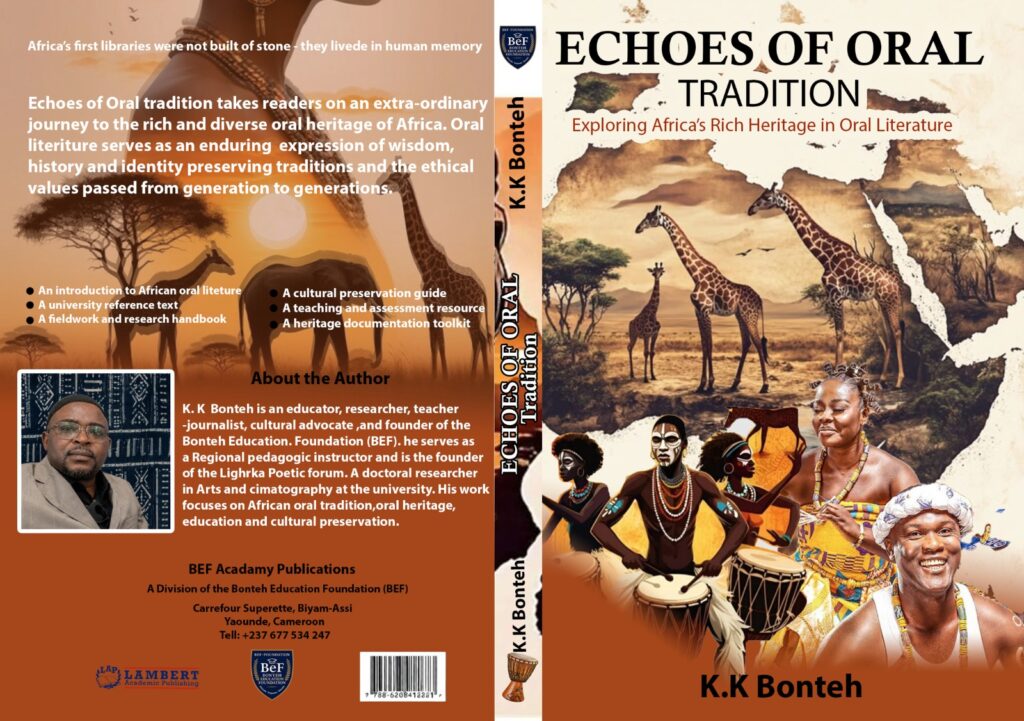
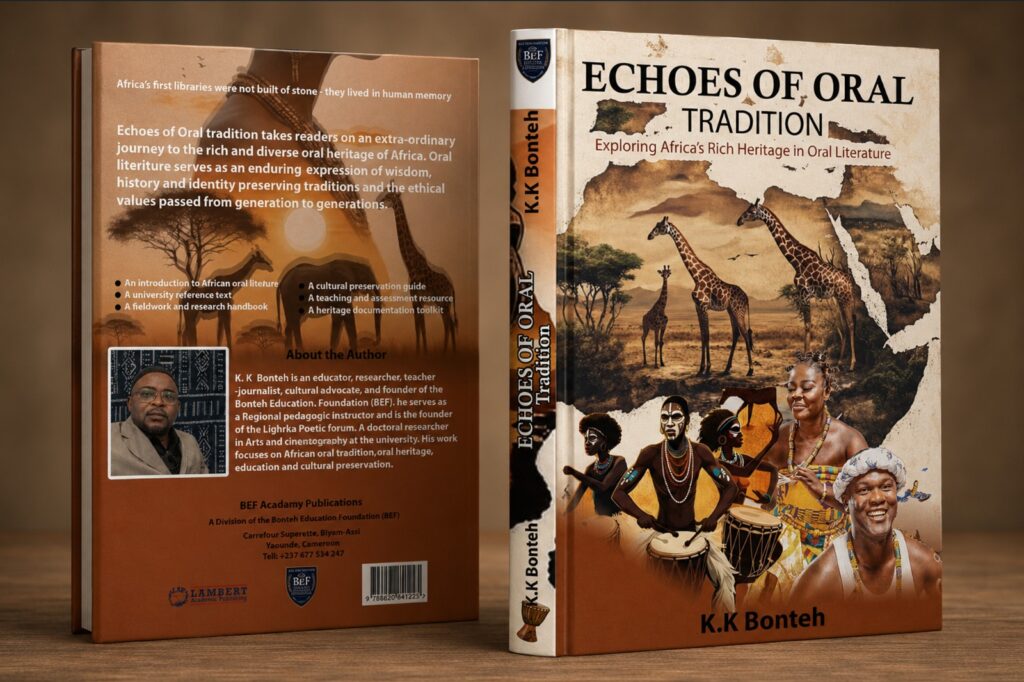
Echoes of Oral Tradition: Exploring Africa’s Rich Heritage in Oral Literature provides a comprehensive examination of African oral traditions, their forms, functions, performance contexts, cultural significance, and contemporary relevance.
The book is organized into four major parts. The first explores the foundations of African oral literature, examining its origins, forms, and performance characteristics. The second investigates its educational, political, social, and spiritual functions. The third presents regional case studies drawn from West, Central, East, and Southern Africa. The final part considers contemporary challenges, preservation efforts, and the future of oral traditions in an increasingly digital world.
Through interdisciplinary perspectives drawn from literature, anthropology, history, linguistics, performance studies, and cultural studies, the book seeks to illuminate the richness, diversity, and enduring significance of African oral traditions.
1.10 Listening to the Echoes
Africa’s history has never been preserved solely in monuments, manuscripts, or archives. It has also been preserved in voices—voices that sang, narrated, chanted, praised, questioned, remembered, and imagined.
Across centuries, storytellers have gathered beneath trees, around fires, within royal courts, inside sacred groves, and in village squares to transmit the wisdom of generations. Their voices continue to echo through time, carrying histories, values, dreams, and identities from one generation to the next.
These echoes remind us that culture survives not simply because it is written down, but because it is remembered, performed, shared, and renewed. They remind us that the spoken word remains one of humanity’s most powerful instruments for preserving meaning and fostering connection.
This book is an invitation to listen—to the griot’s song, the elder’s tale, the poet’s praise, the community’s chant, and the countless voices that have shaped Africa’s cultural heritage. In listening to these echoes, we discover not only Africa’s past but also enduring insights into humanity itself.
As the pages that follow will demonstrate, oral literature is not a relic of a vanished age. It is a living legacy, a dynamic cultural force, and a continuing testament to the creative power of the human voice.