Description
𝗪𝗛𝗘𝗡 𝗔 𝗟𝗔𝗞𝗘 𝗕𝗘𝗖𝗢𝗠𝗘𝗦 𝗔𝗡 𝗔𝗥𝗖𝗛𝗜𝗩𝗘
Breath, Memory and the Ethics of Return in K. K. Bonteh’s AND THE LAKE EXHALED
A Literary Review
There are historical catastrophes so spectacular that literature is tempted to compete with them. There are others whose terror lies precisely in the absence of spectacle. The Lake Nyos disaster of 21 August 1986 belongs overwhelmingly to the latter category. There was no advancing army, no conflagration swallowing a city, no earthquake visibly splitting the earth. A dense release of carbon dioxide moved silently through the valleys around Lake Nyos in Cameroon’s North-West Region. Approximately 1,746 people died, thousands of livestock perished, and entire communities awakened into a world divided permanently into before and after.
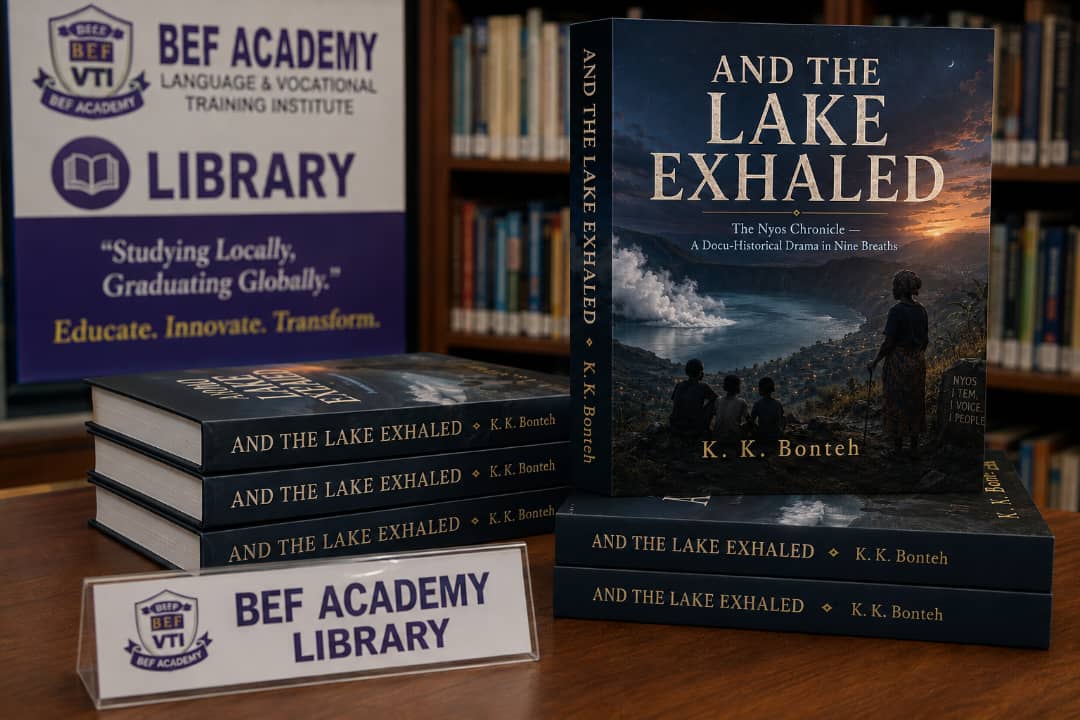
- K. Bonteh’s AND THE LAKE EXHALED: The Nyos Chronicle — A Docu-Historical Drama in Nine Breaths finds its imaginative power in refusing to make that catastrophe louder than it was. Instead, Bonteh gives silence a dramatic vocabulary.
The result is an ambitious work of documentary theatre, historical remembrance, cultural criticism and experimental African dramaturgy. It does not merely dramatise the night Lake Nyos released its lethal burden. It asks a much more disturbing question: what happens to a people after the world stops counting the dead?
Bonteh’s answer is that catastrophe has an afterlife.
The first disaster took away breath.
The second threatens to take away memory.
And between them stands language.
𝗧𝗛𝗘 𝗚𝗘𝗡𝗜𝗨𝗦 𝗢𝗙 𝗧𝗛𝗘 𝗧𝗜𝗧𝗟𝗘
AND THE LAKE EXHALED is an unusually successful title because its central verb governs almost everything that follows.
The lake exhales.
The victims can no longer breathe.
Scientists later construct a system through which the lake may safely release its accumulated carbon dioxide.
The displaced community, meanwhile, must learn to breathe its inherited words back into the mouths of another generation.
Thus breath becomes simultaneously scientific fact, theatrical rhythm, cultural metaphor and spiritual measure. The play itself explains its architecture through this correspondence: breath was lost in 1986, later measured and controlled through science, and finally transformed into speech, names, songs and inherited memory.
It is difficult not to hear, behind this design, echoes of the oldest traditions of tragedy. In Greek theatre, catastrophe is rarely merely private. The fall of one house disturbs the city; the wound of Oedipus becomes the wound of Thebes. So too in AND THE LAKE EXHALED, death radiates outward — from individual bodies to households, from households to villages, from villages to language, land, authority and historical consciousness.
But Bonteh relocates that tragic principle decisively into the Cameroon Grassfields.
His chorus is Kwifon.
His oracle is contested by geochemistry.
His palace is reduced to a corrugated shed.
His tragic messenger may be a radio journalist, a nurse with a ledger, an old woman demanding kola, or a scientist staring at a graph that says simply: the lake is filling again.
𝗔 𝗣𝗟𝗔𝗬 𝗧𝗛𝗔𝗧 𝗥𝗘𝗙𝗨𝗦𝗘𝗦 𝗔𝗖𝗧𝗦
One of the drama’s most striking formal decisions is its rejection of conventional acts and scenes. Instead, Bonteh structures the work as an Inhalation, Nine Breaths, and a Long Exhalation. Within these are “Panels” — Testimony, Palaver, Laboratory, Living Newspaper, Silent Register, Njangoli Interlude, Kwifon Chorus, Double Exposure, Camp Comedy, Screen, Roll-Call and the extraordinary device called The Lake Speaks.
This is not eccentric nomenclature for its own sake. The fragmented architecture mimics both traumatic memory and documentary editing. Testimony is interrupted by statistics. Ritual collides with official communiqués. 1986 and 2026 can occupy the same stage simultaneously.
In this regard the play recalls the montage strategies of Brecht and the documentary experiments of twentieth-century “living newspaper” theatre, while also reaching backwards towards the ritual and choral origins of drama itself. Yet Bonteh’s theatre is not simply Brecht transplanted to Cameroon. Its deeper grammar comes from palaver, oral testimony, proverb, communal response, musical memory and the performative authority of the spoken name.
The audience is never permitted simply to “watch history”.
It is repeatedly implicated in remembering it.
𝗧𝗛𝗘 𝗧𝗘𝗥𝗥𝗢𝗥 𝗢𝗙 𝗢𝗥𝗗𝗜𝗡𝗔𝗥𝗜𝗡𝗘𝗦𝗦
Perhaps the most affecting decision in the opening Breath is that Bonteh refuses to begin with disaster.
He begins with supper.
A disputed cow.
A cooking pot.
Children.
Kola.
A joke in the Fon’s court.
When one man insists that beans somehow entered the path of his cow, the Fon answers with comic judicial economy. The ordinary social world is allowed to breathe before history suffocates it.
This dramaturgical choice is crucial. Tragedy means little unless the audience first encounters what tragedy destroys.
The composite survivor Manu remembers not clouds or geology but corn fufu and vegetables, an enamel plate and his mother blowing on his little sister’s food. His testimony reaches one of the play’s finest formulations:
“There are disasters that announce themselves with fire. This one entered memory through supper.”
And then comes the devastating command:
“First know what was there to lose.”
The line places Bonteh in a long literary tradition in which the domestic object bears historical catastrophe more powerfully than abstract statistics. One thinks of the abandoned household objects of war literature, of the empty shoes and plates that remain after genocide, or of Achebe’s instinct for allowing enormous historical transformations to enter through yam barns, wrestling grounds, family compounds and ordinary speech.
History becomes unbearable when it still carries fingerprints.
𝗧𝗛𝗘 𝗡𝗜𝗚𝗛𝗧 𝗧𝗛𝗘 𝗖𝗢𝗪𝗦 𝗞𝗡𝗘𝗟𝗧
The actual catastrophe is rendered through the first Silent Register.
No choking spectacle is permitted. No actor performs extravagant death. A bowl slips from a hand. A goat lowers itself. Cattle fold at the knees. Human actions simply cease. Above the stage, the Counter advances inexorably until it reaches 1,746.
The restraint recalls classical tragedy’s ancient wisdom that certain horrors become smaller when directly exhibited. Sophocles did not need to show Jocasta’s death on stage for the audience to feel it. Shakespeare could place corpses before us, but some of his most terrible violence occurs first in language and imagination.
Bonteh goes further: he makes absence itself theatrical.
The horror is not screaming.
The horror is that nobody screams.
Yaya Mbùh’s account of cattle kneeling “like men at prayer” creates one of the drama’s most memorable historical images. His bitter observation that the gas smelled like “the question of a man who arrived after” also captures one of the work’s recurring suspicions: outsiders frequently arrive with questions after local people have already paid the price of the answer.
𝗖𝗢𝗨𝗡𝗧𝗜𝗡𝗚 𝗧𝗛𝗘 𝗗𝗘𝗔𝗗, 𝗞𝗘𝗘𝗣𝗜𝗡𝗚 𝗧𝗛𝗘 𝗡𝗔𝗠𝗘𝗦
Numbers dominate AND THE LAKE EXHALED, but Bonteh repeatedly mistrusts numbers.
There are 1,746 dead.
There are 845 injured.
There are tonnes of dissolved carbon dioxide.
There are metres of pipe.
There are years in camps.
There are finally forty words.
Yet behind every number the drama places a name.
At Wum District Hospital, Dr Bih Angela observes that “The number later recorded as injured was eight hundred and forty-five. That number is tidy. The corridor was not.”
That contrast — tidy number, untidy suffering — is central to the moral intelligence of the work.
Nurse Tanto therefore becomes one of the play’s most important figures. She keeps a ledger of the living. When asked about the dead, she replies that they have “too many clerks and no proper book”. Her work resembles that of the dramatist himself: where systems reduce catastrophe to categories, somebody must keep restoring the human name.
The motif reaches ceremonial force in the burial Breath, when Christianity, Islam, traditional authority and indigenous spiritual interpretation meet beside a grave too large for inherited ritual. No tradition is mocked. None is permitted an easy answer.
The Fon declares:
“Today, disagreement must learn to carry a shovel.”
It is a line worthy of the best African political theatre because it converts pluralism from an abstraction into labour.
𝗥𝗜𝗧𝗨𝗔𝗟 𝗔𝗙𝗧𝗘𝗥 𝗖𝗔𝗧𝗔𝗦𝗧𝗥𝗢𝗣𝗛𝗘
Here Bonteh’s dramaturgy invites comparison with Wole Soyinka, whose theatre repeatedly explores the dangerous threshold between communal ritual, metaphysical order and historical rupture.
Yet AND THE LAKE EXHALED refuses the temptation to make traditional metaphysics an easy explanation of a scientific disaster. Ngwa the Diviner and Dr Tanyi the geologist are allowed to confront one another without either being humiliated.
Ngwa insists that a place is more than water: it is path, prohibition, memory, boundary and story.
Tanyi replies with gas accumulation and measurable conditions.
Then comes the intellectual centre of their exchange:
“If you tell her only carbon dioxide, you may give her mechanism without meaning.”
Tanyi answers that the two become enemies only when either claims to answer the other’s question.
This is a sophisticated epistemological position. Science explains mechanism. Culture interprets relationship. Neither is entitled to impersonate the other.
Such balance is especially important in African historical drama, where indigenous cosmology has too often been treated either as primitive superstition awaiting Western correction or romantic wisdom automatically superior to empirical evidence. Bonteh avoids both traps.
𝗧𝗛𝗘 𝗦𝗔𝗧𝗜𝗥𝗘 𝗢𝗙 “𝗖𝗢𝗠𝗣𝗘𝗧𝗘𝗡𝗧 𝗦𝗘𝗥𝗩𝗜𝗖𝗘𝗦”
The play’s darkest subject is periodically punctured by humour, much of it directed at bureaucracy.
The Senior Divisional Officer speaks the immortal dialect of official delay: modalities, conditions precedent, resource mobilisation, competent services.
Brytos translates:
“Not today.”
“Not tomorrow.”
“Find money.”
This satire belongs recognisably to the African literary tradition of bureaucratic comedy running from colonial clerks through postcolonial administrations. One hears faint echoes of Soyinka’s comic officials, Achebe’s civil servants, and the bureaucratic absurdities of Mongo Beti.
But Bonteh establishes an important ethical rule: humour may move upward towards power, sideways towards human folly, but never downward towards the bereaved.
The play repeatedly permits two laughs and then poisons the third.
A goat eats a relief form; the audience laughs. Then a widower asks where on the form he should record his dead wife.
The paper must literally be turned over before bureaucracy can make room for grief.
This is satire functioning not as diversion from tragedy, but as another route into it.
𝗧𝗛𝗘 𝗦𝗘𝗖𝗢𝗡𝗗 𝗗𝗜𝗦𝗔𝗦𝗧𝗘𝗥
The most original dimension of AND THE LAKE EXHALED emerges after the interval.
The lake is still dangerous, but the drama gradually reveals another endangered system: cultural transmission.
In the resettlement camps, displacement saves lives while quietly altering language, authority, land use and identity. The most painful example is not the action of a villain but the decision of a loving mother.
She tells her son to speak English because English will help him pass examinations.
“Our language cannot mark your examination.”
Decades later, that child — Brytos — struggles to pronounce his own family name.
His question is devastating:
“Then why does it feel like somebody paid school fees with something we did not know was money?”
Here the play enters territory familiar to Ngũgĩ wa Thiong’o’s reflections on language, education and cultural inheritance. But again, Bonteh resists simplicity. English is not demonised. Pidgin is not demonised. Multilingualism is not presented as betrayal.
Mama Kilàn eventually makes the distinction brilliantly:
“Do not insult survival.”
The problem is not that displaced children learned other languages.
The problem begins when acquisition becomes erasure.
𝗠𝗔𝗠𝗔 𝗞𝗜𝗟À𝗡: 𝗔 𝗖𝗛𝗔𝗥𝗔𝗖𝗧𝗘𝗥 𝗪𝗛𝗢 𝗥𝗘𝗙𝗨𝗦𝗘𝗦 𝗧𝗢 𝗕𝗘𝗖𝗢𝗠𝗘 𝗔 𝗠𝗢𝗡𝗨𝗠𝗘𝗡𝗧
Mama Kilàn is the dramatic triumph of the final Breath.
She is ninety-two, sharp-tongued, funny, unsentimental and profoundly suspicious of people who wish to transform her into heritage before listening to her as a person.
Her testimony begins with a command:
“Do not call me last.”
People, she observes, love the word last: last old woman, last speaker, last survivor. It produces a photograph. Then everyone departs and leaves the photographed person “to continue being last alone”.
The speech demolishes the sentimental anthropology of the “last native informant”.
Mama Kilàn insists instead on the ordinary abundance of vanished community life: quarrels, bad singing, unpaid kola debts, irritating relatives, comic messengers.
“That is what death steals: not only good people. It steals irritating people. It steals jokes that depended on exactly one person’s bad habit.”
This may be the emotional thesis of the entire drama.
Memory worthy of the dead must restore their humanity, not embalm them into saints.
Her metaphor of language as property is equally memorable:
“No language should become a landlord inside your mouth and evict everybody else.”
The sentence could live far beyond this play.
𝗧𝗛𝗘 𝗣𝗜𝗣𝗘 𝗔𝗡𝗗 𝗧𝗛𝗘 𝗠𝗢𝗨𝗧𝗛
The drama’s boldest structural rhyme arrives through the Lake Nyos degassing project.
Scientists learn how to draw gas-rich deep water upward through pipes so that carbon dioxide can be released gradually rather than catastrophically. The first full-scale pipe begins operating in the drama’s 2001 sequence; the fountain becomes, remarkably, the play’s rare moment of sustained joy.
But scientific success does not end the drama.
The lake can be made safer while a displaced community remains socially fractured.
Hence the Fon’s cutting observation:
“The lake has three pipes. Our return still has none.”
Mama Kilàn later completes the metaphor. If accumulated gas required a controlled route outward, inherited words also require a route from old mouths into young ones:
“We have too many words trapped in old people. Make a road.”
Not one spectacular heritage festival.
Not one anniversary.
Not one documentary.
“One greeting. One plant name. One proverb. One song line. One court word. One child’s name. Slowly.”
This is where the drama’s scientific and cultural narratives finally become one artistic argument.
𝗧𝗛𝗘 𝗪𝗢𝗥𝗗–𝗕𝗢𝗔𝗥𝗗: 𝗛𝗢𝗣𝗘 𝗔𝗦 𝗔𝗥𝗜𝗧𝗛𝗠𝗘𝗧𝗜𝗖
Bonteh wisely refuses the grand reconciliation typical of weaker historical dramas.
Nobody declares the community restored.
Nobody announces that trauma has ended.
Nobody claims the lake is innocent.
Instead, the Word-Board begins with four entries.
For much of the drama it remains at four.
Then, in the final movement, young people begin learning.
Five.
Six.
Eleven.
Twenty-six.
Forty.
At the same moment, the Counter that once measured death and then tonnes of carbon dioxide changes its function. It begins counting words.
It is a superb piece of visual dramaturgy.
The arithmetic of catastrophe becomes the arithmetic of recovery.
Not resurrection.
Not restoration.
Recovery.
The play itself gives us the right formulation:
“Not restored. Reopened.”
𝗪𝗛𝗘𝗡 𝗧𝗛𝗘 𝗖𝗟𝗢𝗖𝗞 𝗦𝗧𝗔𝗥𝗧𝗦 𝗔𝗚𝗔𝗜𝗡
Throughout the production, one clock remains frozen at 9:30 p.m. on 21 August 1986 while another records the present.
At the end, the Child with the Chalk approaches the stopped clock.
Mama Kilàn nods.
The child restarts it.
Crucially, the dead do not resurrect. Bonteh avoids the sentimental fraud of pretending memory can reverse mortality. The figures of 1986 simply resume their ordinary gestures for three seconds — stirring food, handling rope, laughing at a court joke, counting cattle — and then walk into darkness.
The present remains.
Finally, the Child speaks one Mmen word.
It is deliberately untranslated.
This is a daring ending because for the first time the audience must accept not understanding.
At the beginning, linguistic exclusion is discomfort.
At the end, it has become possibility.
The audience does not need to possess the word in order for the word to live.
𝗔 𝗗𝗢𝗖𝗨𝗠𝗘𝗡𝗧𝗔𝗥𝗬 𝗧𝗛𝗘𝗔𝗧𝗥𝗘 𝗢𝗙 𝗘𝗧𝗛𝗜𝗖𝗔𝗟 𝗠𝗘𝗠𝗢𝗥𝗬
One of the strongest aspects of the published text is its explicit documentary discipline. Historical fact, reconstructed documentary material, composite testimony and dramatic invention are differentiated rather than blurred.
That matters enormously.
Real catastrophe carries a dangerous prestige in art. Writers can exploit suffering merely by standing near it. Bonteh repeatedly resists that temptation.
The dead are not props.
Survivors are not repositories of quotable trauma.
Indigenous knowledge is not scenery.
Scientists are not white saviours descending with instruments.
Officials are satirised, but institutions remain necessary.
And the play refuses to invent linguistic authenticity where verified Mmen forms are still required for production.
Such restraint paradoxically strengthens the imaginative work. It establishes that invention has borders.
𝗙𝗜𝗡𝗔𝗟 𝗔𝗦𝗦𝗘𝗦𝗦𝗠𝗘𝗡𝗧
AND THE LAKE EXHALED is more than a play about one of Africa’s strangest natural disasters.
It is a meditation on what history leaves unfinished.
It is about the difference between surviving and returning.
Between translation and inheritance.
Between scientific safety and social repair.
Between recording a language and speaking it.
Between counting the dead and keeping faith with their names.
Its historical canvas may begin at Lake Nyos, but its questions travel widely. What becomes of communities displaced by catastrophe, war, development, climate, resettlement or migration? What happens when children gain the languages of opportunity but lose intimate access to the words that once organised home? When does memorialisation become another form of forgetting? Can science repair danger without repairing belonging? And who has the right to tell a community’s catastrophe?
These questions place Bonteh’s drama within the larger African literary conversation about history and cultural rupture associated with writers from Achebe and Soyinka to Ngũgĩ, while its choral architecture reaches farther backwards towards the communal witness of Greek tragedy and its documentary montage forwards towards Brechtian and verbatim theatre.
Yet the play’s final gesture is unmistakably its own.
A child stands before a blackboard.
Behind that child lies a number: 1,746.
Before that child lies another number: 40.
One counts an ending.
The other counts beginnings.
And therein lies the achievement of AND THE LAKE EXHALED. It does not ask literature to raise the dead. It asks something more difficult of theatre, history and the living:
to keep breathing after them.
— Literary Review
Reviews
There are no reviews yet.