
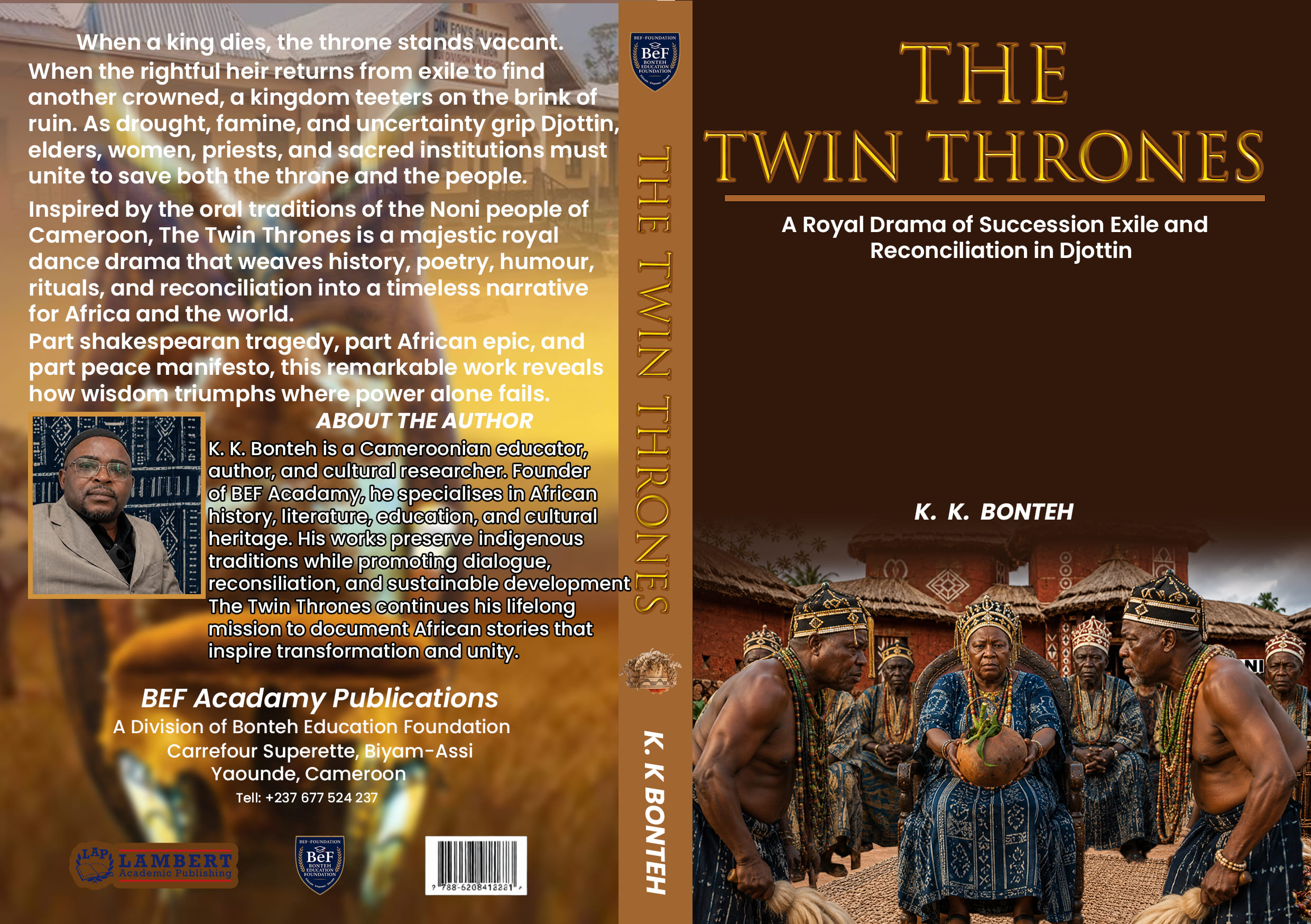
Description
Succession stories rarely stay simple once power actually changes hands, and this Noni royal drama leans fully into that complexity rather than smoothing it over. The Twin Thrones, written by K.K. Bonteh, follows a struggle for leadership built on exile, reconciliation, and the slow, hard-won triumph of wisdom over raw power.
What grounds this Noni royal drama in something more than fantasy is its direct inheritance from real oral tradition. Bonteh draws the story from the storytelling heritage of the Noni people, whose Noni language and cultural memory have carried history across generations in Cameroon’s Northwest long before any of it reached the page. That inheritance gives the throne at the center of the story real cultural weight rather than the generic trappings of an invented kingdom.
The premise itself does a lot of work. Two thrones, two claims, and a kingdom forced to decide what legitimate leadership actually looks like once the obvious answer, raw strength, stops being good enough. Bonteh uses that structure to ask hard questions about exile and return, about what it costs a leader to leave and what it costs a community to welcome that leader back.
This Noni royal drama earns its emotional payoff by refusing to rush reconciliation. The characters pulled into the succession fight carry real grievances, and Bonteh lets those grievances breathe instead of resolving them with a tidy speech. Wisdom, when it finally wins out over naked ambition, feels earned precisely because the book spent real time showing how tempting the alternative was.
Leadership and unity run through every chapter as themes, but Bonteh keeps them grounded in specific characters rather than abstract lessons. Readers watch individual choices accumulate into a verdict on what kind of ruler a community actually needs, which makes the story’s politics feel personal rather than theoretical. That specificity is part of what makes this Noni royal drama resonate with readers who have grown tired of succession stories that reduce every conflict to a simple fight over a crown.
The book also rewards readers interested in African oral storytelling traditions more broadly, since Bonteh treats the Noni cultural inheritance behind the story as something to be honored rather than merely borrowed. Students of African leadership narratives, fans of royal drama, and anyone drawn to stories about exile and the long road back will find plenty here worth sitting with. The twin thrones at the center of the title are never just a plot device. They stand in for every community that has had to choose, sometimes painfully, between competing visions of what leadership should look like, and Bonteh never lets the reader forget how high those stakes actually are.
The supporting cast gets real attention too, not just the two rivals at the center of the title. Advisors, elders, and the ordinary people of the kingdom all get moments that shape how the succession plays out, which keeps the story from collapsing into a simple two-person duel. Readers who enjoy African royal drama more broadly, or who have followed other succession stories across the continent’s literature, will recognize the care Bonteh takes in making every supporting character feel like they have something real at stake in who finally sits on the throne, rather than treating them as background to the main rivalry.
The Twin Thrones joins the rest of K.K. Bonteh’s catalogue exploring Cameroonian identity, available through the full book collection at BEF Academy Publications. This Noni royal drama, a celebration of African culture, leadership, and unity, is available now for only 5,000 FCFA. Few stories manage to make a succession crisis feel this personal, and that intimacy is exactly why The Twin Thrones lingers after the final page.
Reviews
There are no reviews yet.