
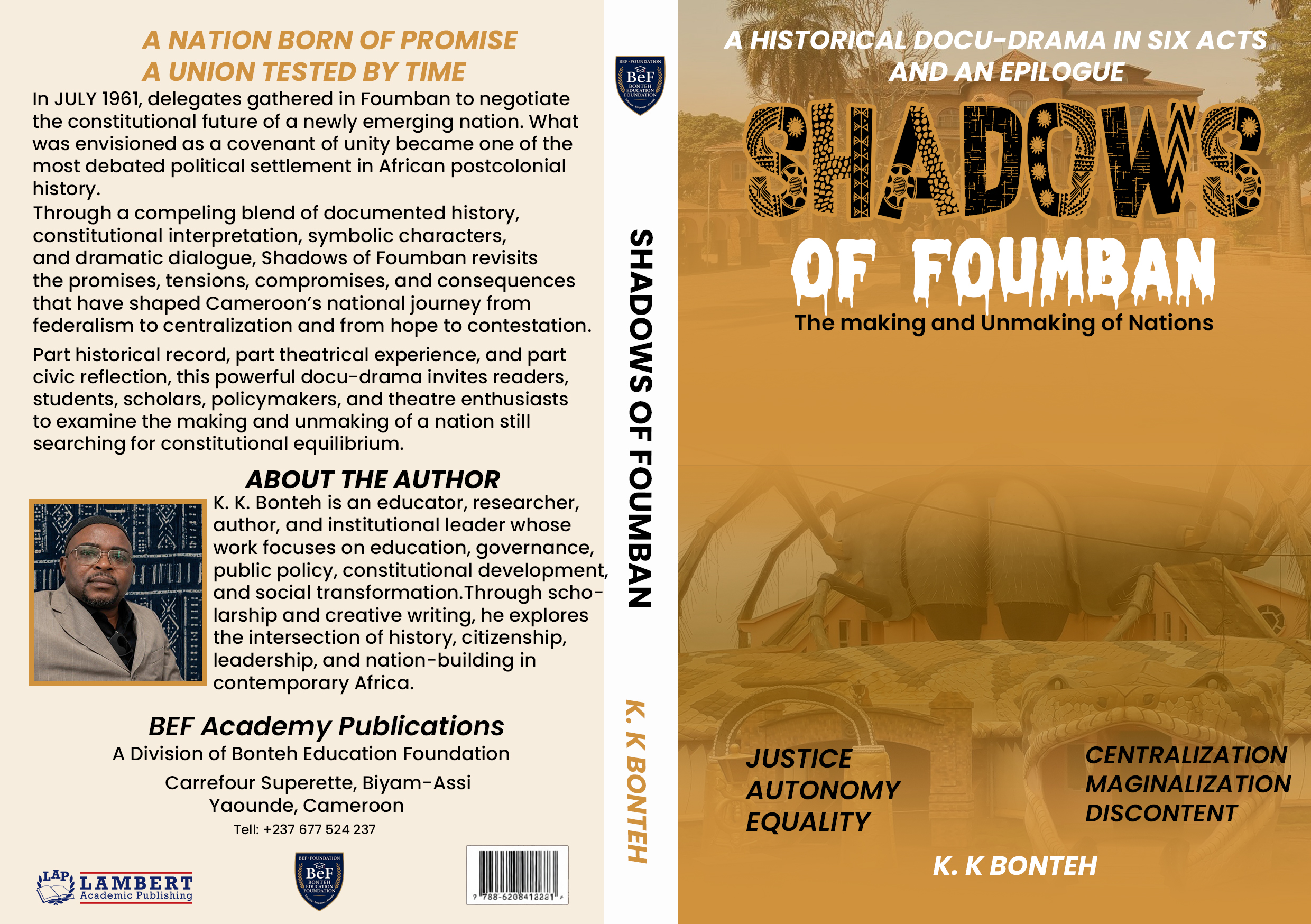
Description
Bodies of Law: The Dramatic Significance of Personifying Memory, Justice, and the Constitution in K. K. Bonteh’s Shadows of Foumban
By The Mirror Theatre Co.
Introduction
Shadows of Foumban takes an unusual dramaturgical risk: it asks an audience to watch abstract legal and civic concepts — Memory, Justice, the Constitution, Unity, the Flag, the State, and eventually Authority — walk, speak, weep, and stand trial as though they were characters with private histories rather than ideas borrowed from a textbook. This is not decoration. Personification in this play is the primary mechanism by which constitutional history is made legible as drama rather than merely summarized as fact. This analysis examines three of the play’s most significant personifications — Memory, Justice, and the Constitution — and argues that each is built with a distinct visual and dramatic logic that allows the play to do something documentary history alone cannot: make the costs of constitutional change visible on a human body, in real time, before an audience.
Justice: Blindfolded, Then Unmasked
Justice enters the play in the Prologue in the most conventional of her iconographic forms — “blindfolded and carrying scales,” a costuming choice that borrows directly from the familiar Western allegorical tradition of impartial law. For most of the play’s six acts, this is exactly how Justice functions: an observer who comments on proceedings — “protection, a necessary duty,” she notes drily during the militarization scenes of Act V — without herself intervening.
The dramatic significance of this personification lies in what the play does with it at the very end. In the final scene of Act VI, Justice re-enters the Court of History “without robes,” stripped of the symbols of power, appearing instead as “only a human presence.” This costuming reversal is the single most important staging choice in the play’s climax. A blindfolded, robed Justice can deliver a verdict; an unmasked, human Justice can only ask questions and refuse one. By physically undressing her own allegory before delivering the play’s famous verdictless ruling, the play makes visible, literally on Justice’s own body, the argument it has been building for six acts: that formal, symbolic authority is insufficient to adjudicate a wound this large, and that only a stripped-down, human Justice — one that has set aside the very emblems of impartial power — is honest enough to say so.
Memory: The Witness Who Precedes the State
Where Justice’s costume changes to mark a single dramatic turn, Memory’s personification works through constancy. She is introduced “clothed in grey” in the Prologue, present before Germany, Britain, or France ever speak, and she remains onstage or nearby through nearly every subsequent scene of constitutional transition — commenting on the “first fractures” of federalism in Act II, watching the fading of federal guarantees in Act III, and standing “for the first time openly among the people” as the 2016 protests begin in Act V.
This unbroken presence is itself the dramatic argument. By never allowing Memory to exit the stage for long, the play insists that constitutional history is not a sequence of discrete, forgettable episodes but a single continuous witness accumulating evidence scene by scene. Memory’s recurring props — “scrolls, testimonies, letters, speeches, constitutional drafts, photographs, and fragments of forgotten promises” — visually externalize what would otherwise be an invisible, interior process: a nation’s slow accumulation of unresolved grievance. When Memory finally calls witnesses in the Act VI trial, the audience has already spent five acts watching her collect the very evidence she now presents, which is what makes her cross-examination by Authority feel less like a courtroom procedure than the culmination of something the audience has been quietly assembling alongside her the entire evening.
The Constitution: A Body That Bears Its Own History
The most sustained and visceral personification in the play belongs to the Constitution herself, whose costume becomes a literal, evolving record of the very amendments the plot dramatizes. She is introduced in Act I “draped in parchment-coloured robes,” her body “covered with clauses, signatures, and amendments that fade and reappear like living scars.” By Act III, her “once-balanced robes are now uneven,” with clauses “stitched into its garment” beginning to fade. By Act IV, her robes are “heavily marked by revisions.” By Act VI, standing in the witness dock of the Court of History, her robes are described as “patched together” from original clauses, amendments, decrees, revisions, and interpretations, no longer “majestic” or “youthful.”
This is personification used as a form of embodied historiography: rather than narrating constitutional amendment as an abstract legislative process, the play makes each revision physically visible as damage, patchwork, or erasure on a body the audience has watched age across the length of the performance. The effect is cumulative and almost unbearable by design — when the Constitution says, late in the play, that she can search for provisions meant to protect balance and “find them altered, reduced, reinterpreted, or gone,” the audience does not merely hear this claim, it has watched her robes thin out scene by scene as evidence of it. Few devices could make the slow, undramatic erosion the Chorus describes — “a covenant does not vanish in a moment” — as viscerally legible as a costume literally coming apart in front of the audience over six acts.
Why Personify at All? Civic and Dramaturgical Function
Three effects of this technique are worth naming directly.
First, it converts legal abstraction into felt experience. Concepts like federal guarantees, centralization, and constitutional amendment are notoriously difficult to dramatize because they are procedural rather than embodied. By giving these processes a body that can be wounded, dressed, undressed, and cross-examined, the play makes constitutional erosion something an audience can watch happen to someone, rather than something it must be told occurred.
Second, it allows the play to stage accountability without naming individuals. The play’s own front matter is explicit that the Constitution, Justice, Memory, Unity, and the Flag are symbolic rather than historical figures. This choice lets the play put power itself on trial, through the newly introduced character of Authority in Act VI, without requiring it to dramatize, name, or libel any specific historical president or official. Personification here functions as a legal and diplomatic safeguard as much as an artistic one, allowing sharp institutional critique to be leveled at the office rather than at any individual who has held it.
Third, it lets the play hold contradictory truths simultaneously. A human character in this kind of political drama would eventually need to be judged sympathetic or unsympathetic; an allegorical one does not. Justice, Memory, and the Constitution are never asked to “win” the argument, only to embody one side of a tension — remembrance, judgment, covenant — that the play insists cannot be resolved by identifying a hero and a villain. This is precisely why the trial in Act VI can end without a verdict: personified abstractions can stand permanently, unresolved, opposite one another in a way that human protagonists in a conventional plot typically cannot.
Conclusion
The personification of Memory, Justice, and the Constitution in Shadows of Foumban is not ornamental allegory borrowed loosely from morality-play tradition; it is the play’s central dramaturgical strategy for making sixty years of constitutional history physically watchable. Memory’s unbroken presence turns accumulated grievance into continuous witness; the Constitution’s disintegrating robes turn legislative amendment into visible wound; and Justice’s final unmasking turns the play’s refusal of a verdict into an embodied, rather than merely argued, conclusion. In each case, the abstraction is not simplified by being made human — it is made harder to look away from.
BefAcademy –
The Quiet Referendum: How Shadows of Foumban Dramatizes the 1972 Transition to a Unitary State
Introduction
Of all the constitutional ruptures Shadows of Foumban stages, the 1972 transition from federation to unitary state is treated with a curious and telling indirection. The event is unambiguously present in the play’s historical apparatus: the back matter’s timeline lists the 20 May 1972 national referendum by date, names it as the vote that replaced the federal system with a unitary state, and the “Notes on Dramatic License” section confirms plainly that “the referendum that established the United Republic of Cameroon is historically documented.” Yet within the dramatized action of Act III itself, the word “referendum” never appears, no date is spoken, and no character stages or announces a vote. The transition is instead rendered entirely through allegory and gradual accumulation, scattered across three consecutive scenes, “The First Amendments,” “Centralization of Power,” and “Dissolution of Federal Guarantees,” before arriving at its most visible symbol in “The Flag and the Stars.” This paper examines how and why the play chooses symbolic accretion over documentary re-enactment to dramatize 1972, and what that choice reveals about its argument concerning how federations actually end.
Historical Grounding, Dramatic Displacement
The play’s own back matter is explicit that the 1972 referendum belongs to its category of verified historical fact, listed as item seven among ten “historically grounded” elements, immediately following the acknowledged fact of the federal structure’s existence between 1961 and 1972. This placement matters: the play is not vague or uncertain about what happened in 1972, and it does not treat the transition as historically contested in the way it treats, say, the interpretation of the Anglophone Crisis’s causes. What the play displaces is not the fact of the referendum but its dramatization as a single event. Rather than staging a vote, a ballot, or an announcement, Act III renders the same constitutional outcome as a process without a clear beginning or end, told through the accumulating exhaustion of a personified Constitution whose “once-balanced robes are now uneven” and whose clauses have, scene by scene, faded, been reduced, reinterpreted, or vanished outright.
The Logic of Gradual Erosion
The clearest statement of the play’s interpretive choice comes directly from its own Chorus in “Dissolution of Federal Guarantees,” which insists that a covenant does not vanish in a moment, that a guarantee rarely disappears overnight, and that what history removes dramatically, politics often removes gradually. This is the play’s thesis about 1972 stated as dramaturgical method: rather than staging the referendum as the cause of the federation’s end, it stages the referendum’s outcome as the visible tip of a much longer accumulation of individual amendments, reinterpretations, and administrative adjustments, each too small to mourn on its own. The Constitution’s own testimony captures this precisely, noting that no bells tolled and no mourning processions marched, yet something precious weakened regardless, and that transformation on this scale is achieved not by enemies alone but sometimes by friends. The 1972 vote, in this rendering, is less an origin point than a ratification of a shift that the play has already been dramatizing incrementally since Act III’s opening scene.
The Scale, the Bridge, and the Fading Manuscript
The play’s central visual devices for the transition are notably mechanical and gradual rather than singular. A massive scale hangs above the Hall of Constitutional Revision, “once balanced,” now “tilting steadily toward the centre,” and by the scene’s end tips decisively as the side labelled AUTONOMY rises and the side labelled CENTRE descends. The bridge marked FEDERATION, present as a set piece since Act II, is described as “visibly fractured” by Act III and has disappeared into darkness entirely by the act’s close. The manuscript of Cameroon suspended overhead undergoes the same treatment: the word AUTONOMY grows faint, GUARANTEES disappears, and CONSOLIDATION takes their place, followed in the very next scene by FEDERATION vanishing altogether and UNITY appearing in its place, with MEMORY glowing faintly and almost invisibly beneath it. None of these devices requires a single dramatized vote to register the transition; each accumulates meaning precisely because it changes slowly, in view of the audience, across multiple scenes rather than in one decisive theatrical moment.
The Flag as the Transition’s Emotional Climax
If the referendum itself goes unstaged, its most emotionally direct dramatization arrives one scene later, in “The Flag and the Stars,” where the two golden stars representing the federal covenant between East and West Cameroon are reduced to one before the audience’s eyes. The scene stages the justification for this change in terms unmistakably drawn from the actual rhetoric surrounding the 1972 transition: the President’s declaration that “the federal experiment has fulfilled its purpose” and that “a stronger national identity now emerges” mirrors the historical framing of the 1972 referendum as national maturation rather than as the removal of constitutional guarantees. The Prime Minister’s counter-question, “who defines that horizon? / The nation itself. / Or those who govern it?”, becomes the play’s substitute for a debate over the referendum’s legitimacy that the drama declines to stage directly, transposing a question of electoral process into a question of symbolic authorship instead.
Why Indirection Rather Than Re-Enactment
This consistent choice to dramatize 1972 through slow institutional and symbolic erosion rather than through a depicted vote is best understood as continuous with the play’s broader method, established in its own front matter, of treating the presidency and other high offices as symbolic rather than individually named historical figures, with dialogue attributed to them explicitly flagged as “imaginatively reconstructed.” Staging an actual referendum scene would require the play to dramatize a specific historical vote, its administration, and its result in a manner closer to documentary re-enactment than to allegory, raising exactly the kind of individually attributable historical claim the play’s legal notice is careful to avoid. By instead rendering 1972 as the culmination of amendments, centralizing scenes, and fading constitutional clauses that have been building since the act’s first scene, the play preserves its documented chronology, the timeline in its back matter is unambiguous about the date and outcome, while keeping its dramatized action at the level of institutional and emotional consequence rather than reconstructed political mechanics.
Conclusion
Shadows of Foumban treats the 1972 transition to a unitary state as historically settled fact and dramatically diffuse process simultaneously. Its back matter names the referendum plainly and places it among the play’s verified historical anchors; its dramatized action never stages the vote itself, choosing instead to render the same outcome through a tilting scale, a fracturing bridge, a fading manuscript, and finally an extinguished star on the national flag. This is a considered dramaturgical argument in its own right: that federations are not usually undone by a single referendum so much as by the accumulated erosions that a referendum merely formalizes, and that the emotional truth of 1972 is better captured by watching a constitution’s clauses fade one by one than by re-staging a ballot whose outcome the historical record has never seriously disputed.
BefAcademy –
The Court That Would Not Convict: Memory versus Authority in K. K. Bonteh’s Shadows of Foumban
Introduction
Among the many personified institutions that populate Shadows of Foumban — the Constitution, the State, Justice, Unity, the Flag — none carries the play’s central argument as directly as the pairing of Memory and Authority. The two are not introduced as equals. Memory is present from the play’s very first stage direction, standing silently behind the unfinished manuscript of Cameroon in the Prologue, before a single line of dialogue has been spoken. Authority, by contrast, does not appear as a personified character at all until Act VI, where the stage direction introduces her explicitly as “a new symbolic character,” embodying “power exercised in the name of order, unity, sovereignty, and national survival.” This asymmetry of introduction is not incidental; it is the play’s first and most important statement about the relationship between the two forces. Memory precedes the nation’s founding and outlives every government; Authority is something the nation generates and must eventually be made to answer for. This paper traces how that relationship develops across the play and argues that the unresolved trial between them in Act VI is less a failure of dramatic nerve than the logical destination of a tension the play has been building since its opening image.
Memory as Witness from the Beginning
Memory’s placement in the Prologue, alongside Justice and Unity behind the blank manuscript labelled “Cameroon,” establishes her as older than the state itself, present even before the Tribunal of History hears Germany, Britain, and France defend their competing colonial legacies. Her first substantive intervention in the play is a rebuke: when Germany insists its empire deserves credit for founding order, Memory replies only that ink may stain as well as illuminate. This early exchange sets the pattern for every subsequent appearance: Memory does not argue policy, she supplies the record against which policy will later be judged. She reappears at nearly every major constitutional transition in the play, remarking on the “first fractures” of federalism in Act II, watching the erosion of federal guarantees in Act III, and standing, for the first time openly among the people rather than beside institutions, at the beginning of the 2016 mobilization in Act V. Her recurring role is less that of a character with her own desires than of a conscience the play refuses to let the audience forget is watching.
Authority’s Delayed Arrival
Authority’s absence as a personified figure for five acts is a deliberate structural choice, not an oversight. Power exists throughout the earlier acts, but it speaks through diffuse, situational voices, the President, the State, various ministers and legal advisers, none of whom are asked to justify power as such, only to justify particular decisions. The word “Authority” itself appears earlier than the character does: in Act II, it flickers onto the overhead manuscript of Cameroon alongside “Autonomy,” “Coordination,” and “Precedent,” noticed, the stage direction specifies, only by the audience and not by the delegates onstage. This is the play planting the concept years before it personifies it, allowing Authority’s eventual arrival in Act VI to feel less like an invention than an overdue reckoning, the moment the nation is finally forced to confront, as a single accountable presence, what had previously been allowed to operate under many smaller, more forgivable names.
The Trial as Dramatic Culmination
When Authority finally appears, seated on a throne facing Memory’s own, the play stages their confrontation as a formal trial rather than a debate, complete with witnesses, objections, and cross-examination. Memory calls Foumban itself as a witness, represented by a young, hopeful version of Cameroon who testifies only to what was promised: partnership, balance, coexistence. Authority’s cross-examination is sharp and, crucially, not dishonest: it does not deny that promises were made, only insists that belief is not governance and that aspirations are not institutions. This is the play’s most important choice regarding Authority as a character — it refuses to make her a simple villain. Her defense, that a nation inheriting division and instability required cohesion, and that judging history comfortably means forgetting the pressures of actual governance, is permitted to land with real force. When Memory presses her on whether centralization’s cost was what history demanded or what power simply preferred, Authority’s answer, “both,” is staged as a moment of genuine honesty rather than evasion, and Memory receives it as such.
Neither Fully Right
The trial’s deepest structural move is to let both figures be partly correct without collapsing the distinction between them. Memory insists that promises create legitimacy; Authority answers that survival creates continuity. Neither claim is allowed to defeat the other. The Chorus’s own commentary makes this explicit, observing that the arguments clash and that neither position is “entirely wrong” nor “entirely complete.” This refusal of a clean hierarchy between the two forces is what ultimately produces the play’s famous verdictless ending: Justice’s ruling that no single party is absolved and no single party is condemned is not a dodge but the direct consequence of having built Memory and Authority, across six acts, as two forces each indispensable to a functioning nation and each capable, unchecked, of doing it serious harm. A nation governed by Memory alone risks paralysis, endlessly relitigating its founding promises without ever acting; a nation governed by Authority alone risks the same slow erosion of trust the play dramatizes across Acts III and IV, in which safeguards are not abolished but merely allowed to fade into what the Constitution calls “historical references.”
Conclusion
Memory and Authority function in Shadows of Foumban not as hero and antagonist but as two constitutive forces a nation cannot survive without and cannot allow to overrule one another. The play’s decision to let Memory watch from the very first scene while withholding Authority’s personification until the final trial dramatizes an underlying claim about the nature of political power: that memory is a nation’s constant condition, while authority is something a people must periodically call before the court of its own history and ask to account for itself. That the play ends with both figures still standing, unreconciled but no longer strangers, having at least been made to face one another directly, is offered not as resolution but as the only honest place such a confrontation can end while the history it dramatizes remains, as the epilogue insists, still being written.
BefAcademy –
One Star, Two Memories: Unity and Regional Identity in K. K. Bonteh’s Shadows of Foumban
Introduction
If Shadows of Foumban has a single sustained argument beneath its six acts, it is that “unity” and “uniformity” are not synonyms, and that a nation’s failure to keep them distinct is where its deepest wounds originate. The play stages this tension not as background theme but as literal dramatic conflict, embodied in a personified character named Unity who is repeatedly interrogated, defended, and accused by the other symbolic figures around her. Regional identity, meanwhile, is carried by an unusually wide set of vehicles: two rival legal traditions, two educational systems, a House of Chiefs speaking for ancestral custom, and — most vividly — the literal stars on the national flag. Tracing how these devices interact across the play shows a drama less interested in declaring unity good or regional identity endangered than in dramatizing the precise mechanism by which one can be pursued in a way that extinguishes the other.
Two Traditions at the Founding Table
The tension begins at Foumban itself. Act I stages the conference not as two equal parties drafting together but as one delegation bringing a largely finished draft constitution to a partner expecting joint authorship — dramatized in the play as “the silent imbalance,” the title of the act’s third scene.
This founding asymmetry matters because it establishes, from the very first act, that the union between East and West Cameroon was constitutionally imagined as a partnership of two distinct legal, educational, and administrative inheritances, but was negotiated under conditions where one inheritance already held more leverage than the other. Everything that follows in the play, the erosion of federal safeguards, the two-stars-into-one-star flag, the divergence of courts and schools, is presented as the slow unfolding of a asymmetry present at the covenant’s origin rather than a betrayal invented later.
The House of Chiefs and the Warning Against Uniformity
The play’s clearest formulation of its central thesis arrives early, in Act II’s Scene III, where the House of Chiefs confronts the Prime Minister and President over the place of traditional authority within the new republic. The Chiefs do not oppose the federation; they explicitly welcome it. Their objection is narrower and sharper: that “development” and “administration,” the vocabulary of the modern state, risk uprooting the “memory” and “culture” that regional and ancestral identity depend on. Their instruction to the assembled institutions, that unity must not become uniformity, that development must not erase culture, functions as the play’s thesis statement, delivered early enough to frame everything that follows as a test of whether the republic can heed it. Tellingly, the personified character Unity herself seems wounded by the accusation implicit in this warning, asking “Am I accused again?”, to which the Chiefs answer that they are defending her, not attacking her, because genuine unity protects difference rather than erasing it. This exchange is the play’s most direct statement that unity and regional identity are not, in its own moral universe, opposed forces, only forces that can be made to appear opposed by how power chooses to pursue the former.
The Flag: Symbol as Battleground
If the House of Chiefs scene states the play’s thesis, the Flag and the Stars scene in Act III enacts it. The national flag begins the play bearing two golden stars, representing the federal covenant between East and West Cameroon; by the scene’s end, one star is deliberately extinguished before the audience’s eyes, leaving a single star that the President frames as a stronger, clearer national identity and the Prime Minister frames as the loss of the federation’s emblem. The scene refuses to let either reading cancel the other out — Memory’s closing judgment is that “two truths” now stand opposite one another, “as they have stood since Foumban” — but its staging is unambiguous about the mechanism: the change is presented as a transformation imposed from the centre, and the Flag itself, personified, asks pointedly whether it is being renewed or rewritten, a distinction the play treats as the whole question. This scene is the drama’s most economical image for how national unity, pursued through the elimination of a regional symbol rather than through its accommodation, becomes indistinguishable from assimilation.
Institutional Divergence: Law and Language as Regional Identity
Act IV relocates the same tension from symbolism to lived institutional experience. The stage splits between a Common Law courtroom and a Civil Law tribunal, with a school between them whose blackboard bears the unresolved inscription “Common Law — Civil Law” and “Anglophone Education — Francophone Education,” its chalk literally broken. Here regional identity is not an abstraction but a set of professional and educational inheritances, precedent-based reasoning against codified statute, that the play shows struggling to coexist as centralization increases. The State’s demand for “national consistency” is met by a Common Law judge’s pointed question, “what improves legitimacy?”, which reframes the entire scene’s conflict in the same terms the House of Chiefs established earlier: efficiency and coherence, pursued without regard for the traditions they override, do not automatically produce legitimate unity, only administrative uniformity that regional communities may or may not consent to regard as unity at all.
From Institutional Grievance to Public Voice
Act V dramatizes what happens when this institutional tension, contained for decades within courtrooms and classrooms, becomes public and collective. The 2016 mobilization the play stages is populated by lawyers, teachers, students, and ordinary citizens whose demand is named, repeatedly and without embellishment, as “recognition.” Significantly, the play frames this demand as continuous with, not a departure from, the House of Chiefs’ warning thirty years and two acts earlier: Memory observes that the same vocabulary, recognition, trust, participation, has recurred “since Foumban,” suggesting that regional identity’s claim on the nation was never resolved, only deferred, and that its reappearance in the form of public protest is the return of an unanswered constitutional question rather than a new grievance invented in 2016.
Unresolved by Design
The play declines to resolve this tension in its own final act. Act VI’s trial pits Memory, who speaks for the promises of partnership made at Foumban and eroded since, against Authority, who speaks for the practical necessity of a “coherent” state, and Justice’s verdict explicitly refuses to rule that unity was pursued in bad faith or that regional identity’s grievances were exaggerated. Instead, the Court finds that “trust was weakened,” that “opportunities were missed,” and that responsibility for the resulting distance between unity and regional identity is shared rather than one-sided. This is consistent with everything the play has staged: the tension between unity and regional identity is not, in Bonteh’s dramatization, a conflict between a legitimate national project and an illegitimate regional resistance to it, but a structural feature of a union built asymmetrically at its founding and repeatedly tempted, at each subsequent constitutional moment, to resolve that asymmetry through erasure rather than accommodation.
Conclusion
Across six acts, Shadows of Foumban returns obsessively to a single distinction: unity that protects difference versus unity that requires its removal. The House of Chiefs names this distinction directly; the flag’s extinguished star dramatizes it visually; the divided courtroom and broken chalk stage it institutionally; and the 2016 street mobilization proves it was never actually settled. The play’s refusal to deliver a final verdict on which side of that distinction the Cameroonian state has ultimately landed on is not evasiveness but fidelity to its own argument — that the question of whether unity has become uniformity is not one a courtroom, or a play, can answer on a nation’s behalf. It is a question, the drama insists, that each subsequent generation must keep asking for itself.
BefAcademy –
Crowns Without Kings: Shakespearean Dramatic Traditions in K. K. Bonteh’s Shadows of Foumban
Introduction
Shadows of Foumban announces its own genealogy unusually openly for a play. Its back matter states directly that the work draws on Shakespearean tragedy for its treatment of ambition, power, legitimacy, memory, and historical consequence, alongside classical Greek theatre for its choric commentary and African oral tradition for its communal and ancestral voice. Its bibliography names four specific Shakespeare tragedies — Hamlet, King Lear, Julius Caesar, and Macbeth — as reference points, and its stage directions repeatedly instruct the Chorus to speak “in solemn Shakespearean cadence,” “in grand Shakespearean cadence,” or “in tragic Shakespearean cadence,” using the phrase as a recurring performance instruction rather than a one-time acknowledgment. This is not a play borrowing Shakespearean texture incidentally; it is a play that has built Shakespearean tragedy into its own stated theory of itself. The question worth asking is not whether the influence exists, but how it operates, and to what dramatic effect.
The Chorus as Structural Inheritance
The most sustained and explicit Shakespearean device in the play is the Chorus, whose function recalls less the tragedies than Shakespeare’s history plays — particularly Henry V, where a Chorus enters between acts to compress time, frame the audience’s moral perspective, and narrate what the stage cannot show directly. Bonteh’s Chorus performs an almost identical function across all six acts: it summarizes constitutional developments too gradual or administrative to dramatize scene by scene, narrates the passage of years between one act and the next, and repeatedly steps outside the immediate action to offer interpretive commentary directly to the audience. Passages describing the earliest fractures in the federal compromise, delivered in what the stage direction calls “solemn Shakespearean cadence,” use the same technique Shakespeare’s Chorus uses in Henry V: elevated, quasi-choric verse that asks the audience to feel the weight of historical inevitability even before the characters onstage have recognized it themselves. The device lets the play move at the pace of decades within two hours of stage time, exactly as Shakespeare’s history-play Chorus does with the Hundred Years’ War.
Personified Institutions and the Language of Kingship
Where the play departs from strict Shakespearean form is in its cast of allegorical institutional characters — the Constitution, the State, Justice, Memory, Unity, the Flag — none of whom have a direct equivalent in Shakespeare’s own dramatis personae. Yet the vocabulary these figures use is saturated with the language of Shakespearean kingship and legitimacy. The Constitution speaks of covenant, inheritance, and betrayal in terms that echo Richard II’s meditations on the sanctity and fragility of a broken compact between ruler and realm; Authority’s courtroom defense of centralization — that without authority there is no state, and without a state there is no nation — has the cadence of a Shakespearean ruler justifying necessary cruelty in the name of order, a rhetorical move familiar from Henry IV’s and Henry V’s own justifications of hard governance. The play borrows Shakespeare’s central insight that political legitimacy is always partly rhetorical, constructed through the speeches rulers give about themselves, rather than treating legitimacy as a fact simply established by law.
Echoes of the Four Cited Tragedies
The bibliography’s specific citation of Hamlet, King Lear, Julius Caesar, and Macbeth is not incidental, and each leaves a distinct trace in the play’s construction.
King Lear is the most structurally suggestive parallel. Lear’s tragedy begins with the division of a kingdom, an act of apparent generosity that unleashes decades of consequence its author cannot foresee or control. Shadows of Foumban stages an inverse but related act: not a division but a union, the federal joining of two territories at Foumban, whose “unresolved clauses,” as Act I’s own theme names them, unspool across the following five acts in a manner directly comparable to how Lear’s initial division generates the play’s entire subsequent catastrophe. Both works ask the same underlying question: what happens to a political body when its founding division, or founding union, is made in haste, under emotional or symbolic pressure, without the mechanisms to survive contested interpretation later.
Julius Caesar supplies the play’s model for civic institutions debating the legitimacy of power in public, deliberative speech rather than private intrigue. The trial structure of Act VI, in which Memory and Authority argue before Justice and a chorus of citizens, recalls the forum scenes of Julius Caesar, where Brutus and Antony compete for the judgment of the Roman crowd through rhetoric rather than force. Bonteh’s play shares Shakespeare’s underlying premise that a republic’s crises are decided as much in the register of persuasion and public witness as in the register of law.
Macbeth lends the play its vocabulary of ambition curdling into control. Authority’s admission, late in the Act VI trial, that centralization was pursued “at the cost history demanded” and, pressed further, “at the cost power preferred,” mirrors Macbeth’s own descent from justified action into self-serving consolidation — the same rhetorical slide from necessity to appetite that Shakespeare traces across five acts. The play does not personify a single ambitious individual as Macbeth does, distributing that ambition instead across an institutional character, but the moral shape of the transformation, power that begins in stated necessity and hardens into control for its own sake, is recognizably the same arc.
Hamlet contributes the play’s preoccupation with delayed reckoning and the difficulty of clean judgment. Hamlet’s tragedy turns on the impossibility of acting decisively on partial, contested knowledge of the past; Shadows of Foumban’s climactic refusal of verdict, its insistence that “no single party is absolved, no single party is condemned,” dramatizes a strikingly similar epistemic paralysis, though the play frames that paralysis as principled restraint rather than personal failing. Where Hamlet’s inability to act is tragic, Justice’s inability to convict is offered as wisdom — a telling inversion that shows the play borrowing Shakespeare’s structure of irresolution while reversing its moral valence.
Blank-Verse Cadence and Elevated Diction
Stylistically, the play’s most consistent Shakespearean debt is in its diction rather than in strict metrical form. The dialogue is not written in regular iambic pentameter, but it is deliberately elevated wherever institutional or symbolic characters speak, favoring short declarative clauses stacked in parallel rhythm, inverted syntax, and abstract personification, all recognizable techniques from Shakespearean tragic and history-play verse. Lines built on anaphora and antithesis, memory against authority, promise against necessity, hope against certainty, recall the balanced rhetorical structures Shakespeare gives his most politically self-aware characters, from Brutus’s forum speech to Ulysses’s degree speech in Troilus and Cressida. The effect is a register the play itself names outright in its stage directions: not naturalistic dialogue, but declamation meant to carry the weight of historical judgment.
Dramatic Irony and the Withholding of Verdict
One of the play’s own listed study topics asks students to discuss the role of dramatic irony in the work, and the device is indeed Shakespearean in its deployment: the audience is repeatedly positioned to understand the gap between what characters believe they are securing (a covenant, a federal balance, an act of necessary order) and what the Chorus, speaking from a vantage point closer to the present, already knows those choices will cost. This is the same technique that gives Shakespeare’s history plays their melancholy undertow — the audience watching Richard II’s abdication, for instance, already knows the civil wars that abdication will unleash. Bonteh’s Chorus performs this function continuously, narrating “the first fractures” of federalism while the characters onstage still believe they have achieved compromise.
Where the play most decisively departs from Shakespearean tragic convention is in its ending. Shakespearean tragedy typically closes with a restoration of order purchased at catastrophic cost — Fortinbras assuming Denmark’s throne, Malcolm restoring Scotland, Octavius inheriting Rome — a resolution that is politically settled even when morally ambiguous. Shadows of Foumban refuses this closure entirely. Its trial ends without verdict; its national manuscript ends on a blank page entrusted to those “yet unborn.” This is a meaningful revision of the inherited form: the play borrows Shakespeare’s tragic architecture, the buildup of consequence, the courtroom of history, the weight of choric judgment, but declines the one gesture Shakespearean tragedy nearly always supplies, a new order stepping in to close the play’s questions. In a nation whose constitutional argument remains unresolved in life as well as on stage, this refusal is the play’s most pointed act of formal originality within an otherwise deeply Shakespearean inheritance.
Conclusion
Shadows of Foumban draws on Shakespeare not as decorative allusion but as working dramaturgical method: a Chorus modeled on the history plays to compress historical time, a vocabulary of kingship and legitimacy borrowed to give institutional characters real rhetorical weight, and specific thematic debts to Lear, Julius Caesar, Macbeth, and Hamlet that the play’s own bibliography acknowledges. Its elevated, choric diction and its use of dramatic irony are recognizably Shakespearean techniques put to new use. Yet its refusal of tragic closure, a trial without verdict, a manuscript without a final page, marks the point at which the play sets its Shakespearean inheritance aside in favor of a form better suited to a history that, unlike Hamlet’s Denmark or Lear’s Britain, has not yet finished happening.
BefAcademy –
History on Trial: The Historical and Political Dimensions of K. K. Bonteh’s Shadows of Foumban
Abstract
K. K. Bonteh’s Shadows of Foumban: The Making and Unmaking of a Nation (2026) describes itself as a “historical docu-drama in six acts and an epilogue,” positioning the play at the intersection of documented constitutional history and dramatic interpretation. This paper examines the extent to which the play is genuinely historical and genuinely political, arguing that it is historical primarily in its chronological architecture and paratextual apparatus, and political primarily in its subject matter and vocabulary rather than in any partisan conclusion it reaches. The play’s structural refusal to deliver a verdict at its own climactic trial scene is read here as its central political gesture: a deliberate withholding of judgment that functions simultaneously as ethical even-handedness and as institutional caution, given that the conflict it dramatizes remains unresolved in Cameroon today.
1. Introduction
Few historical episodes in postcolonial Africa carry as much unresolved constitutional weight as the Foumban Conference of July 1961, at which representatives of the newly independent Republic of Cameroon and the soon-to-reunify Southern Cameroons attempted to draft a federal constitution capable of binding two distinct colonial inheritances into a single state. That conference, and the six decades of constitutional transformation that followed it, form the spine of Bonteh’s play. The work is unusual among literary treatments of this history in refusing to settle comfortably into either the register of historical drama or that of political advocacy. Instead, it constructs itself explicitly as a docu-drama, a genre that promises fidelity to documented fact while reserving the right to dramatic reconstruction, symbolism, and allegory. This paper asks a simple but consequential question: to what extent does Shadows of Foumban succeed in being both historical and political at once, and what does the balance between those two modes reveal about the play’s ultimate purpose?
2. The Historical Dimension
2.1 Chronological Architecture
The play’s six acts are organized as a near-continuous constitutional timeline rather than a conventional dramatic plot built around individual protagonists. Act I dramatizes the 1961 Foumban conference itself; Act II covers the founding of the Federal Republic and its early institutional tensions; Act III depicts the amendments that progressively centralized power; Act IV stages the accumulation of institutional grievance in courts, schools, and administration; Act V dramatizes the 2016 mobilization of lawyers, teachers, and citizens that marks the beginning of the contemporary Anglophone Crisis; and Act VI stages the resulting rupture as a formal trial. This structure mirrors, almost act for act, the periodization used by historians and legal scholars of Cameroon’s constitutional development: colonial partition, reunification and federalism, constitutional transformation toward a unitary state, and the emergence of what is widely termed the Anglophone Question. The play’s chronology is not loosely inspired by this history; it is organized by it.
2.2 Paratextual Apparatus
What distinguishes Shadows of Foumban from a conventional historical play is the density of scholarly apparatus surrounding the dramatic text itself. The front matter includes a “Historical Note for Students” that summarizes the colonial partition, the 1961 plebiscite, and the establishment of the Federal Republic in language indistinguishable from a textbook account. The back matter extends this further: a timeline of constitutional evolution from 1961 to the present, a glossary defining terms such as federalism, decentralisation, marginalisation, and self-determination, study questions organized by discipline (constitutional studies, theatre studies, political science, history, and peace and reconciliation studies), suggested essay topics ranging from secondary school through doctoral level, and a bibliography sorted into constitutional documents, government publications, historical sources, and academic articles. This apparatus does more than support classroom use; it makes an implicit argument that the play should be read as continuous with historical scholarship rather than as a departure from it. Few plays carry this degree of pedagogical scaffolding, and its presence signals that the author intends the work’s historical claims to be checked, not merely felt.
2.3 The Limits of Historical Fidelity
The play is nonetheless candid about where documented fact ends and dramatic invention begins. Its own legal notice and “Notes on Dramatic License vs Historical Fact” section state plainly that certain characters — the Constitution, the State, Justice, Memory, Unity, and the Flag — are symbolic and allegorical rather than historical individuals, and that dialogue attributed to institutional roles such as the President, the Prime Minister, or the constitutional delegates has been “imaginatively reconstructed” for dramatic and educational purposes. This is a significant methodological admission. It means the play’s historicity operates at the level of sequence, institution, and consequence — what happened, in what order, and with what effect — rather than at the level of verified individual utterance. The result is a work that is historically disciplined in its bones and openly theatrical in its dialogue, a distinction the play itself insists readers maintain.
3. The Political Dimension
3.1 Subject Matter and Vocabulary
If the play’s historical grounding is evident in its structure, its political character is evident in its choice of subject and language. The acts move through vocabulary drawn directly from contemporary Cameroonian political discourse: centralization, marginalization, decentralization, dialogue, security, and, in the acts dramatizing the post-2016 period, militarisation and displacement. Act V stages the mobilization of lawyers and teachers with evident sympathy for their grievances, framing their demands as recognition repeatedly denied rather than as illegitimate agitation. Act V’s third scene, “Militarisation of Governance,” stages the arrival of security forces as a shift from a vocabulary of consultation and participation to one of control and containment, a transformation the play’s chorus narrates as a loss rather than a necessary correction. In this sense, the play is unambiguously political: it takes as its subject a live, unresolved national conflict, uses the vocabulary of the parties actually engaged in that conflict, and stages the grievances of one side with clear dramatic sympathy.
3.2 The Trial as Political Structure
The play’s most sustained political argument occurs in Act VI, where the narrative resolves into a formal courtroom structure pitting a personified “Memory” against a newly introduced symbolic character, “Authority.” Memory calls witnesses — the young, hopeful Cameroon of 1961, the Federal Dream draped in its two stars — to testify to promises made and gradually eroded. Authority, cross-examining, does not deny the erosion but reframes it as adaptation demanded by the practical burdens of governing a newly independent, internally diverse state. This structure allows the play to stage the strongest available case for both grievance and governance without requiring either character to be discredited. Authority’s central claim — that without authority there is no state, and without a state there is no nation — is permitted to stand as a serious argument rather than a straw position, even as Memory’s insistence that adaptation is not the same as forgetting is given equal rhetorical weight.
3.3 Judgment Withheld as Political Statement
The play’s climax is not a verdict but its explicit absence. Justice, presiding over the trial, poses a sequence of direct questions to the assembled chorus — was the covenant perfect, was every grievance imagined, was every consequence unavoidable — and receives uniform answers of “no” that refuse to allocate blame cleanly to either side. The Court’s formal finding states that promises were made, trust was weakened, power was exercised, grievances accumulated, and responsibility is shared, before adjourning explicitly “without verdict.” This is the play’s most consequential political choice. It declines to name a guilty party in a conflict where many Cameroonians, and much of the relevant scholarship, would insist that responsibility is not, in fact, evenly distributed. Read generously, this is a mature dramatic ethics: a recognition that a stage trial cannot and should not substitute for the political dialogue the play itself repeatedly calls for. Read more skeptically, the withheld verdict is also the least legally and politically exposed position available to a Cameroon-based author and publisher writing about an active national conflict, and the play’s evenhandedness may owe something to institutional prudence as well as to dramatic principle. Both readings are plausible, and the text does not fully foreclose either.
4. Historical and Political Modes in Tension
The relationship between the play’s historical and political dimensions is not one of simple coexistence but of productive tension. The historical apparatus — the timeline, the glossary, the bibliography — asserts a claim to documentary authority, inviting the reader to treat the play’s account of events as broadly reliable. The political structure of the trial, by contrast, asserts a claim to interpretive humility, insisting that the same documented history admits of no single authoritative moral reading. The play, in effect, wants to be trusted as history and distrusted as verdict simultaneously. This is a coherent position rather than a contradictory one: it separates the question of what happened, which the play treats as largely settled and citable, from the question of what it means and who bears responsibility, which the play treats as genuinely open and properly belonging to ongoing civic dialogue rather than to dramatic pronouncement. The recurring image of the blank final page of the national manuscript, left unwritten at the play’s close and entrusted to “those yet unborn,” crystallizes this division: the historical record is treated as legible up to the present moment, while the political future remains, deliberately, unauthored.
5. Conclusion
Shadows of Foumban is historical to a degree unusual for a stage play, anchoring itself in a documented chronology and surrounding itself with scholarly apparatus that invites, rather than discourages, independent verification. It is simultaneously political in the fullest sense, dramatizing a live national conflict in the vocabulary of its actual participants and staging the grievances of the Anglophone regions with evident dramatic sympathy. What it declines to be is partisan: its central structural device, a trial that ends without a verdict, converts the play’s political content into a deliberately unresolved argument rather than an advocacy piece. Whether this restraint should be understood as principled dramatic ethics, as institutional self-protection, or as both at once is a question the play itself, fittingly, leaves open — much as it leaves the final page of its own national manuscript blank.
Prepared for The Mirror Theatre Co.