

Prophecy, Memory and the Architecture of Fate in K. K. Bonteh’s 𝑹𝒐𝒂𝒅 𝒇𝒐𝒓 𝑴𝒖𝒚𝒐
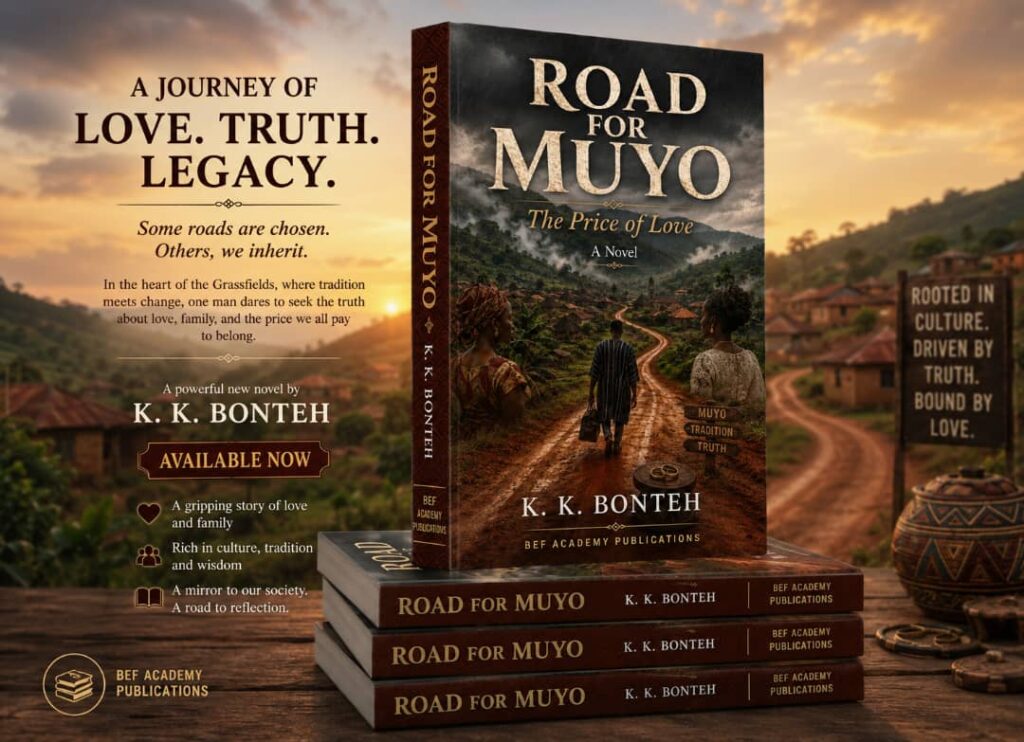
𝐓𝐇𝐄 𝐒𝐇𝐎𝐔𝐓 𝐀𝐓 𝐓𝐇𝐄 𝐁𝐄𝐆𝐈𝐍𝐍𝐈𝐍𝐆 𝐎𝐅 𝐓𝐇𝐄 𝐑𝐎𝐀𝐃
Prophecy, Memory and the Architecture of Fate in K. K. Bonteh’s 𝑹𝒐𝒂𝒅 𝒇𝒐𝒓 𝑴𝒖𝒚𝒐
𝐀 𝐋𝐢𝐭𝐞𝐫𝐚𝐫𝐲 𝐏𝐚𝐩𝐞𝐫
There are opening sentences that merely open a book, and there are opening sentences that contain the book in embryo. The beginning of K. K. Bonteh’s Road for Muyo: The Price of Love belongs to the second category. Its first paragraphs are not simply an introduction to Nsom Vitalis Bikom; they constitute a compressed prophecy of the entire novel. The shout, the fainting women, the children who stop playing, the village’s manufacture of competing versions of events, the unknown truth, the road, the rain, the ruined suit, the two doors, the hidden wealth and the strangely calm man at the centre of the commotion are all narrative seeds that germinate repeatedly across the Eight Roads of the novel.
The opening therefore functions like a literary strand running through the complete narrative, binding apparently separate incidents into one moral design.
Bonteh begins:
“The first time the village heard him shout, three women fainted, two neighbours ran into the compound, and the children stopped playing as if somebody had announced a funeral.”
Immediately, the novel announces several of its deepest concerns: voice and silence, community and rumour, children and consequence, marriage and death, appearance and truth. The word funeral arrives before the reader fully knows the man. Symbolically, therefore, death enters before biography. This is appropriate because Road for Muyo will become, among other things, a novel about relationships that die long before they are formally buried.
The genius of the opening becomes clearer only when the reader reaches the end. What initially appears to be a dramatic hook turns out to have been an architectural blueprint.
𝐓𝐇𝐄 𝐎𝐏𝐄𝐍𝐈𝐍𝐆 𝐀𝐒 𝐀 𝐌𝐈𝐍𝐈𝐀𝐓𝐔𝐑𝐄 𝐎𝐅 𝐓𝐇𝐄 𝐖𝐇𝐎𝐋𝐄 𝐍𝐎𝐕𝐄𝐋
The first chapter is titled “The Man Nobody Knew.” The title is deceptive in a productive way. Everyone knows Nsom. The young men at the junction know him. His neighbours know him. The Cooperative Manager knows him. His wives know him. His children know him. The parish knows him.
And yet nobody knows him.
That contradiction becomes the central psychological condition of the novel.
The narrator tells us that the shouting shocks the village because Nsom has spent thirty-seven years establishing the opposite identity:
“What frightened them was not the shouting itself. It was that the man had spent thirty-seven years teaching the world that his voice was not a weapon.”
The verb “teaching” is crucial. Nsom has not simply been quiet; he has constructed quietness as a public identity. His personality has become a lesson taught to the community. The whole novel will subsequently reveal the dangerous difference between character and performance.
Nsom performs poverty.
He performs contentment.
He performs harmlessness.
He performs certainty.
He performs a version of marital stability.
And because the performance lasts decades, the community begins to mistake repetition for truth.
Here Bonteh’s Nsom enters into fruitful dialogue with Jay Gatsby in F. Scott Fitzgerald’s The Great Gatsby. Gatsby is a mysterious wealthy man around whom society manufactures stories because it cannot penetrate the truth of his identity. Nsom is, intriguingly, almost an anti-Gatsby. Gatsby displays enormous wealth while disguising the past that produced it; Nsom disguises enormous wealth while displaying an invented poverty. Both men construct alternative selves in the hope that the constructed self will make love possible.
And both discover that one cannot indefinitely build intimacy upon an identity that intimacy itself has not been allowed to know.
𝐓𝐇𝐄 𝐒𝐇𝐎𝐔𝐓: 𝐖𝐇𝐄𝐍 𝐒𝐈𝐋𝐄𝐍𝐂𝐄 𝐅𝐈𝐍𝐀𝐋𝐋𝐘 𝐁𝐑𝐄𝐀𝐊𝐒
The shout is perhaps the most important sound in the opening because it emerges from a novel dominated by things not said.
It rises over the compound wall “like something escaping”. The simile suggests that the sound has been imprisoned. Nsom’s voice is therefore not merely loud; it is liberated pressure.
For decades, silence has accumulated inside him.
He does not tell Anita the truth about his wealth.
He does not fully explain his motivations.
He hides important facts from his family.
He turns uncomfortable conversations into postponements.
He gives anonymously when acknowledgement would expose him.
He repeatedly discovers that silence is convenient.
Eventually, however, silence becomes uncontainable.
The children describe the shout most accurately. It sounds, they say, “like a man calling across a valley to somebody who had already gone too far to hear.”
This image is extraordinarily important because it joins voice to distance, and therefore joins the shout to the novel’s controlling symbol—the road.
Nsom has spent years measuring physical distances while creating emotional ones.
The tragedy is not merely that someone has gone.
The tragedy is that the words arrive after distance has already been created.
In this sense, the shout belongs to the same tragic universe as Thomas Hardy. In novels such as Tess of the d’Urbervilles and Jude the Obscure, disaster frequently grows not from monstrous wickedness but from missed moments, delayed disclosures, social pressures and choices that might once have seemed reversible. Hardy’s tragedy often asks what might have happened if one letter had arrived, one truth had been heard, one meeting had occurred differently.
Bonteh makes the same question central to Nsom’s life.
The catastrophe is not inevitable.
That is precisely what makes it tragic.
𝐊𝐍𝐎𝐖𝐋𝐄𝐃𝐆𝐄, 𝐑𝐔𝐌𝐎𝐔𝐑 𝐀𝐍𝐃 𝐓𝐇𝐄 𝐆𝐑𝐄𝐄𝐊 𝐂𝐇𝐎𝐑𝐔𝐒 𝐎𝐅 𝐍𝐊𝐎𝐑
The third paragraph of the novel establishes another permanent concern:
“By sunset, everybody had heard a different version of what had happened. By midnight, only one person knew the truth.”
This is almost a thesis statement for the whole novel.
Who knows? Who thinks they know? Who is believed? Who controls the story?
These questions return constantly.
The Ncha quarter functions, in many respects, like the chorus of Greek tragedy. In Sophocles, the chorus watches events, responds, judges, fears and interprets—but never possesses complete knowledge. Similarly, Bonteh’s neighbours are everywhere. They interpret Nsom’s poverty, marriages, quarrels, departures and children. They manufacture social truth from partial evidence.
But the community is not foolish.
It simply does what communities often do: it transforms fragments into narratives.
This makes Road for Muyo close in spirit to Gabriel García Márquez’s Chronicle of a Death Foretold, where an entire community possesses pieces of knowledge while truth and responsibility remain strangely dispersed. Bonteh likewise explores the paradox of collective knowledge: many people can know many facts and still fail to know what actually happened.
The novel repeatedly contrasts public story with private record.
The neighbours have one version.
Nsom’s black book has another.
Anita’s exercise book has another.
Lucy has her documents.
The children have memories.
The tribunal eventually gathers these versions together.
Thus the opening sentence about different stories is not incidental. It anticipates the novel’s entire narrative method.
𝐓𝐇𝐄 “𝐅𝐎𝐎𝐋𝐈𝐒𝐇 𝐒𝐓𝐔𝐃𝐄𝐍𝐓 𝐎𝐅 𝐋𝐎𝐕𝐄”
Few phrases in the opening are more important than Nsom’s retrospective description of himself as “a very foolish student of love.”
The expression establishes the novel’s great educational metaphor.
Nsom thinks love is an examination.
He constructs tests.
He observes behaviour.
He interprets evidence.
He reaches conclusions.
But the irony is devastating: the self-appointed examiner has misunderstood the subject.
This places Nsom beside King Lear, perhaps literature’s most famous man who attempts to test love. Lear asks his daughters to demonstrate affection according to an examination he himself has designed. He mistakes performance for devotion and truth for disobedience.
Nsom’s error is different in cultural circumstance but remarkably similar in moral structure.
He too decides that love must provide evidence.
He too controls the conditions of the test.
He too interprets responses according to his own fears.
And he too discovers that love subjected to an unfair examination can become the victim of the examiner.
Later, Anita conducts her own examination, but hers is morally superior precisely because she tells Nsom the questions. The narrator eventually gives the verdict: she passes; he fails.
Thus the phrase “student of love” becomes more than self-mockery. It is the organising educational irony of the entire novel.
Nsom spends decades learning a lesson that was present in the first examination.
𝐓𝐇𝐄 𝐌Á𝐑𝐐𝐔𝐄𝐙–𝐋𝐈𝐊𝐄 𝐅𝐎𝐋𝐃𝐈𝐍𝐆 𝐎𝐅 𝐓𝐈𝐌𝐄
The sentence “Years later, when his children asked him…” deserves special attention.
Its structure recalls the celebrated temporal technique associated with Gabriel García Márquez’s One Hundred Years of Solitude, whose opening famously folds future memory back into present narration.
Bonteh employs a similar temporal manoeuvre.
We are standing near the beginning of Nsom’s story, but the narrator suddenly gives us his older self looking backwards. The children already exist. Three marriages have already happened. Nsom already knows that he has been foolish.
Then the narrative reverses direction again:
“But the road had not begun with the third woman.”
And then farther backwards:
“It had begun in the rain, with a borrowed motorcycle, a ruined suit…”
The opening therefore refuses straightforward chronology.
Instead, time behaves like memory.
The novel starts with consequence, moves towards cause, returns to consequence, and continually forces later knowledge to reinterpret earlier events.
This structure is essential because Road for Muyo is fundamentally about reinterpretation.
The proverb means one thing and later another.
The suit means one thing at the wedding and another at the burial.
The road means one thing to the young bridegroom and another to the old widower.
The door means escape before it means imprisonment.
The quiet husband appears virtuous before silence itself becomes part of the offence.
The entire novel therefore moves not merely forwards but back through its own meanings.
𝐓𝐇𝐄 𝐑𝐎𝐀𝐃: 𝐅𝐑𝐎𝐌 𝐆𝐄𝐎𝐆𝐑𝐀𝐏𝐇𝐘 𝐓𝐎 𝐏𝐒𝐘𝐂𝐇𝐎𝐋𝐎𝐆𝐘
The road is introduced almost immediately, and by the end it has become the novel’s governing metaphor.
The opening tells us:
“The road was never finished. That was the joke. That was also, though none of them knew it, the truth of his entire life.”
This is foreshadowing in its purest form.
The unfinished physical road corresponds to the unfinished moral journey of Nsom.
Throughout literature, the road has represented transformation. Homer’s Odyssey transforms travel into a struggle to return home. Dante’s Divine Comedy makes a journey through darkness the means by which a lost man acquires moral vision. Bunyan’s The Pilgrim’s Progress turns the road into spiritual education.
Bonteh creates a specifically Grassfields version of this ancient archetype.
Nsom’s road runs through Nkor, Muyo, Kumbo, Bamenda, Ntumbaw and the Kimbi valley, but its ultimate destination is self-knowledge.
That becomes explicit late in the novel when, on the same Muyo road and again in the rain, he finally understands:
“The far thing was me.”
He admits that Anita could sleep only eleven metres away while remaining separated from him by a wall of withheld speech. The man capable of walking hours through mud could not cross eleven metres to tell the truth.
Thus the physical road collapses into an inward one.
The journey to Muyo was never principally about kilometres.
It was about the distance between self-concealment and self-revelation.
𝐓𝐇𝐄 𝐑𝐔𝐈𝐍𝐄𝐃 𝐒𝐔𝐈𝐓: 𝐓𝐇𝐄 𝐎𝐁𝐉𝐄𝐂𝐓 𝐓𝐇𝐀𝐓 𝐑𝐄𝐌𝐄𝐌𝐁𝐄𝐑𝐒
The opening quietly tells us that Nsom owns one suit, ruined in 1979 and never replaced.
At first this seems eccentric.
Later it becomes monumental.
The suit is ruined during the journey to his wedding at Muyo. Red laterite transforms the expensive grey garment into something resembling a wound, even staining the shirt over his heart. At that moment Nsom briefly sees the possibility of confession. He could tell Anita and her family that he owns lorries and has constructed a false poverty. For a few seconds the door to truth stands open.
He closes it.
The suit therefore becomes a material archive of the moment truth was available and rejected.
This is one of Bonteh’s strongest symbolic techniques. Objects remember what people wish to forget.
The metal box remembers.
The floorboard remembers.
The doors remember.
The ledger remembers.
The suit remembers.
By the epilogue, the suit remains on its nail forty-four years later. It has attended burials and a tribunal and has become part of the family’s inheritance—not economically valuable, but morally priceless.
In this respect, Bonteh joins a distinguished literary tradition in which ordinary objects become repositories of memory. One thinks of the green light in The Great Gatsby, the handkerchief in Shakespeare’s Othello, or the letter in countless nineteenth-century novels. The object matters not because of what it materially is, but because of the human meaning deposited into it.
Nsom’s ruined suit becomes the garment of a choice.
𝐓𝐇𝐄 𝐓𝐖𝐎 𝐃𝐎𝐎𝐑𝐒: 𝐀𝐑𝐂𝐇𝐈𝐓𝐄𝐂𝐓𝐔𝐑𝐄 𝐀𝐒 𝐌𝐎𝐑𝐀𝐋 𝐒𝐘𝐌𝐁𝐎𝐋
The opening describes Nsom’s modest house and then pauses:
“There were two doors. Everybody in Nkor knew about the two doors. Nobody knew why.”
This is another apparently simple detail containing the future novel.
Pa Ngala originally explains the two doors as practical wisdom: a man should always have somewhere through which to leave. But the fuller proverb is darker: if trouble knows both doors, then the trouble must already be living inside the house.
Nsom remembers the first half more readily than the second.
That selective memory becomes his life.
He repeatedly seeks another door rather than confronting what is already inside.
A second relationship.
Another house.
Another explanation.
Another postponement.
Another silence.
In Henrik Ibsen’s A Doll’s House, the closing of a door became one of modern literature’s most famous signs of marital rupture. Bonteh’s novel conducts a long conversation with the same symbolic architecture. But his ultimate image moves in the opposite direction.
After 2008, the front door of Nsom’s house is never shut again.
The permanently open door represents the painful replacement of concealment by transparency.
Thus the opening doors already contain the ending.
𝐑𝐀𝐈𝐍: 𝐖𝐈𝐓𝐍𝐄𝐒𝐒, 𝐏𝐔𝐑𝐈𝐅𝐈𝐂𝐀𝐓𝐈𝐎𝐍 𝐀𝐍𝐃 𝐑𝐄𝐓𝐔𝐑𝐍
Rain accompanies the most important turns of the novel.
The opening shout happens while rain enters through the smaller door.
The wedding journey happens in rain.
The suit is destroyed by mud and rain.
Years later, Nsom returns along the same route in the same weather for Anita’s burial.
Rain therefore does not merely establish Grassfields climate. It becomes a ritual element.
At the wedding, rain covers and exposes him simultaneously. It destroys the respectable surface of the suit but gives him an opportunity to speak honestly.
He refuses.
At Anita’s burial decades later, the rain returns, and this time Nsom refuses protection. He comes covered in the same red mud and tells those gathered:
“Na the same road. Na different man.”
The repetition is almost ceremonial.
The first muddy journey produces poetry without complete truth.
The second produces truth without poetry.
That reversal is one of the structural triumphs of the novel.
𝐓𝐇𝐄 𝐂𝐇𝐈𝐋𝐃𝐑𝐄𝐍 𝐒𝐓𝐎𝐏 𝐏𝐋𝐀𝐘𝐈𝐍𝐆
It is significant that children appear in the very first sentence.
They stop playing.
Why begin a marriage novel by showing children reacting to an adult’s cry?
Because the novel will eventually insist that marital conflict never belongs exclusively to the adults who create it.
The children become witnesses, sufferers, archivists and eventually judges of the family story.
One of the most quietly devastating observations in the opening is that the children are “the most reliable witnesses and were never asked.”
That sentence contains an entire social criticism.
Adults talk.
Neighbours interpret.
Elders deliberate.
Institutions decide.
But children see.
Yefon, introduced later as the child who “decided to watch first”, spends decades remembering.
By the end, the eight children become custodians of the family inheritance—not simply property but the suit, the open door, the immovable table and the unanswered questions. They consciously refuse to invent certainty where their dead parents can no longer answer.
The children who stopped playing in the opening therefore become the adults who finally understand what the adults before them could not say.
𝐓𝐇𝐄 𝐌𝐀𝐍 𝐍𝐎𝐁𝐎𝐃𝐘 𝐊𝐍𝐄𝐖 𝐀𝐍𝐃 𝐓𝐇𝐄 𝐌𝐀𝐍 𝐖𝐇𝐎 𝐃𝐈𝐃 𝐍𝐎𝐓 𝐊𝐍𝐎𝐖 𝐇𝐈𝐌𝐒𝐄𝐋𝐅
The deepest irony of the chapter title is eventually revealed.
“The Man Nobody Knew” does not finally mean only that the community failed to know Nsom.
Nsom himself did not know Nsom.
This gives the novel an affinity with Sophocles’ Oedipus Rex.
Oedipus is intellectually formidable. He solves riddles. He investigates facts. He demands truth. Yet the truth he seeks is ultimately a truth about himself.
Nsom likewise possesses impressive practical intelligence. He understands money, coffee, transport, accounts, human behaviour and the ethics of weighing farmers’ produce. Yet his blindness concerns the one object he examines most relentlessly: himself.
He believes his problem is that women may love money.
Later he believes his problem is marital incompatibility.
Later still he thinks a proverb offers a solution.
But the novel gradually brings him to the recognition that his greatest difficulty has always been his habit of arranging circumstances so that he does not have to become vulnerable.
This is classical anagnorisis—recognition.
And, as in tragedy, recognition comes late.
But Bonteh departs from the absolute bleakness of classical tragedy. Nsom cannot repair everything, but he can finally stop hiding.
Hence the final journey matters.
𝐅𝐑𝐎𝐌 𝐀𝐂𝐇𝐄𝐁𝐄‘𝐒 𝐏𝐑𝐎𝐕𝐄𝐑𝐁𝐈𝐀𝐋 𝐖𝐎𝐑𝐋𝐃 𝐓𝐎 𝐁𝐎𝐍𝐓𝐄𝐇‘𝐒 𝐏𝐑𝐎𝐕𝐄𝐑𝐁𝐈𝐀𝐋 𝐑𝐄𝐕𝐈𝐒𝐈𝐎𝐍
The old man’s saying in the opening also places Road for Muyo firmly within the African tradition of proverbial narration associated most famously with Chinua Achebe.
But Bonteh makes an important addition to that tradition.
The question is not merely whether proverbs contain wisdom.
The question is whether later generations still understand the circumstances that produced them.
The phrase “Road for Muyo, the house no di far” moves through several meanings. The book’s own proverbial notes identify a progression from the physical road, to the distance between families, to the distance between husband and wife, and ultimately to the distance between a man and the truth about himself.
Likewise, “medicine for woman na woman” is misunderstood for decades before being restored to its original meaning of mediation and human assistance.
The novel therefore does something intellectually sophisticated with oral tradition: it treats the proverb as living interpretation rather than fossilised commandment.
True words walk, as Pa Ngala suggests.
But because they walk, they can also arrive wearing meanings they did not originally possess.
𝐓𝐇𝐄 𝐎𝐏𝐄𝐍𝐈𝐍𝐆 𝐀𝐒 𝐂𝐈𝐑𝐂𝐋𝐄: “𝐓𝐇𝐄 𝐒𝐀𝐌𝐄 𝐑𝐎𝐀𝐃. 𝐀 𝐃𝐈𝐅𝐅𝐄𝐑𝐄𝐍𝐓 𝐌𝐀𝐍.”
By the conclusion, nearly every major image introduced in the opening has returned.
The road remains.
The rain returns.
The ruined suit survives.
The doors remain.
The children become witnesses.
The community is still listening.
The stories are still being corrected.
The wealth has finally become public.
And the man whose voice once shocked the village eventually learns to speak without hiding.
Most importantly, Nsom returns to Muyo along the same road decades later.
At thirty-four he had stood on the hill, seen an opportunity to disclose the truth and closed it.
At old age, he returns covered in mud and finally understands that the road was never the real distance.
Hence his magnificent recognition:
“The house no di far. The man di far.”
The entire novel can almost be read as the long explanation of that sentence.
What is unfinished in the opening becomes understood at the end.
What begins as geography becomes psychology.
What begins as comedy becomes tragedy.
What begins as proverb becomes confession.
What begins as disguise becomes self-knowledge.
What begins with a closed door ends with an open one.
And what begins with a shout nobody understands ends with a family capable, at last, of interpreting the silence behind it.
𝐂𝐎𝐍𝐂𝐋𝐔𝐒𝐈𝐎𝐍
The First Pages as the Novel’s Hidden Map
The opening of Road for Muyo possesses literary richness because it performs the highest function of a great beginning: it tells us almost everything before we are capable of understanding what we have been told.
Like Márquez, Bonteh folds future memory into the opening moment.
Like Sophocles, he constructs tragedy through knowledge that exists before recognition.
Like Shakespeare’s King Lear, he makes the testing of love the beginning of self-destruction.
Like Hardy, he shows catastrophe accumulating through apparently small choices and delayed speech.
Like Fitzgerald, he explores the dangerous construction of a false self in the pursuit of love.
Like Ibsen, he turns the domestic door into a moral symbol.
And like Achebe, he gives proverbs intellectual and structural authority—while adding the crucial warning that inherited wisdom must continually be interpreted.
Yet Road for Muyo remains unmistakably its own novel.
Its symbols grow naturally from the Grassfields: laterite, coffee, motorcycles, zinc roofs, compounds, wine-carrying, proverbs, neighbours, rain and roads.
That is precisely why its universality is convincing.
The road to Muyo becomes every road on which a human being postpones the truth.
The two doors become every escape we invent instead of entering a difficult conversation.
The ruined suit becomes every object that remembers the moment when honesty was possible.
The village becomes every community that confuses repeated stories with complete truth.
The children become every generation required to inherit consequences it did not create.
And the shout becomes the sound produced when a lifetime of silence finally discovers that silence was never the same thing as peace.
That is why the first line’s suggestion of a funeral is prophetic. Long before bodies are buried, something has already been dying: communication, trust, intimacy, and the possibility of being completely known.
The opening therefore does not merely begin Road for Muyo.
It contains its roads.
The rest of the novel is the long, painful journey by which the reader—and finally Nsom himself—learns how to read the map that was placed before us on the first page.
The road was never unfinished because of the earth.
It was unfinished because the man walking it had not yet reached himself.