
K. K. Bonteh’s Dramatic Argument for the Right to Belong
𝐖𝐇𝐄𝐍 𝐀 𝐃𝐄𝐒𝐊 𝐁𝐄𝐂𝐎𝐌𝐄𝐒 𝐀 𝐃𝐎𝐎𝐑
K. K. Bonteh’s Dramatic Argument for the Right to Belong
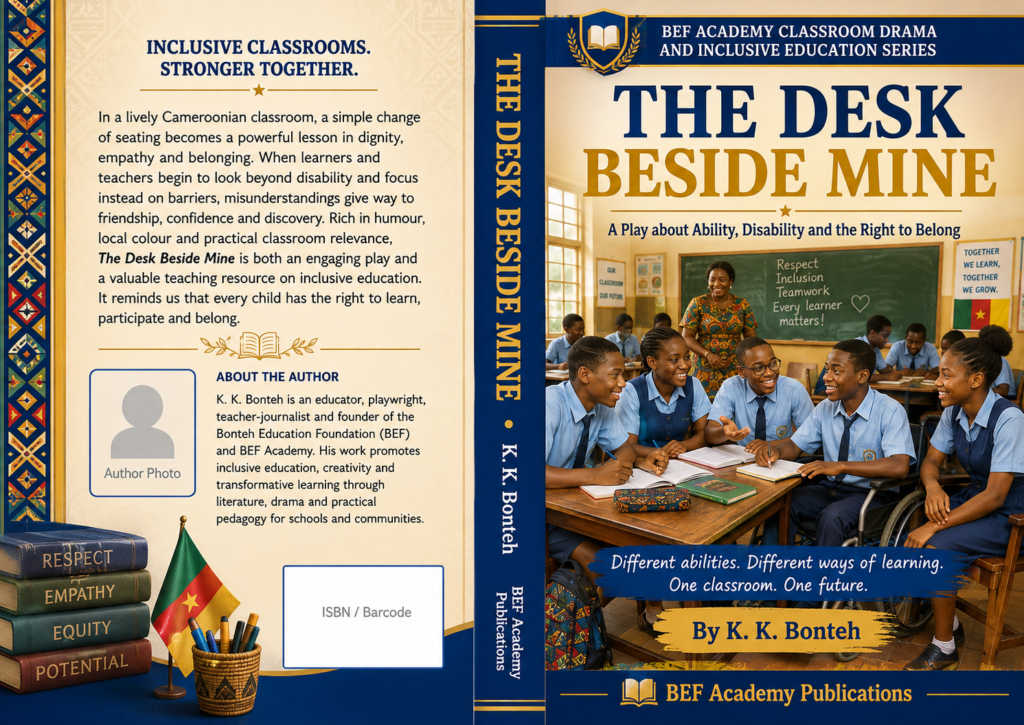
𝐀 𝐋𝐢𝐭𝐞𝐫𝐚𝐫𝐲 𝐑𝐞𝐯𝐢𝐞𝐰 𝐨𝐟 𝐓𝐡𝐞 𝐃𝐞𝐬𝐤 𝐁𝐞𝐬𝐢𝐝𝐞 𝐌𝐢𝐧𝐞: 𝐀 𝐏𝐥𝐚𝐲 𝐚𝐛𝐨𝐮𝐭 𝐀𝐛𝐢𝐥𝐢𝐭𝐲, 𝐃𝐢𝐬𝐚𝐛𝐢𝐥𝐢𝐭𝐲 𝐚𝐧𝐝 𝐭𝐡𝐞 𝐑𝐢𝐠𝐡𝐭 𝐭𝐨 𝐁𝐞𝐥𝐨𝐧𝐠
By K. K. Bonteh
BEF Academy Classroom Drama and Inclusive Education Series
BEF Academy Publications, 2026
There are books that begin with a character. Others begin with an event. K. K. Bonteh’s The Desk Beside Mine begins, significantly, with an object.
A desk.
Not a throne, a grave, a battlefield or the mysterious castle through which classical tragedies traditionally announce danger. It is simply a school desk standing apart from the others.
Yet before the Prologue is over, that ordinary piece of classroom furniture has acquired the symbolic weight of a locked gate.
The Three Bell Voices circle it. They joke about it. Perhaps, one suggests, the desk has failed its examination. But humour gives way to uneasiness until the decisive question is asked: is something wrong with the desk, or is something wrong with the way the classroom has been arranged?
This is the imaginative key to Bonteh’s play. Throughout The Desk Beside Mine, disability is steadily moved away from the body of the learner and relocated within the architecture, attitudes, language, routines and assumptions of the institution. The manuscript itself identifies the desk, gate, bell and ramp as recurring symbols whose meanings develop as the school moves from separation towards participation.
In that deceptively simple dramatic manoeuvre lies the considerable achievement of this work.
𝐓𝐡𝐞 𝐩𝐥𝐚𝐲 𝐢𝐬 𝐧𝐨𝐭 𝐫𝐞𝐚𝐥𝐥𝐲 𝐚𝐛𝐨𝐮𝐭 𝐚 𝐜𝐡𝐢𝐥𝐝 𝐰𝐡𝐨 𝐜𝐚𝐧𝐧𝐨𝐭 𝐞𝐧𝐭𝐞𝐫 𝐚 𝐬𝐜𝐡𝐨𝐨𝐥. 𝐈𝐭 𝐢𝐬 𝐚𝐛𝐨𝐮𝐭 𝐚 𝐬𝐜𝐡𝐨𝐨𝐥 𝐭𝐡𝐚𝐭 𝐡𝐚𝐬 𝐧𝐨𝐭 𝐲𝐞𝐭 𝐥𝐞𝐚𝐫𝐧𝐞𝐝 𝐡𝐨𝐰 𝐭𝐨 𝐞𝐧𝐭𝐞𝐫 𝐭𝐡𝐞 𝐰𝐨𝐫𝐥𝐝 𝐨𝐟 𝐚𝐥𝐥 𝐢𝐭𝐬 𝐜𝐡𝐢𝐥𝐝𝐫𝐞.
𝐓𝐡𝐞 𝐈𝐫𝐨𝐧𝐲 𝐨𝐟 “𝐄𝐝𝐮𝐜𝐚𝐭𝐢𝐨𝐧 𝐟𝐨𝐫 𝐀𝐥𝐥”
Bonteh establishes his central irony almost immediately.
Ada Nfor, a Form Two learner who uses a wheelchair, arrives at Unity Bilingual Secondary School, Ndem, where a proud sign announces EDUCATION FOR ALL. Directly beneath it are five concrete steps.
The contradiction is almost too perfect.
Ada looks at the motto and remarks: “Big words for a small staircase.”
That sentence contains the play in miniature.
It also places Bonteh, whether deliberately or by literary affinity, within a long African tradition in which public slogans are tested against private and communal realities. One thinks of the satirical Cameroon of Ferdinand Oyono and Mongo Beti, where official language frequently promises one reality while ordinary experience delivers another. Bonteh’s satire is gentler, because his principal audience is young, but its mechanism is comparable: put the institution’s noble words beside what the institution actually does and allow the contradiction to expose itself.
The phrase Education for All carries historical resonance beyond the fictional school. The global Education for All movement was formally articulated at Jomtien in 1990 and reaffirmed at the World Education Forum in Dakar in 2000. The Salamanca Statement of 1994 subsequently gave enormous international impetus to inclusive schooling by insisting that schools should accommodate children with diverse needs within common educational environments. The UN Convention on the Rights of Persons with Disabilities later placed inclusive education firmly within a rights-based framework through Article 24.
Bonteh translates those declarations from conference halls into concrete.
A right becomes five steps.
A policy becomes a narrow library door.
An international principle becomes a small-print worksheet that Ewole cannot read.
A philosophy becomes an assembly instruction that assumes every child can stand.
And the enormous language of educational reform is ultimately reduced to perhaps the wisest question in the play:
Where would you prefer to sit?
𝐀𝐝𝐚: 𝐍𝐨𝐭 𝐚 𝐒𝐲𝐦𝐛𝐨𝐥 𝐁𝐮𝐭 𝐚 𝐏𝐞𝐫𝐬𝐨𝐧
One of the dangers confronting any dramatist writing about disability is the temptation to convert disabled characters into moral furniture. They become saints, victims, inspirational examples or mechanisms for improving everybody else.
Bonteh largely avoids that trap.
Ada is not written to invite pity. She is intelligent, observant, impatient, occasionally mischievous and capable of laughing at herself and others. The manuscript explicitly insists that her disability must never become her entire personality.
Indeed, Ada frequently possesses the sharpest language in the play.
When adults begin discussing how many boys should carry her up the inaccessible school steps, Mr Ebolo refers vaguely to “the situation”. Ada replies that the situation has a name. When the school finally consults her, her satisfaction comes not from being rescued but from being recognised as an agent capable of defining her own needs.
This distinction between helping someone and deciding for someone becomes one of the play’s most sophisticated ethical ideas.
The title scene dramatises it beautifully. Merveille, Nji and Tiko hold an absurd miniature conference about where Ada should sit. They consider wind, lighting, rules and classroom geography. Everyone is discussing Ada.
Nobody is speaking to her.
Then Kemi walks across the classroom and asks:
“Where would you prefer to sit?”
Silence follows.
The dramatic power lies precisely in how embarrassingly easy the solution is. The play thereby exposes one of paternalism’s oldest habits: speaking elaborately on behalf of people whose own voices are available but unheard.
𝐓𝐡𝐞 𝐁𝐞𝐥𝐥 𝐕𝐨𝐢𝐜𝐞𝐬: 𝐅𝐫𝐨𝐦 𝐒𝐨𝐩𝐡𝐨𝐜𝐥𝐞𝐬 𝐭𝐨 𝐭𝐡𝐞 𝐂𝐚𝐦𝐞𝐫𝐨𝐨𝐧𝐢𝐚𝐧 𝐂𝐥𝐚𝐬𝐬𝐫𝐨𝐨𝐦
The Three Bell Voices constitute one of the play’s most inventive structural devices.
Their ancestry can be traced, at least by literary analogy, to the Greek chorus. In Aeschylus and Sophocles, the chorus stands between event and audience, interpreting, questioning, fearing and judging. Bonteh domesticates that ancient dramatic machinery and places it in school uniform.
His chorus does not chant before the palace of Thebes.
It rings.
Ding! Ding!
Action freezes. Questions begin.
Yet the Bell Voices are rarely moral policemen. They are interrogators. They repeatedly complicate the obvious answer. When Nji knows the theory of a lever but Musa understands intuitively how to make it work, the Bell Voices ask which boy is cleverer — only to interrupt their own question: perhaps that itself is the wrong question.
The technique also carries a faint Brechtian echo. Bertolt Brecht often interrupted dramatic illusion so that spectators might think rather than surrender completely to emotional identification. Bonteh’s Bell Breaks similarly prevent passive watching. But where Brecht frequently sought distance, Bonteh seeks participation.
And by the Epilogue, the affinity with Augusto Boal’s Theatre of the Oppressed becomes even stronger. Boal sought to transform the passive spectator into a participant in social reality. Bonteh does something comparable when the actors abandon character, face the audience and ask what barrier they can begin removing. The house lights rise until stage and auditorium appear to become one room.
The metaphor is complete.
The audience is no longer watching Unity School.
The audience is Unity School.
𝐃𝐢𝐜𝐤𝐞𝐧𝐬’𝐬 𝐆𝐫𝐚𝐝𝐠𝐫𝐢𝐧𝐝 𝐌𝐞𝐞𝐭𝐬 “𝐏𝐫𝐨𝐟𝐞𝐬𝐬𝐨𝐫” 𝐍𝐣𝐢
Among the most amusing characters is Nji, nicknamed “Professor”, whose faith in examination marks is almost theological.
Here The Desk Beside Mine enters another long literary debate: what exactly does education mean?
Readers of Charles Dickens’s Hard Times will remember Thomas Gradgrind and his devotion to measurable “Facts”. Nji is no Gradgrind tyrant, of course; he is a bright adolescent whose mistake is more innocent. But the philosophical resemblance is delightful. He knows definitions. He reads instructions rapidly. He can explain a fulcrum.
Then his lever collapses.
Musa, who struggles with written instructions, silently examines the structure, shifts the fulcrum, and makes it work. His explanation is wonderfully concise: “The shape told me before the words did.”
This is not an argument against scholarship or literacy. Bonteh wisely refuses that false opposition. Mr Tamfu eventually asks Nji to explain the theory while Musa demonstrates it. Together they teach the same lesson “from two directions at once”.
The scene therefore overturns hierarchy without merely reversing it. Musa does not replace Nji at the top of another ladder. The ladder itself disappears.
Different competences become complementary.
That idea reaches its dramatic climax during the Innovation Challenge. When the electronic screen unexpectedly fails, the presentation survives because every learner possesses something the others need: Ada supplies composure and direction, Chantal produces visual material, Musa diagnoses a loose cable, Ewole remembers the sequence, Nji retrieves his calculations, and Tiko communicates with the gathering audience.
In a lesser didactic drama, disability would have been the problem for the “normal” characters to solve.
Here, diversity becomes the solution to a problem none of them could have solved alone.
That reversal is perhaps the play’s most important dramatic victory.
𝐖𝐡𝐞𝐧 𝐭𝐡𝐞 𝐓𝐞𝐬𝐭 𝐈𝐭𝐬𝐞𝐥𝐟 𝐅𝐚𝐢𝐥𝐬
Bonteh extends this argument into assessment in the cleverly titled “The Test That Failed the Class.”
The title itself is a reversal of conventional educational judgement.
Musa scores seven out of twenty despite having demonstrated strong practical understanding. Madam Etoundi consequently asks whether the learners failed the test or whether the test sometimes failed to measure the learners. She compares assessment to a thermometer incapable of measuring part of the temperature range. The discussion culminates in the principle: same competence, same criteria, different evidence.
That scene may be pedagogically motivated, but dramatically it also asks a larger philosophical question: Who has the authority to define intelligence?
It is a question that has haunted educational literature for centuries, from Dickens’s Coketown to postcolonial African classrooms where examination success has frequently carried enormous social prestige.
Bonteh does not reject examinations. His position is more subtle. A measuring instrument should not mistake its own limitations for the limitations of the person being measured.
𝐋𝐚𝐮𝐠𝐡𝐭𝐞𝐫 𝐖𝐢𝐭𝐡𝐨𝐮𝐭 𝐂𝐫𝐮𝐞𝐥𝐭𝐲
For a play carrying so substantial a social argument, The Desk Beside Mine is frequently very funny.
This matters.
Nothing kills classroom drama faster than the suspicion that the characters have been assembled merely to deliver a sermon.
Bonteh therefore gives us Mr Ebolo and his whistle, committees that threaten to organise committees, Nji’s intellectual self-confidence, Tiko’s inexhaustible appetite for jokes, and the deliciously Cameroonian mixture of school authority, parent meetings, puff-puff, formal “Sir” and “Madam”, English, Cameroon English, French and the rhythms of everyday bilingual life. The text deliberately draws its names and linguistic textures from varied Cameroonian communities rather than fixing the fictional school within a single ethnic identity.
But the play draws an important boundary around comedy.
In “It Was Only a Joke”, Tiko’s imitation of Mr Ebolo is genuinely funny until he shifts his performance towards Ada’s wheelchair. The laughter collapses. Ada explains the distinction: the joke has changed its target. The first comedy concerns behaviour; the second makes a body the punchline.
It is a remarkably mature lesson in comic ethics because Ada does not abolish humour. After Tiko apologises, she asks him to perform the funny part again.
Thus the scene travels from comedy to discomfort, then apology, and finally back to comedy.
The restoration of laughter is important. Inclusion is not represented as a joyless republic in which everybody is terrified of saying the wrong thing. It is instead a community learning how to laugh without requiring somebody’s humiliation as the price of admission.
𝐓𝐡𝐞 𝐁𝐚𝐫𝐫𝐢𝐞𝐫–𝐁𝐫𝐢𝐝𝐠𝐞 𝐃𝐫𝐚𝐦𝐚𝐭𝐮𝐫𝐠𝐲
Formally, Bonteh organises the work through what he calls the Barrier–Bridge Dramaturgy: a barrier is encountered; its real nature is discovered; a practical bridge is constructed. The five acts move suggestively through Gate, Wall, Mirror, Bridge and Open Door.
These are architectural nouns, but also psychological ones.
The Gate asks who enters.
The Wall asks what obstructs participation.
The Mirror turns accusation inward.
The Bridge demands collaborative action.
The Open Door imagines a new institutional culture.
There is something almost reminiscent of the medieval morality play in this progression, although Bonteh replaces personified abstractions such as Virtue and Vice with recognisable schoolchildren, teachers, parents, desks, whistles, notices and examination papers.
The architecture also resembles a pilgrimage. Yet the destination is deliberately unfinished.
That matters enormously.
𝐍𝐨 𝐅𝐚𝐥𝐬𝐞 𝐇𝐚𝐩𝐩𝐲 𝐄𝐧𝐝𝐢𝐧𝐠
Many educational plays weaken themselves by ending in miraculous unanimity. The bully repents, the authorities reform, everyone embraces, and the social problem apparently evaporates before curtain call.
Bonteh refuses that convenience.
By Scene Fifteen the ramp has been built and signage improved, but the library door remains narrow and the toilets remain inaccessible. Madam Principal openly admits that more remains unfinished than completed.
This may be the most politically mature moment in the play.
Real reform is not represented as conversion but as continuing work.
Then comes the quiet resolution of the central symbol.
Tiko jokingly asks whether Ada wants her “special desk” back. Kemi moves slightly aside and answers:
“No special corner. There is a place beside mine.”
Ada joins the cluster.
Nothing spectacular happens.
That is precisely why the scene succeeds.
The symbolic desk has travelled from isolation, through controversy and consultation, into ordinary belonging.
And then the bell rings.
Earlier, its ringing froze the action and allowed the Bell Voices to intervene. This time nobody stops. Learners continue working, talking and laughing.
The lesson no longer requires interruption because it has entered the life of the classroom.
The chorus turns towards us:
Perhaps the lesson is no longer inside the play.
𝐅𝐫𝐨𝐦 𝐂𝐥𝐚𝐬𝐬𝐫𝐨𝐨𝐦 𝐏𝐥𝐚𝐲 𝐭𝐨 𝐂𝐢𝐯𝐢𝐜 𝐓𝐡𝐞𝐚𝐭𝐫𝐞
This is where The Desk Beside Mine finally exceeds the category of “school play”.
Its competence-based tasks, BIIP learning cycle, teacher guides and language workshops unquestionably make it an educational text. Indeed, the book is deliberately constructed so that scenes can function independently as lessons while remaining parts of a continuous drama.
Yet its best moments resist the dead hand of instructional writing.
Bonteh understands that drama teaches most effectively when the lesson has first become conflict, embarrassment, laughter, silence, surprise or recognition.
His true pedagogic instrument is therefore not the worksheet.
It is dramatic irony.
It is the child who sees what the adult has failed to see.
It is the test that fails the learner.
It is the “Education for All” sign standing above inaccessible steps.
It is the supposedly weak learner rescuing the supposedly clever learner’s machine.
It is the bell that rings — and discovers nobody needs it any more.
And it is finally the house lights rising on the spectators themselves.
Shakespeare famously imagined the world as a stage. Bonteh performs a small but important reversal: the stage becomes the world. The fictional classroom and the real audience merge, and the spectator can no longer pretend that exclusion belongs only to Ada’s imaginary school.
That is the wager behind the closing questions:
Who is still outside an apparently open door?
What barrier can we remove?
What can we begin changing today?
𝐕𝐞𝐫𝐝𝐢𝐜𝐭
The Desk Beside Mine is at once classroom drama, social comedy, pedagogic experiment, civic theatre and an argument about human dignity.
Its finest innovation lies in refusing the conventional question, What is wrong with this learner?, and replacing it with the infinitely more productive one:
What in this environment prevents the learner from participating?
Its characters make mistakes without becoming monsters. Adults are allowed to learn from children without being caricatured as fools. Disabled learners possess weaknesses, strengths, humour and agency rather than serving as objects of sympathy. Even sceptics such as Papa Tiko are persuaded through argument and experience rather than conveniently defeated.
And through the Barrier–Bridge structure, Bonteh turns inclusion from an abstract moral command into dramatic action: noticing, asking, listening, redesigning, testing, failing, improvising and trying again.
That is why the modest object in the title matters so much.
A desk can separate.
A desk can stigmatise.
A desk can become the place from which people discuss you rather than speak to you.
But moved a few feet — and accompanied by a different way of thinking — the same desk can become an invitation.
In the long literary history of doors, gates and thresholds, from ancient tragedy to modern African social drama, Bonteh adds his own deliberately ordinary image: a school desk moved close enough for another child to say, simply, “There is a place beside mine.”
And perhaps that is the most persuasive definition of inclusion literature can offer.
𝐍𝐨𝐭 𝐩𝐢𝐭𝐲.
𝐍𝐨𝐭 𝐜𝐡𝐚𝐫𝐢𝐭𝐲.
𝐍𝐨𝐭 𝐞𝐯𝐞𝐧 𝐭𝐨𝐥𝐞𝐫𝐚𝐧𝐜𝐞.
𝐀 𝐩𝐥𝐚𝐜𝐞 𝐛𝐞𝐬𝐢𝐝𝐞 𝐦𝐢𝐧𝐞.