Description
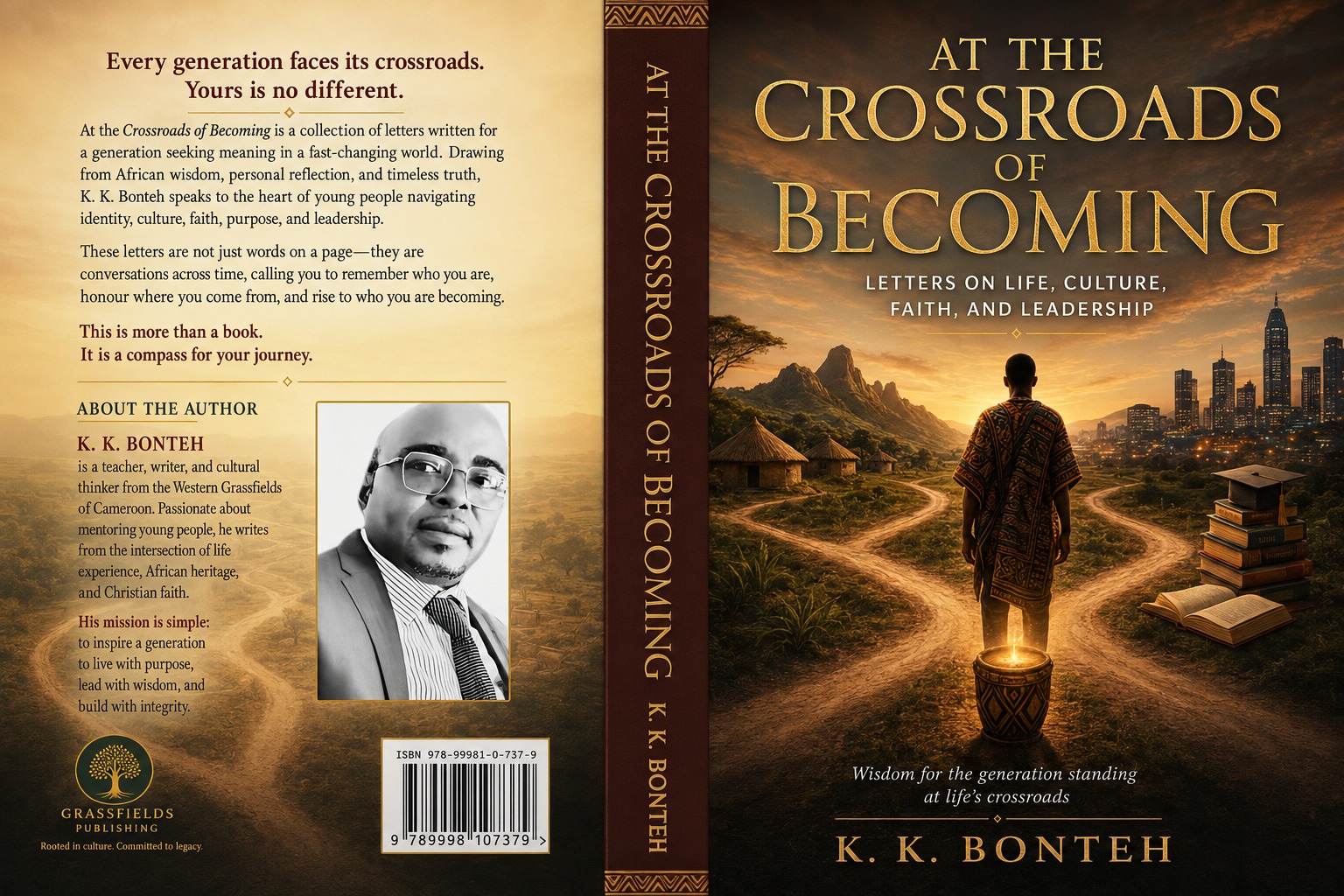
AT THE CROSSROADS OF BECOMING
Letters on Life, Culture, Faith, and Leadership
In this intimate and profound collection, K. K. Bonteh speaks directly to the rising generation as a father speaks to his children — with clarity, honesty, and hard-earned wisdom.
Framed as a series of thoughtful letters, the book explores the vital territories of our time: the courage to belong to a living culture while remaking it responsibly; the healing power of language as bridge rather than wound; the moral life built on small, daily choices; the covenant of marriage beyond fleeting feeling; the honest search for faith; the temptations and true purpose of power; genuine education for an independent mind; the discipline of hope amid suffering; and the sacred responsibility we owe to those yet unborn.
Written in the reflective tradition of Bernard Fonlon, these letters offer no easy certainties but a steady companionship at life’s inevitable crossroads. Rooted in Cameroonian and African wisdom while reaching toward universal truths, At the Crossroads of Becoming is both a moral compass and a loving invitation to choose courage over fear, integrity over convenience, and hope over despair.
For every young person navigating identity, leadership, faith, family, and purpose in a changing world — this is essential reading.
………….
AU CARREFOUR DU DEVENIR
Lettres sur la vie, la culture, la foi et le leadership
Dans ce recueil intime et profond, K. K. Bonteh s’adresse directement à la génération montante comme un père parle à ses enfants — avec clarté, honnêteté et une sagesse durement acquise.
Présentées sous forme de lettres réfléchies, ces pages explorent les territoires essentiels de notre époque : le courage d’appartenir à une culture vivante tout en la refaçonnant de manière responsable ; le pouvoir guérisseur de la langue comme pont plutôt que comme blessure ; la vie morale construite sur de petits choix quotidiens ; l’alliance du mariage au-delà des sentiments fugaces ; la recherche honnête de la foi ; les tentations et le véritable sens du pouvoir ; une éducation authentique pour un esprit indépendant ; la discipline de l’espérance face à la souffrance ; et la responsabilité sacrée que nous devons à ceux qui ne sont pas encore nés.
Écrit dans la tradition réfléchie de Bernard Fonlon, ces lettres n’offrent aucune certitude facile, mais une compagnie fidèle aux inévitables carrefours de la vie. Enracinées dans la sagesse camerounaise et africaine tout en touchant des vérités universelles, Au Carrefour du Devenir est à la fois une boussole morale et une invitation affectueuse à choisir le courage plutôt que la peur, l’intégrité plutôt que la facilité, et l’espérance plutôt que le désespoir.
Pour chaque jeune qui navigue entre identité, leadership, foi, famille et sens dans un monde en mutation — une lecture essentielle.
BefAcademy –
A Powerful African Voice in Classical Tragedy: A Review of The King at the Crossroads by K. K. Bonteh
By BEF ACADEMY Literary Correspondent
In an era when African literature continues to reclaim and reinvent global canons, K. K. Bonteh’s The King at the Crossroads stands as a masterful achievement. Subtitled A Tragic Chronicle of Blood, Power, and Destiny, this bold African recasting of Sophocles’ Oedipus the King is far more than an adaptation — it is a profound cultural transposition that relocates classical tragedy into the heart of African ritual, cosmology, and contemporary political consciousness.
A Hybrid Masterpiece of Form and Substance
Bonteh fuses three powerful traditions with remarkable skill:
African ritual performance — drums, masks, ancestral invocation, and communal chorus
Medieval dramatic structure — processional prologue, moral interludes, and didactic choral commentary
Classical tragic intensity — the inexorable movement toward self-recognition and downfall
The result is a hybrid tragic form that feels both ancient and urgently modern. Set in a mythic yet timeless African kingdom at the symbolic crossroads of history, trade, prophecy, and power, the play follows a victorious ruler whose hidden crimes return to haunt his reign as plague and disorder ravage the land.
Themes That Resonate Deeply
At its core, The King at the Crossroads is a searing political and moral tragedy. Bonteh masterfully explores:
Fate versus Free Will — presenting fate as a moral trajectory shaped by human denial and refusal to remember
Political Power and Moral Blindness — showing how authority insulates leaders from truth
Sacred Kingship and Communal Responsibility — leadership as ritual guardianship rather than personal privilege
Truth as a Destructive yet Necessary Force — the painful necessity of historical reckoning
The Failure of Modern Leadership — a sharp commentary on post-colonial governance, contested power, and ethical accountability
The rich symbolic framework — crossroads, drums, blindness, masks, dust and ash — elevates the drama beyond narrative into ritual language that speaks
to both heart and mind.
Why This Play Matters Today
Bonteh does not merely retell a Greek story in African costume. He creates a genuine African tragic consciousness where guilt is communal and cosmic, where the Chorus functions as Elders and Griots bearing collective memory, and where the king’s fall carries consequences for the entire land.
This is theatre as civic intervention — ideal for university drama programs, secondary school literature curricula (especially Cameroon GCE), professional theatre companies, and peace-building workshops. The extensive supplementary materials (playwright’s commentary, symbolic analysis, performance notes, discussion questions, and curriculum alignment) make it an invaluable resource for educators and practitioners.
Final Verdict
The King at the Crossroads is a significant contribution to African dramatic literature. With its ritual power, moral depth, and unflinching engagement with leadership and truth, it deserves a prominent place on stages, in classrooms, and in the hearts of readers who believe theatre can both reflect and transform society.
K. K. Bonteh has given us not only a compelling tragedy but a mirror for our times — one that reminds us that true leadership demands the courage to face unbearable truth, and that nations, like their kings, stand perpetually at crossroads where memory and accountability determine the road ahead.
Highly recommended for anyone passionate about African literature, classical adaptations, political theatre, or the enduring power of moral storytelling.
Available now. A must-read (and must-perform) work from one of Cameroon’s most important contemporary voices.
BefAcademy –
A Timely Gift for the Rising Generation: A Review of At the Crossroads of Becoming by K. K. Bonteh
By BEF ACADEMY Literary Correspondent
In a world that often shouts but rarely listens, K. K. Bonteh offers something rare and deeply needed: the quiet, authoritative voice of a wise elder speaking directly to the heart of the next generation. At the Crossroads of Becoming: Letters on Life, Culture, Faith, and Leadership is not just another book of advice — it is a profound, loving, and unflinchingly honest companion for young Africans navigating identity, purpose, and responsibility in a rapidly changing continent and world.
A Fatherly Voice in the Tradition of Fonlon
Written as a series of intimate letters addressed to a son or daughter who represents every young person standing at life’s crossroads, Bonteh continues the noble intellectual lineage of Bernard Fonlon. He speaks plainly yet elegantly, blending African proverbial wisdom, Christian humanism, personal reflection, and sharp cultural insight without pretension or abstraction.
The book moves gracefully through nine essential territories:
Culture and the Courage to Belong — a powerful call to live an authentic, living African identity rather than performing borrowed modernity or imagined purity.
Language as Wound and Bridge — a courageous examination of Cameroon’s bilingual reality and its potential for national healing.
Wisdom and the Moral Life — grounding ethics in everyday choices and ancestral proverbs.
Marriage and the Bonds of Love — redefining covenant over fleeting romance.
Faith and the Search for Truth — inviting honest questioning within a living faith.
Power and Its Temptations — echoing the moral warnings of his own play The King at the Crossroads.
Education and the Making of a Genuine Mind — a critique of certificate-driven learning and a vision for true intellectual formation.
Suffering and the Discipline of Hope — offering grounded, resilient hope rather than cheap optimism.
Death, Legacy, and the Unborn — a moving reflection on what we owe those yet to come.
Why This Book Will Touch Many Hearts
What makes At the Crossroads of Becoming particularly compelling is its rare combination of warmth and incisiveness. Bonteh does not lecture — he accompanies. He does not offer simplistic solutions — he shares hard-won wisdom.
The letters feel personal yet universal, rooted in Cameroonian and Grassfields experience while speaking to any young person wrestling with belonging, leadership, faith, family, and legacy.
In an age of short attention spans and superficial content, this slim, readable volume rewards both quick reading and repeated return. Parents will gift it to their children. Teachers will recommend it to students. Young professionals will find in it a trusted mentor.
Bonteh’s message is clear and persuasive: the crossroads is not a place of paralysis but of sacred choice. Standing there with courage, integrity, and hope is the true measure of becoming.
Highly Recommended
At the Crossroads of Becoming is essential reading for every young African — and for anyone who cares about raising the next generation with wisdom, conscience, and rooted hope. It is a beautiful, timely, and deeply moving work that deserves a wide audience.
Get your copy today. Give it to someone standing at their own crossroads. They will thank you for years to come.
K. K. Bonteh has given us a modern classic of African wisdom literature.
BefAcademy –
On Language as Wound and Bridge
My dear son,
I write to you about a thing so ordinary that we forget its danger: the words in our mouths.
You have grown up speaking English at home, French in the streets of Yaoundé, and Lamnso’ in your grandmother’s compound when the harmattan brings the family together. You move between these tongues the way a man moves between rooms in his own house, barely noticing the doorways. I envy you this. I also worry for you, because what feels like ease to you was bought, in my generation and the ones before it, with confusion, humiliation, and sometimes blood.
Let me tell you what I mean.
When the Germans left and the British and French divided what had been one territory between them, they did not ask us which language belonged to our mouths. They simply built two houses on land that had once been a single compound, and they raised the children in each house to suspect the other. We were told, on one side, that to speak French well was to be modern, to be serious, to be capable of governing. We were told, on the other side, that to speak English well was to be free, to be different, to be apart. Neither story was about us. Both stories used us.
I have watched grown men in this country switch their entire bearing — posture, vocabulary, even the tilt of the head — depending on which language they were made to prove themselves in. I have watched a brilliant student dismissed in an interview not because his ideas were poor but because his French carried the wrong accent, the accent of the hills rather than the accent of the capital. I have watched a francophone civil servant transferred to an anglophone town and treated, by his own countrymen, as a kind of occupier, simply because the government that sent him spoke in a tongue the people there did not trust. This is not a small wound. It is the wound underneath many of our other wounds — economic, political, and now, in our own lifetime, a wound that has hardened into something close to war.
I do not say this to despair you. I say it because a letter that pretends language is innocent in this country would be a lie, and I have not raised you on lies.
But here is the other thing I must tell you, and it matters more than the first: a bridge is built from the same material as a wound. The very thing that was used to divide us is the thing most capable of healing us, if we have the courage to use it rightly.
Bernard Fonlon understood this before most of his generation. He did not ask Cameroon to choose between English and French, as though loyalty to one tongue proved loyalty to the nation. He asked something harder and wiser: that we hold both, fully, as a sign that this nation was never meant to be owned by either inheritance alone. To speak two colonial languages well, he believed, was not betrayal of our African selves — it was evidence that we could take what history forced upon us and turn it into a tool of our own making. Bilingualism, for him, was not surrender. It was sovereignty exercised through the very instruments meant to divide us.
I want you to understand this distinction, because it is easy to confuse pride in one’s mother tongue with hostility toward a neighbor’s. They are not the same thing. You may love Lamnso’ the way I love it — the way it carries our proverbs, our names, our way of greeting an elder, things that English and French will never carry the same way — without needing English or French to disappear, and without needing the French-speaking child in Douala to feel that his language makes him less Cameroonian than you. The wound was never the existence of two languages. The wound was the lie that one tongue must dominate the other for the nation to make sense.
So here is what I ask of you, and what I believe this whole country still owes itself.
Speak your languages without apology, but do not let any one of them become a wall. When you hear an accent unlike your own, resist the old reflex that turns difference into suspicion. When you have power — and you will have power, in whatever room life places you — do not let language be the gate that decides who is heard and who is dismissed. I have seen too many meetings in this country where a good idea died simply because it arrived in the wrong tongue, spoken by someone the room had already decided not to trust.
And when you write, when you teach, when you raise your own children one day, remember that a bridge does not erase the banks on either side of the river. It simply allows what was separated to reach itself. Cameroon does not need to choose between its English and its French inheritance, nor between either of these and the dozin languages we carried long before the Germans, the British, or the French arrived. It needs the courage to let all of them stand, without forcing any one of them to rule.
This is not naïveté, my son. I have lived through enough to know that language alone will not undo what decades of mistrust have done. But I also know that no peace in this country will be built by people who have already decided, before a conversation begins, that the other person’s tongue disqualifies them from being heard.
Be the kind of Cameroonian who listens past the accent. It is a small thing to ask. It may be the only thing, in the end, that saves us.
With all my hope for the bridge you will build,
Your father
Culled from: At the Crossroads of Becoming
Letters on Life, Culture, Faith, and Leadership
By K. K. Bonteh