Description
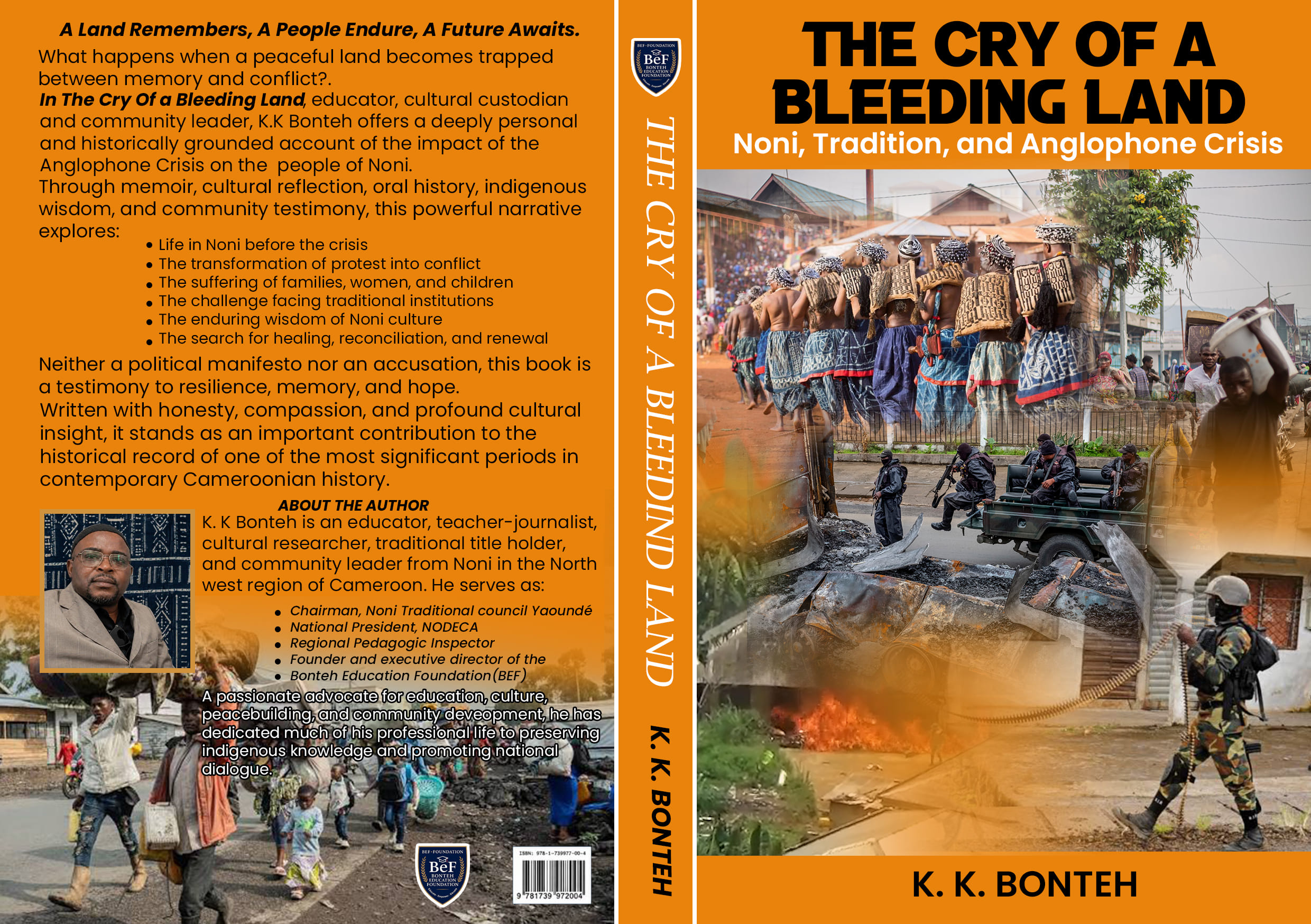
Some books document a conflict from a distance. This Anglophone Crisis memoir does the opposite, writing from inside the wound. The Cry of a Bleeding Land, by K.K. Bonteh, centers the Noni people of Cameroon’s Northwest, tracing their cultural heritage alongside the very real damage the Anglophone Crisis has done to that heritage over the past several years.
What sets this Anglophone Crisis memoir apart from a straightforward history is how much room it gives to culture before it ever turns to conflict. Bonteh spends real time on Noni tradition, language, and community life, so that by the time the narrative turns to loss, readers already understand exactly what was at stake. The grief that follows lands harder because the book earns it first.
That grief is grounded in a documented reality. Cameroon’s Anglophone Crisis, an ongoing conflict between the country’s English-speaking regions and the central government that escalated sharply after 2017, has displaced hundreds of thousands of people and reshaped daily life across the Northwest and Southwest. The Cry of a Bleeding Land does not treat that history as background noise. It places the Noni people’s specific experience directly inside that larger, well-documented crisis.
Bonteh blends memoir, history, and cultural reflection rather than picking just one mode, and the book is stronger for refusing to specialize. Personal testimony sits next to documented historical detail, and cultural reflection threads through both, so the result reads less like a report and more like a community speaking for itself about what it has survived.
Healing is where the book ultimately points, even after dwelling honestly in the damage. Bonteh does not rush past the pain of displacement and loss, but the book consistently returns to resilience and the possibility of reconciliation, treating both as things a community has to actively build rather than simply wait for. That refusal to end in despair is what separates this Anglophone Crisis memoir from pure tragedy.
Readers drawn to conflict memoirs, African history, or stories about communities rebuilding after crisis will find a text that never loses its specificity. This is not a generalized account of an abstract war. It is the Noni people’s account of their own war, told by someone willing to name both the damage and the path back from it. Researchers and students studying the Anglophone Crisis will also find real value in a perspective grounded in lived community experience rather than only policy analysis.
The book also makes room for specific testimony rather than staying at the level of general history. Bonteh includes voices from within the Noni community itself, people describing what displacement actually looked like in daily terms, not just in headline numbers. That choice keeps the larger statistics from swallowing the individual stories behind them. The dual pricing structure reflects the same instinct, keeping the book genuinely affordable for readers inside Noni itself rather than treating the community at the center of the story as just another national market to sell into.
The Cry of a Bleeding Land joins the rest of K.K. Bonteh’s catalogue exploring Cameroonian identity, available through the full book collection at BEF Academy Publications. This Anglophone Crisis memoir is available now for 5,000 FCFA nationwide, or for just 3,000 FCFA within Noni itself. Few books manage to honor a community’s pain and its resilience in equal measure, and that balance is what makes this one worth reading slowly.
BefAcademy –
𝑻𝑯𝑬 𝑪𝑹𝒀 𝑶𝑭 𝑨 𝑩𝑳𝑬𝑬𝑫𝑰𝑵𝑮 𝑳𝑨𝑵𝑫
𝑾𝒉𝒆𝒏 𝒂 𝑷𝒓𝒐𝒕𝒆𝒔𝒕 𝑩𝒆𝒄𝒂𝒎𝒆 𝒂 𝑾𝒐𝒖𝒏𝒅: 𝑨 𝑪𝒓𝒚 𝒇𝒐𝒓 𝑹𝒆𝒄𝒐𝒏𝒄𝒊𝒍𝒊𝒂𝒕𝒊𝒐𝒏
Distinguished Guests, Traditional Authorities, Religious Leaders, Scholars, Ladies and Gentlemen,
There are moments in the life of a people when silence becomes betrayal. There are moments when the cries of widows, orphans, displaced families, and broken communities become too loud to ignore. It is from such a moment that 𝑻𝒉𝒆 𝑪𝒓𝒚 𝒐𝒇 𝒂 𝑩𝒍𝒆𝒆𝒅𝒊𝒏𝒈 𝑳𝒂𝒏𝒅 was born.
This book is not merely about conflict.
It is about a tragedy.
It is about a dream interrupted.
It is about a people who once stood together to express grievances peacefully, only to find themselves trapped in a cycle of violence that has consumed lives, families, communities, and aspirations.
Many of us remember how it began.
Teachers demanded respect for an educational system they cherished.
Lawyers demanded respect for legal traditions they believed were under threat.
Ordinary citizens marched with hopes, not weapons.
They carried expectations, not bullets.
They sought dialogue, not destruction.
Yet somewhere along the road, something changed.
A cry for justice became a cry of anguish.
A protest became a conflict.
A conflict became a wound.
And that wound continues to bleed.
Today, perhaps the most painful question confronting us is not who started the conflict.
The most painful question is:
What have we become?
How did a struggle that claimed to defend a people reach a point where members of the same communities fear one another?
How did brothers become enemies?
How did villages become battlefields?
How did sons of the same soil turn their weapons against fellow sons of that same soil?
Today, too often, Anglophones are mourning Anglophones.
Families grieve not because strangers have harmed them, but because violence has entered their own communities.
The blood that stains our land is increasingly the blood of our own people.
The tears flowing from our mothers’ eyes are shed for sons lost on every side.
The graves do not ask whether the dead belonged to one camp or another.
The grave only reminds us that a human life has been lost.
And every lost life diminishes us all.
Ladies and Gentlemen,
One of the central messages of this book is that every conflict reaches a dangerous stage when it loses sight of the people in whose name it claims to be fought.
When fear replaces purpose.
When revenge replaces principle.
When violence becomes an end in itself.
At that point, everybody loses.
The farmer loses.
The teacher loses.
The student loses.
The trader loses.
The traditional ruler loses.
The church loses.
The community loses.
And ultimately, the future loses.
That is why 𝑻𝒉𝒆 𝑪𝒓𝒚 𝒐𝒇 𝒂 𝑩𝒍𝒆𝒆𝒅𝒊𝒏𝒈 𝑳𝒂𝒏𝒅 is both a testimony and a warning.
It documents suffering.
It preserves memory.
But it also challenges us to rethink the path we have taken.
For if we continue to define victory by the number of lives destroyed, then there will be no victors.
Only survivors.
And even they will carry wounds for generations.
This book calls upon all Cameroonians, especially the sons and daughters of the North-West and South-West Regions, to rediscover the values that once held our communities together:
Respect.
Dialogue.
Compassion.
Forgiveness.
Solidarity.
These values are not signs of weakness.
They are the foundations of lasting peace.
Our ancestors understood this truth.
Traditional institutions understood this truth.
Communities that survived centuries of challenges understood this truth.
Peace is not built by eliminating one another.
Peace is built by listening to one another.
Peace is built by restoring trust.
Peace is built by remembering that before we belonged to causes, movements, parties, or ideologies, we belonged to families, communities, and a shared humanity.
As readers journey through the pages of this book, they will encounter pain.
They will encounter loss.
But they will also encounter hope.
For even in a bleeding land, healing remains possible.
Even after years of darkness, dawn remains possible.
Even after division, reconciliation remains possible.
And even after conflict, peace remains possible.
May this book serve not merely as a record of what happened.
May it become a reminder of what must never happen again.
And may future generations look back on this period not only as a time of suffering, but as the moment when a wounded people found the courage to heal, reconcile, and rebuild.
𝑻𝒉𝒂𝒏𝒌 𝒚𝒐𝒖.
𝑴𝒂𝒚 𝑷𝒆𝒂𝒄𝒆 𝑷𝒓𝒆𝒗𝒂𝒊𝒍. 𝑴𝒂𝒚 𝑹𝒆𝒄𝒐𝒏𝒄𝒊𝒍𝒊𝒂𝒕𝒊𝒐𝒏 𝑻𝒓𝒊𝒖𝒎𝒑𝒉. 𝑴𝒂𝒚 𝑶𝒖𝒓 𝑳𝒂𝒏𝒅 𝑯𝒆𝒂𝒍.
BefAcademy –
𝑳𝑨𝑼𝑵𝑪𝑯 𝑺𝑷𝑬𝑬𝑪𝑯
𝑻𝒉𝒆 𝑺𝒊𝒈𝒏𝒊𝒇𝒊𝒄𝒂𝒏𝒄𝒆 𝒐𝒇 𝑻𝒉𝒆 𝑪𝒓𝒚 𝒐𝒇 𝒂 𝑩𝒍𝒆𝒆𝒅𝒊𝒏𝒈 𝑳𝒂𝒏𝒅 𝒊𝒏 𝒕𝒉𝒆 𝑪𝒐𝒏𝒕𝒆𝒙𝒕 𝒐𝒇 𝑷𝒆𝒂𝒄𝒆, 𝑪𝒐𝒏𝒇𝒍𝒊𝒄𝒕, 𝒂𝒏𝒅 𝑹𝒆𝒄𝒐𝒏𝒄𝒊𝒍𝒊𝒂𝒕𝒊𝒐𝒏
𝑮𝒖𝒆𝒔𝒕𝒔 𝒐𝒇 𝑯𝒐𝒏𝒐𝒖𝒓, 𝑻𝒓𝒂𝒅𝒊𝒕𝒊𝒐𝒏𝒂𝒍 𝑹𝒖𝒍𝒆𝒓𝒔, 𝑹𝒆𝒍𝒊𝒈𝒊𝒐𝒖𝒔 𝑳𝒆𝒂𝒅𝒆𝒓𝒔, 𝑨𝒄𝒂𝒅𝒆𝒎𝒊𝒄𝒔, 𝑴𝒆𝒎𝒃𝒆𝒓𝒔 𝒐𝒇 𝑪𝒊𝒗𝒊𝒍 𝑺𝒐𝒄𝒊𝒆𝒕𝒚, 𝑳𝒂𝒅𝒊𝒆𝒔 𝒂𝒏𝒅 𝑮𝒆𝒏𝒕𝒍𝒆𝒎𝒆𝒏,
It is with profound humility and a deep sense of responsibility that I stand before you today to present a work born out of reflection, observation, lived experiences, and an enduring hope for a more peaceful future. Today, we gather not merely to launch a book, but to engage in a conversation that concerns every Cameroonian, every African, and indeed every citizen of the world who believes in the sanctity of human life and the possibility of reconciliation.
𝑻𝒉𝒆 𝑪𝒓𝒚 𝒐𝒇 𝒂 𝑩𝒍𝒆𝒆𝒅𝒊𝒏𝒈 𝑳𝒂𝒏𝒅 is more than a literary creation. It is a testimony. It is a mirror held before society. It is a voice for the voiceless, a tribute to victims, a challenge to perpetrators of violence, and a call to all stakeholders to embrace dialogue, understanding, and peace.
Cameroon, often described as Africa in miniature, has for decades been a beacon of cultural diversity, coexistence, and resilience. Yet, like many nations, it has not been immune to social tensions, political disagreements, communal conflicts, and more recently, the devastating consequences of armed confrontations that have left communities fractured, families displaced, and countless lives irreversibly altered.
The bleeding land portrayed in this work is not merely a geographical space. It is a symbolic representation of every community wounded by hatred, mistrust, injustice, and violence. It is a reflection of villages abandoned, schools deserted, homes destroyed, dreams interrupted, and generations growing up amid uncertainty and fear.
Yet, this book does not seek to deepen wounds. It seeks to illuminate them so that healing may begin.
Peace cannot emerge where pain is denied. Reconciliation cannot occur where truth is ignored. Healing cannot begin where silence reigns.
One of the central messages of this work is that sustainable peace requires more than the absence of gunfire. Peace is the restoration of trust. Peace is the rebuilding of relationships. Peace is the courage to listen to those with whom we disagree. Peace is the willingness to place our common humanity above our differences.
In the Cameroonian context, this message is particularly significant. The challenges confronting our nation cannot be resolved solely through force, accusations, or entrenched positions. Lasting solutions demand dialogue, empathy, justice, and mutual respect. They require us to recognise that regardless of language, ethnicity, region, religion, or political affiliation, we remain members of one national family whose destinies are interconnected.
This book therefore serves as an invitation—an invitation to reflect on the cost of conflict and the value of peace.
It invites policymakers to consider the human consequences of decisions.
It invites community leaders to become agents of reconciliation.
It invites traditional authorities to continue playing their historic role as custodians of peace and social harmony.
It invites religious leaders to strengthen messages of forgiveness and coexistence.
It invites young people to reject violence and become ambassadors of constructive engagement.
And it invites every reader to ask a simple but profound question:
What role can I play in transforming a bleeding land into a healing land?
Ladies and Gentlemen,
History teaches us that nations emerge stronger when they possess the courage to confront difficult realities and the wisdom to pursue reconciliation. The greatest victories are not always won on battlefields. Often, they are won around negotiation tables, within communities, and in hearts willing to forgive and rebuild.
The significance of 𝑻𝒉𝒆 𝑪𝒓𝒚 𝒐𝒇 𝒂 𝑩𝒍𝒆𝒆𝒅𝒊𝒏𝒈 𝑳𝒂𝒏𝒅 lies precisely in this vision. It is an appeal for a future where dialogue triumphs over division, understanding over suspicion, and reconciliation over revenge.
As readers journey through its pages, they will encounter stories of suffering, resilience, courage, and hope. They will be reminded that even in the darkest moments of human experience, the possibility of renewal remains alive.
For every cry of pain, there can be a response of compassion.
For every wound, there can be healing.
For every conflict, there can be reconciliation.
For every bleeding land, there can be restoration.
As I conclude, permit me to express my gratitude to all those whose sacrifices, experiences, and aspirations inspired this work. I also extend my appreciation to scholars, peace advocates, traditional institutions, religious communities, and all men and women of goodwill who continue to labour tirelessly for peace in Cameroon and beyond.
May this book contribute, however modestly, to ongoing efforts aimed at fostering dialogue, promoting mutual understanding, preserving collective memory, and advancing the noble cause of peace.
May it challenge us to think deeply.
May it inspire us to act responsibly.
And may it remind us that the future of our nation depends not on the divisions that separate us, but on the values that unite us.
𝑻𝒉𝒂𝒏𝒌 𝒚𝒐𝒖 𝒇𝒐𝒓 𝒚𝒐𝒖𝒓 𝒌𝒊𝒏𝒅 𝒂𝒕𝒕𝒆𝒏𝒕𝒊𝒐𝒏.
𝑳𝒐𝒏𝒈 𝑳𝒊𝒗𝒆 𝑷𝒆𝒂𝒄𝒆. 𝑳𝒐𝒏𝒈 𝑳𝒊𝒗𝒆 𝑹𝒆𝒄𝒐𝒏𝒄𝒊𝒍𝒊𝒂𝒕𝒊𝒐𝒏. 𝑳𝒐𝒏𝒈 𝑳𝒊𝒗𝒆 𝑪𝒂𝒎𝒆𝒓𝒐𝒐𝒏.
BefAcademy –
𝗧𝗛𝗘 𝗘𝗡𝗘𝗠𝗬 𝗜𝗦 𝗡𝗢𝗧 𝗢𝗨𝗧𝗦𝗜𝗗𝗘: 𝗜𝗧 𝗜𝗦 𝗧𝗛𝗘 𝗩𝗜𝗢𝗟𝗘𝗡𝗖𝗘 𝗪𝗘 𝗛𝗔𝗩𝗘 𝗔𝗟𝗟𝗢𝗪𝗘𝗗 𝗧𝗢 𝗦𝗣𝗘𝗔𝗞 𝗜𝗡 𝗢𝗨𝗥 𝗡𝗔𝗠𝗘
A Revolutionary Reflection on the Tragedy in the North-West and South-West Regions of Cameroon
By K. K. Bonteh
𝗦𝗔𝗗 𝗡𝗘𝗪𝗦
If the reports circulating on social media concerning the alleged abduction of four clergymen near Bambui while travelling towards Fundong are true, then every person of conscience must condemn the act in the strongest possible terms.
Kidnapping men and women whose calling is to preach peace, hope, reconciliation, and the Word of God cannot be justified by any political grievance, military objective, or ideological argument. The abduction of religious leaders, teachers, farmers, traders, students, and ordinary civilians is not liberation. It is an assault on the very society whose interests are purportedly being defended.
The time has come for us to ask difficult questions.
What exactly is happening in the North-West and South-West Regions?
Can we honestly continue to describe this tragedy merely as an “Anglophone War” or an “Anglophone Crisis” without interrogating the realities before our eyes?
Who exactly is fighting whom?
Who is the enemy?
Who is being protected?
And who is suffering?
For nearly a decade, villages have been emptied, schools destroyed, livelihoods shattered, families displaced, and countless lives lost. Yet the overwhelming majority of victims have been the very people in whose name this struggle is often proclaimed.
Anglophones against Anglophones.
Brothers against brothers.
Sisters against sisters.
Neighbours against neighbours.
Entire communities living in fear of those who claim to speak on their behalf.
What kind of liberation terrorises the people it seeks to liberate?
What kind of freedom is purchased with the tears of widows, the silence of abandoned classrooms, and the cries of children growing up amidst uncertainty and violence?
Let us be clear.
A genuine struggle for justice does not require the kidnapping of civilians.
A genuine struggle for justice does not demand ransom from impoverished families.
A genuine struggle for justice does not threaten teachers, burn schools, silence journalists, or abduct clergy.
Such actions do not advance a cause; they undermine it.
They do not restore dignity; they destroy it.
They do not build a nation; they fracture one.
Many citizens of the North-West and South-West Regions initially hoped that grievances concerning governance, education, law, and representation would be addressed through meaningful dialogue and reform. Those concerns were real. Those concerns deserved attention.
But somewhere along the way, criminality, opportunism, and violence began masquerading as resistance.
Enemies of the people disguised themselves as defenders of the people.
Fear began speaking louder than reason.
And too many of us remained silent.
History teaches us that meaningful change is not achieved through terror.
Real change comes from courageous individuals willing to stand for truth, justice, and human dignity.
When Rosa Parks refused to surrender her seat during the era of racial segregation in the United States, she did not kidnap anyone.
She did not extort anyone.
She did not terrorise her community.
She challenged injustice through moral courage.
That single act helped transform history.
Today, our communities need similar courage—not the courage to wield weapons against neighbours, but the courage to reject violence wherever it comes from.
In my recent publication, 𝑲𝒑𝒘𝒆 𝒚𝒊̀ 𝑵𝒔𝒉ɛ 𝑩𝒆𝒆𝒍𝒆 ɛ 𝑩𝒐𝒐𝒌𝒆 ɛ 𝑳ɛ𝒎ɛ (The Cry of a Bleeding Land), I sought to capture the anguish of a people wounded by conflict, division, and silence. Though inspired by the experiences of the Noni and Bui communities, its message resonates far beyond those localities.
A bleeding land does not ask which side fired the bullet.
A bleeding land asks who will stop the bleeding.
A bleeding land does not ask which flag was raised.
A bleeding land asks who will rebuild the school.
Who will comfort the orphan?
Who will heal the traumatised?
Who will restore trust among neighbours?
The future of our communities cannot be built upon fear.
It cannot be built upon kidnappings.
It cannot be built upon ransom demands.
It cannot be built upon the humiliation of innocent people.
If indeed clergymen have been abducted, they must be released immediately and unconditionally.
Every citizen of goodwill must reject such acts.
The time for silence has passed.
The time for moral clarity has arrived.
Let us redefine this conflict honestly.
Let us name evil for what it is.
Let us reject violence irrespective of who commits it.
And let us remember that no people can claim victory when they are destroying themselves.
For when brothers fight brothers, there are no winners.
Only a land that continues to bleed.
K. K. Bonteh
Author of 𝑲𝒑𝒘𝒆 𝒚𝒊̀ 𝑵𝒔𝒉ɛ 𝑩𝒆𝒆𝒍𝒆 ɛ 𝑩𝒐𝒐𝒌𝒆 ɛ 𝑳ɛ𝒎ɛ
(The Cry of a Bleeding Land)
BefAcademy –
𝗕𝗢𝗢𝗞 𝗥𝗘𝗟𝗘𝗔𝗦𝗘 𝗔𝗡𝗡𝗢𝗨𝗡𝗖𝗘𝗠𝗘𝗡𝗧
𝗖𝗢𝗠𝗜𝗡𝗚 𝗢𝗨𝗧 𝗦𝗢𝗢𝗡!
𝗧𝗵𝗲 𝗖𝗿𝘆 𝗼𝗳 𝗮 𝗕𝗹𝗲𝗲𝗱𝗶𝗻𝗴 𝗟𝗮𝗻𝗱:
𝗡𝗼𝗻𝗶, 𝗧𝗿𝗮𝗱𝗶𝘁𝗶𝗼𝗻, 𝗮𝗻𝗱 𝘁𝗵𝗲 𝗔𝗻𝗴𝗹𝗼𝗽𝗵𝗼𝗻𝗲 𝗖𝗿𝗶𝘀𝗶𝘀
By K.K. Bonteh
A powerful historical, cultural, and documentary testimony on one of the most significant periods in the history of Noni and the Anglophone Regions of Cameroon.
From the sacred hills of Nkor-Noni to the turbulent years of the Anglophone Crisis, “𝗧𝗵𝗲 𝗖𝗿𝘆 𝗼𝗳 𝗮 𝗕𝗹𝗲𝗲𝗱𝗶𝗻𝗴 𝗟𝗮𝗻𝗱” chronicles the story of a people whose traditions, institutions, memories, and aspirations have endured despite political uncertainty, social upheaval, displacement, and conflict.
Combining history, oral tradition, cultural anthropology, memoir, documentary narration, photography, and socio-political analysis, this remarkable work serves as both a cultural archive and a compelling call for reflection, reconciliation, and renewal.
𝗜𝗻𝘀𝗶𝗱𝗲 𝘁𝗵𝗶𝘀 𝗴𝗿𝗼𝘂𝗻𝗱𝗯𝗿𝗲𝗮𝗸𝗶𝗻𝗴 𝗯𝗼𝗼𝗸:
✓ The historical origins and evolution of Noni
✓ Noni traditions, customs, and cultural institutions
✓ Oral histories and ancestral memories
✓ Traditional leadership and governance systems
✓ The impact of colonialism and post-independence transformations
✓ The Anglophone Crisis and its consequences on local communities
✓ Stories of resilience, displacement, survival, and hope
✓ Rare cultural photographs and documentary records
✓ Reflections on peacebuilding, identity, and cultural preservation
✓ A vision for reconciliation and sustainable community development
𝗪𝗵𝘆 𝘁𝗵𝗶𝘀 𝗯𝗼𝗼𝗸 𝗺𝗮𝘁𝘁𝗲𝗿𝘀
At a time when cultures face erosion and collective memories risk being forgotten, 𝗧𝗵𝗲 𝗖𝗿𝘆 𝗼𝗳 𝗮 𝗕𝗹𝗲𝗲𝗱𝗶𝗻𝗴 𝗟𝗮𝗻𝗱 stands as an important contribution to the preservation of Noni heritage and the documentation of a critical chapter in Cameroon’s contemporary history.
It is a book for:
• Scholars and researchers
• Historians and anthropologists
• Cultural activists and traditional leaders
• Students and educators
• Policymakers and development practitioners
• Members of the Noni community worldwide
• Anyone interested in peace, identity, heritage, and nation-building
𝗔 𝗖𝗔𝗟𝗟 𝗧𝗢 𝗔𝗖𝗧𝗜𝗢𝗡
This book is more than a publication; it is an invitation to participate in the preservation of Noni’s cultural heritage.
Readers are encouraged to contribute to this collective effort by sharing photographs, historical records, oral testimonies, videos, cultural events, traditional ceremonies, and other materials that document the life and history of the Noni people.
Such contributions may be shared through:
NODECA WhatsApp Forum
or
NODECA Facebook Page
Together, we can document, promote, preserve, and transmit the rich cultural heritage of Noni to future generations.
𝗣𝗥𝗘-𝗢𝗥𝗗𝗘𝗥𝗦 𝗡𝗢𝗪 𝗢𝗣𝗘𝗡
Available in:
✓ Premium Print Edition
✓ Print-on-Demand (POD) Edition
✓ Institutional and Library Edition
✓ Future Digital Edition
Orders and enquiries:
BEF Academy Publications
Email: info@befacademy.org
Website: http://www.befacademy.org
“When a people preserve their memories, they preserve their future.”
𝗧𝗵𝗲 𝗖𝗿𝘆 𝗼𝗳 𝗮 𝗕𝗹𝗲𝗲𝗱𝗶𝗻𝗴 𝗟𝗮𝗻𝗱
Coming Soon — 2026
A Landmark Contribution to Noni History, Culture, and Memory.