Description
𝗕𝗘𝗙 𝗔𝗖𝗔𝗗𝗘𝗠𝗬 𝗘𝗗𝗨𝗖𝗔𝗧𝗜𝗢𝗡 𝗖𝗢𝗥𝗥𝗘𝗦𝗣𝗢𝗡𝗗𝗘𝗡𝗖𝗘
𝗕𝗼𝗼𝗸 𝗥𝗲𝘃𝗶𝗲𝘄
𝗠𝗔𝗦𝗧𝗘𝗥𝗜𝗡𝗚 𝗟𝗜𝗧𝗘𝗥𝗔𝗥𝗬 𝗔𝗣𝗣𝗥𝗘𝗖𝗜𝗔𝗧𝗜𝗢𝗡: 𝗔 𝗡𝗲𝘄 𝗕𝗲𝗻𝗰𝗵𝗺𝗮𝗿𝗸 𝗳𝗼𝗿 𝗟𝗶𝘁𝗲𝗿𝗮𝘁𝘂𝗿𝗲 𝗘𝗱𝘂𝗰𝗮𝘁𝗶𝗼𝗻 𝗶𝗻 𝗔𝗳𝗿𝗶𝗰𝗮
Reviewed by the Education Correspondence Desk, BEF Academy
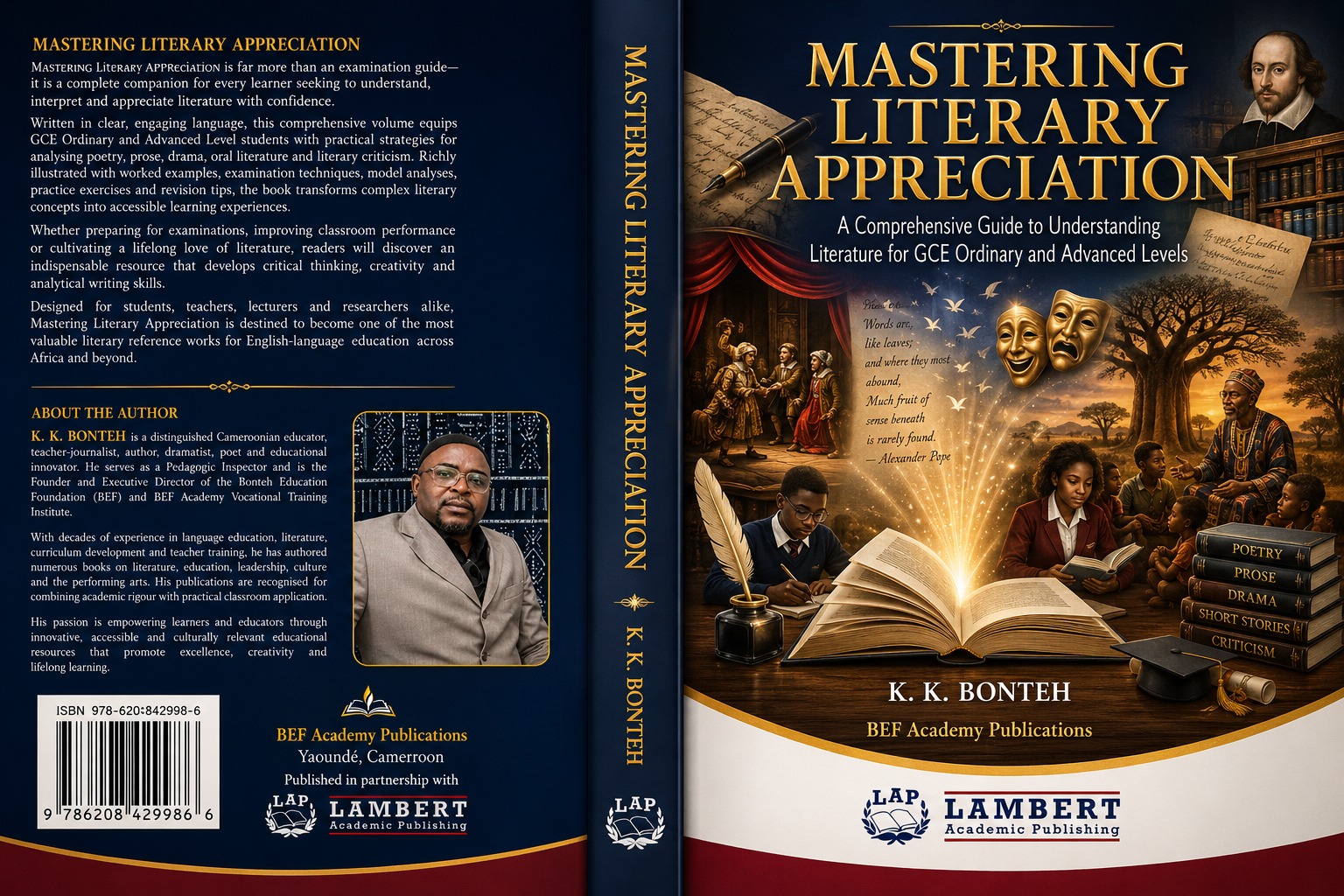
In an era when learners are increasingly expected not merely to read literary texts but to interpret, evaluate, and appreciate them critically, Mastering Literary Appreciation by K. K. Bonteh emerges as one of the most practical and comprehensive educational resources currently available for the teaching and learning of English Literature.
Far more than an examination handbook, this carefully designed volume serves as a complete learning companion for students, teachers, lecturers, and researchers. It bridges the gap between literary theory and classroom practice, offering readers a structured pathway towards mastering the skills required for literary analysis and appreciation.
One of the book’s greatest strengths lies in its accessibility. Bonteh employs clear, engaging language that simplifies complex literary concepts without sacrificing academic depth. Students who often find literary criticism intimidating will appreciate the logical progression from fundamental concepts to more advanced analytical techniques.
The book provides comprehensive treatment of the principal branches of literature, including poetry, prose, drama, oral literature, and literary criticism. Each section is supported with carefully selected examples, practical illustrations, model analyses, revision exercises, and examination-oriented guidance. This practical approach makes the book equally useful inside and outside the classroom.
From an educational perspective, the work reflects sound pedagogical principles. Rather than encouraging rote memorisation, it develops higher-order thinking skills by teaching learners how to interpret texts independently, identify literary techniques, evaluate themes, and construct convincing literary arguments. Such an approach aligns with contemporary competency-based educational philosophies and prepares students for both examinations and lifelong learning.
Teachers will find the book particularly valuable as a classroom resource. The explanations are systematic, the examples relevant, and the exercises adaptable to different learning contexts. It can effectively support lesson preparation, classroom discussions, continuous assessment, remedial teaching, and examination revision.
Another commendable feature is the author’s integration of literary appreciation with broader educational objectives. Throughout the text, literature is presented not simply as an academic discipline but as a means of developing communication skills, creativity, empathy, cultural awareness, analytical reasoning, and intellectual curiosity. This holistic perspective reinforces the enduring educational value of literature in shaping responsible and reflective citizens.
K. K. Bonteh brings to this work decades of experience as an educator, curriculum specialist, teacher trainer, educational administrator, and author. His practical understanding of learners’ needs is evident throughout the volume. The explanations anticipate common areas of difficulty and provide effective strategies for overcoming them, making the book particularly learner-centred.
Importantly, Mastering Literary Appreciation addresses the needs of multiple educational audiences. While it is especially suited to GCE Ordinary and Advanced Level candidates, its usefulness extends to university students, teacher training institutions, educational colleges, and independent researchers. It is equally appropriate for school libraries, university libraries, and personal collections.
The production quality of the work further enhances its educational value. Its organised structure, reader-friendly presentation, logical sequencing, and practical orientation contribute to an enjoyable and effective learning experience.
𝗘𝗱𝘂𝗰𝗮𝘁𝗶𝗼𝗻𝗮𝗹 𝗦𝗶𝗴𝗻𝗶𝗳𝗶𝗰𝗮𝗻𝗰𝗲
At a time when quality educational resources remain essential to improving learning outcomes across Africa, Mastering Literary Appreciation represents an important contribution to English Language and Literature education. It exemplifies how locally authored scholarship can address curriculum needs while maintaining international academic standards.
The book deserves adoption by secondary schools, teacher training colleges, universities, and educational institutions seeking to strengthen literary competence among learners.
𝗙𝗶𝗻𝗮𝗹 𝗔𝘀𝘀𝗲𝘀𝘀𝗺𝗲𝗻𝘁
Mastering Literary Appreciation is an outstanding educational publication that successfully combines scholarly rigour with practical classroom application.
It transforms literary appreciation from a challenging academic exercise into an engaging intellectual journey, equipping readers with the confidence and competence to analyse literature with insight and precision.
For students striving for academic excellence, teachers seeking effective instructional resources, and institutions committed to quality education, this volume is a highly recommended investment.
𝗕𝗘𝗙 𝗔𝗰𝗮𝗱𝗲𝗺𝘆 𝗘𝗱𝘂𝗰𝗮𝘁𝗶𝗼𝗻 𝗥𝗮𝘁𝗶𝗻𝗴
⭐⭐⭐⭐⭐ 5/5
A comprehensive, learner-friendly, and academically robust guide that sets a new standard for the teaching and learning of Literature in English. An essential resource for every classroom, library, educator, and serious student of literature.
— Education Correspondence Desk
BEF Academy
BefAcademy –
𝗖𝗥𝗜𝗧𝗜𝗖𝗔𝗟 𝗧𝗛𝗜𝗡𝗞𝗜𝗡𝗚 𝗔𝗦 𝗧𝗛𝗘 𝗙𝗢𝗨𝗡𝗗𝗔𝗧𝗜𝗢𝗡 𝗢𝗙 𝗟𝗜𝗧𝗘𝗥𝗔𝗥𝗬 𝗔𝗣𝗣𝗥𝗘𝗖𝗜𝗔𝗧𝗜𝗢𝗡: 𝗔 𝗖𝗥𝗜𝗧𝗜𝗖𝗔𝗟 𝗥𝗘𝗔𝗗𝗜𝗡𝗚 𝗢𝗙 𝗞. 𝗞. 𝗕𝗢𝗡𝗧𝗘𝗛’𝗦 𝗠𝗔𝗦𝗧𝗘𝗥𝗜𝗡𝗚 𝗟𝗜𝗧𝗘𝗥𝗔𝗥𝗬 𝗔𝗣𝗣𝗥𝗘𝗖𝗜𝗔𝗧𝗜𝗢𝗡
An Academic Paper for Teachers, Literature Lecturers, Curriculum Developers, Educational Researchers, Teacher Trainers, and Students of English Literature
𝗔𝗯𝘀𝘁𝗿𝗮𝗰𝘁
The teaching of Literature in English has increasingly shifted from the memorisation of literary facts to the development of critical, analytical, and interpretive competencies. This paper examines K. K. Bonteh’s Mastering Literary Appreciation as a pedagogical resource that promotes critical thinking through systematic literary instruction. It argues that the book represents an important contribution to literature education by integrating literary theory with practical classroom methodologies and learner-centred strategies. The study further explores how the text aligns with contemporary competency-based education and supports the development of analytical writing, interpretive reasoning, and creative engagement with literary texts. It concludes that the book offers a sustainable model for improving literature instruction in secondary schools, teacher training institutions, and universities across Africa.
Keywords: Literary Appreciation, Critical Thinking, Literature Education, Competency-Based Learning, Literary Criticism, Pedagogy, English Literature.
1. Introduction
Literature remains one of the most effective disciplines for cultivating intellectual maturity, cultural understanding, emotional intelligence, and critical reasoning. Yet many learners continue to perceive Literature in English as one of the most challenging school subjects because instruction often emphasises examination preparation rather than genuine literary appreciation.
K. K. Bonteh’s Mastering Literary Appreciation addresses this educational challenge by presenting literature as a process of inquiry rather than memorisation. The book encourages learners to question, interpret, evaluate, compare, and justify literary meanings, thereby transforming literature into an active intellectual discipline.
This paper analyses how the text develops critical thinking skills and why its pedagogical approach is particularly relevant within African educational contexts.
2. Literature and Critical Thinking
Critical thinking has become one of the most valued competencies in twenty-first-century education. According to Richard Paul and Linda Elder (2014), critical thinking involves disciplined reasoning that enables learners to analyse, interpret, evaluate, and improve their thinking.
Literature naturally provides opportunities for such intellectual engagement because literary texts rarely offer simple answers. Instead, they encourage readers to investigate character motivations, symbolic meanings, social contexts, ideological positions, and aesthetic techniques.
Bonteh recognises this relationship by organising literary appreciation around inquiry rather than prescription.
Rather than asking:
“What is the correct answer?”
the book repeatedly encourages students to ask:
“Why does the author make this choice?”
“How does this literary device contribute to meaning?”
“What alternative interpretations are possible?”
Such questioning develops independent readers rather than passive learners.
3. Moving Beyond Examination Preparation
One of the book’s most significant educational contributions is its rejection of rote learning.
Many literature guides simply provide summaries and examination answers.
Bonteh instead teaches students how to think like literary critics.
Each literary concept is explained before practical applications are introduced.
The learner gradually progresses from understanding literary terminology to analysing complete literary texts.
This pedagogical sequencing reflects Jerome Bruner’s theory of scaffolded learning, whereby knowledge is constructed progressively through guided experience.
4. Developing Analytical Reading Skills
The book introduces practical strategies for reading literary texts actively.
Students learn to identify:
narrative perspective;
symbolism;
imagery;
irony;
metaphor;
tone;
atmosphere;
diction;
characterisation;
plot structure;
thematic development.
Rather than presenting these as isolated definitions, Bonteh demonstrates how they interact to produce literary meaning.
Consequently, learners begin to appreciate literature as an integrated artistic system rather than a collection of technical terms.
5. The Teacher as a Facilitator of Inquiry
One notable strength of the book is its usefulness for teachers.
Instead of functioning merely as a student handbook, it provides educators with practical classroom methodologies.
Teachers are encouraged to facilitate discussion, interpretation, collaborative learning, textual comparison, and analytical writing.
This learner-centred philosophy corresponds with constructivist educational theories advanced by Lev Vygotsky, who argued that learning occurs most effectively through guided interaction and dialogue.
6. Alignment with Competency-Based Education
Educational systems across Africa increasingly emphasise competency development.
The competencies promoted include:
communication;
creativity;
collaboration;
problem solving;
critical thinking.
Bonteh’s instructional model reflects these objectives remarkably well.
Students are not merely expected to remember literary information.
They are expected to analyse, evaluate, defend interpretations, and produce evidence-based literary arguments.
These competencies extend far beyond literature classrooms into higher education, employment, leadership, and civic participation.
7. Relevance for African Literature Education
One of the book’s greatest achievements is its contextual relevance.
Although grounded in internationally recognised literary theory, its explanations remain sensitive to African educational realities.
Teachers working within resource-constrained environments can easily adapt the instructional strategies presented.
Likewise, learners preparing for regional examinations such as the Cameroon GCE, WAEC, and university entrance assessments will find the practical orientation particularly valuable.
The work therefore bridges global literary scholarship with African classroom practice.
8. Implications for Curriculum Development
Curriculum developers may draw several lessons from Bonteh’s work.
First, literary education should emphasise interpretation over memorisation.
Second, assessment should reward analytical reasoning rather than factual recall.
Third, classroom activities should encourage collaborative inquiry and independent textual investigation.
Finally, teacher education programmes should integrate practical literary pedagogy alongside theoretical literary criticism.
These recommendations align with current international educational reforms promoting deeper learning.
9. Conclusion
Mastering Literary Appreciation represents considerably more than another literature textbook.
It is a pedagogical framework designed to cultivate reflective, analytical, and intellectually independent readers.
Its greatest strength lies in demonstrating that literary appreciation is fundamentally an exercise in critical thinking.
By combining accessible explanations, practical classroom strategies, model analyses, and learner-centred pedagogy, K. K. Bonteh has produced a resource capable of improving literature education at secondary, tertiary, and professional levels.
As educational systems continue to prioritise higher-order thinking skills, this book offers an important model for transforming literature classrooms into spaces of intellectual inquiry, creativity, and lifelong learning.
Its adoption by schools, teacher training colleges, universities, and educational policymakers would contribute significantly to improving the quality of literature instruction across Africa.
Works Cited
Bonteh, K. K. Mastering Literary Appreciation: A Comprehensive Guide to Understanding, Analysing and Appreciating Literature. BEF Academy Publications, 2026.
Bruner, Jerome S. The Process of Education. Harvard University Press, 1960.
Elder, Linda, and Richard Paul. Critical Thinking: Tools for Taking Charge of Your Learning and Your Life. 3rd ed., Pearson, 2014.
Freire, Paulo. Pedagogy of the Oppressed. Continuum, 1970.
Rosenblatt, Louise M. The Reader, the Text, the Poem: The Transactional Theory of the Literary Work. Southern Illinois University Press, 1978.
Vygotsky, Lev S. Mind in Society: The Development of Higher Psychological Processes. Harvard University Press, 1978.
Target Audience
This paper is recommended for:
Literature teachers and lecturers
Teacher trainers
Curriculum developers
Educational policymakers
Students of English Literature
Researchers in language and literature education
University libraries and teacher education institutions