
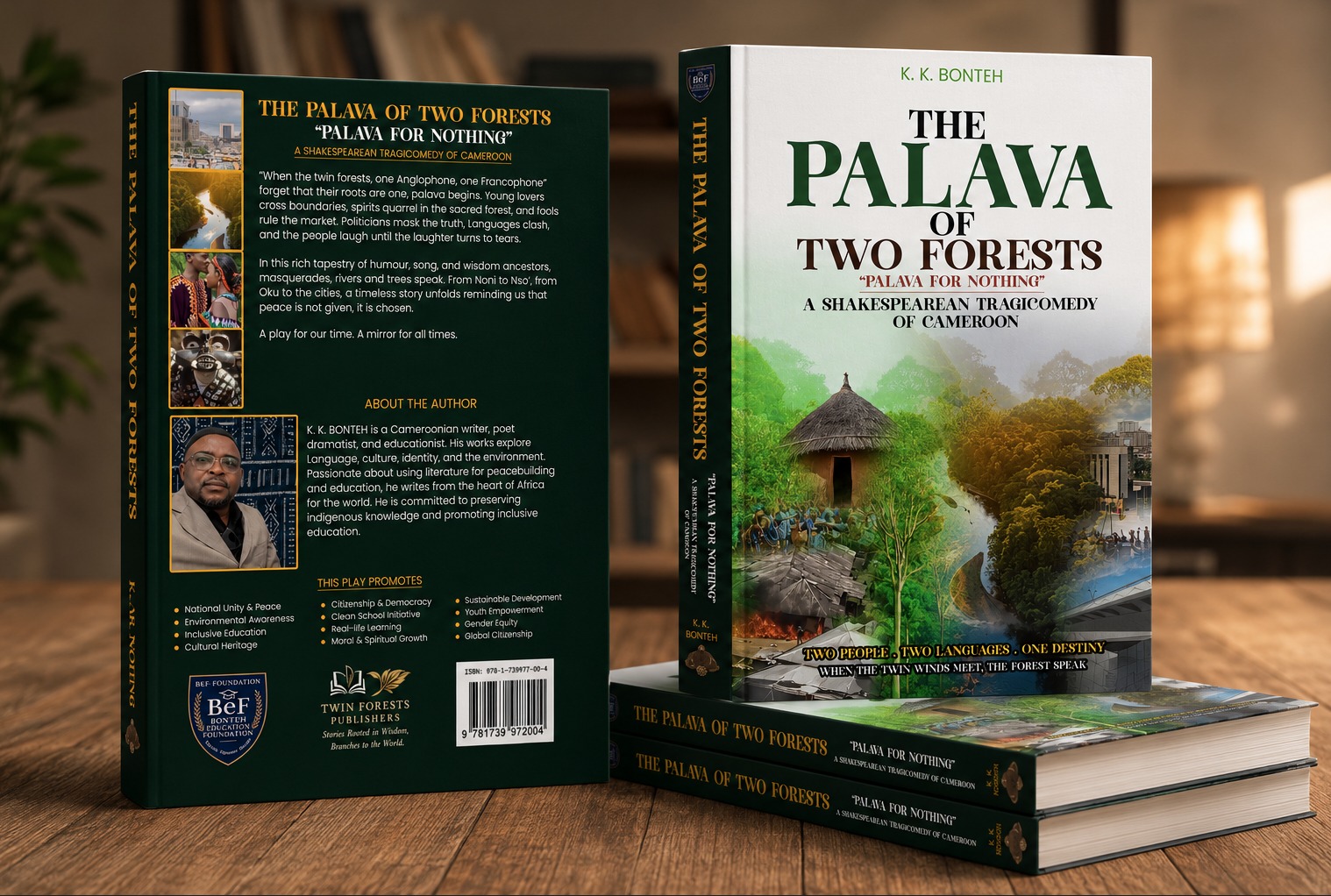
Description
Shakespeare gave us comedies that flirted with disaster before pulling back from the edge, and this Cameroonian tragicomedy play borrows that same nerve. The Palava of Two Forests, subtitled Palava for Nothing, comes from K.K. Bonteh and wears its theatrical ambition openly, staging a national wound as a story two warring villages can almost laugh their way through, if they choose to.
The premise is deceptively simple. Two neighboring forests, one Anglophone and one Francophone, share roots that stretch back generations. When that shared history gets buried under pride, suspicion, and old grudges dressed up as principle, what should be a minor disagreement curdles into something closer to war. This Cameroonian tragicomedy play never lets the audience forget that the conflict is, at bottom, a family argument that got dangerously out of hand.
The allegory lands because it is rooted in something real. Cameroon’s own Anglophone Crisis, a documented conflict between English-speaking and French-speaking regions that has reshaped the country’s politics since 2016, sits just beneath the surface of Bonteh’s twin forests. Readers familiar with that history will recognize every beat of the villages’ standoff, even as the play keeps its setting just fictional enough to let humor do work that straight reportage never could.
What keeps this Cameroonian tragicomedy play from tipping into pure tragedy is its commitment to comedy’s oldest trick: showing people their own absurdity until they can’t help but laugh. Bonteh fills the script with love stories that cross village lines, political posturing that collapses under its own weight, and language jokes that only land if you have lived inside Cameroon’s bilingual reality. Tears are never far away, but neither is the laugh that defuses them.
The play earns its ancestral texture honestly. Song, proverb, and oral storytelling run through every act, giving elders and ancestral voices real authority over the unfolding chaos rather than treating tradition as set dressing. Bonteh trusts these older forms to carry as much weight as any modern political speech, and the play is richer for refusing to choose between the two registers.
Identity is the quiet engine running under all the noise. Every character in this Cameroonian tragicomedy play is forced to answer some version of the same question: what do you owe the place you came from when it starts demanding things that hurt the people you love? Bonteh refuses easy answers, letting love, language, and political loyalty pull characters in different directions scene after scene, which is exactly what makes the eventual reconciliation feel earned rather than convenient.
None of this would land without the play’s central insight, delivered almost as a closing argument: peace is not given, it is chosen. That line does a lot of work across the script, reframing every act of stubbornness and every small kindness as a choice with consequences. Readers and theatre groups drawn to political drama, Shakespearean structure, or stories about bilingual identity will find a script that rewards close reading as much as a live performance. Drama teachers looking for material that handles real political weight without losing its sense of humor will find this an unusually flexible choice for the classroom or the stage. The two-forest structure also makes it easy to stage with a modest cast, splitting characters cleanly between the Anglophone and Francophone sides without requiring an enormous ensemble. That practicality, on top of the script’s emotional range, is part of why directors keep coming back to it.
The Palava of Two Forests joins the rest of K.K. Bonteh’s catalogue exploring Cameroonian identity, available through the full book collection at BEF Academy Publications. This Cameroonian tragicomedy play, equal parts comedy and warning, is available now for just 5,000 FCFA. Few scripts manage to be this funny and this serious at the same time, and that balance is exactly why audiences keep choosing peace by the final curtain.
Reviews
There are no reviews yet.