Description
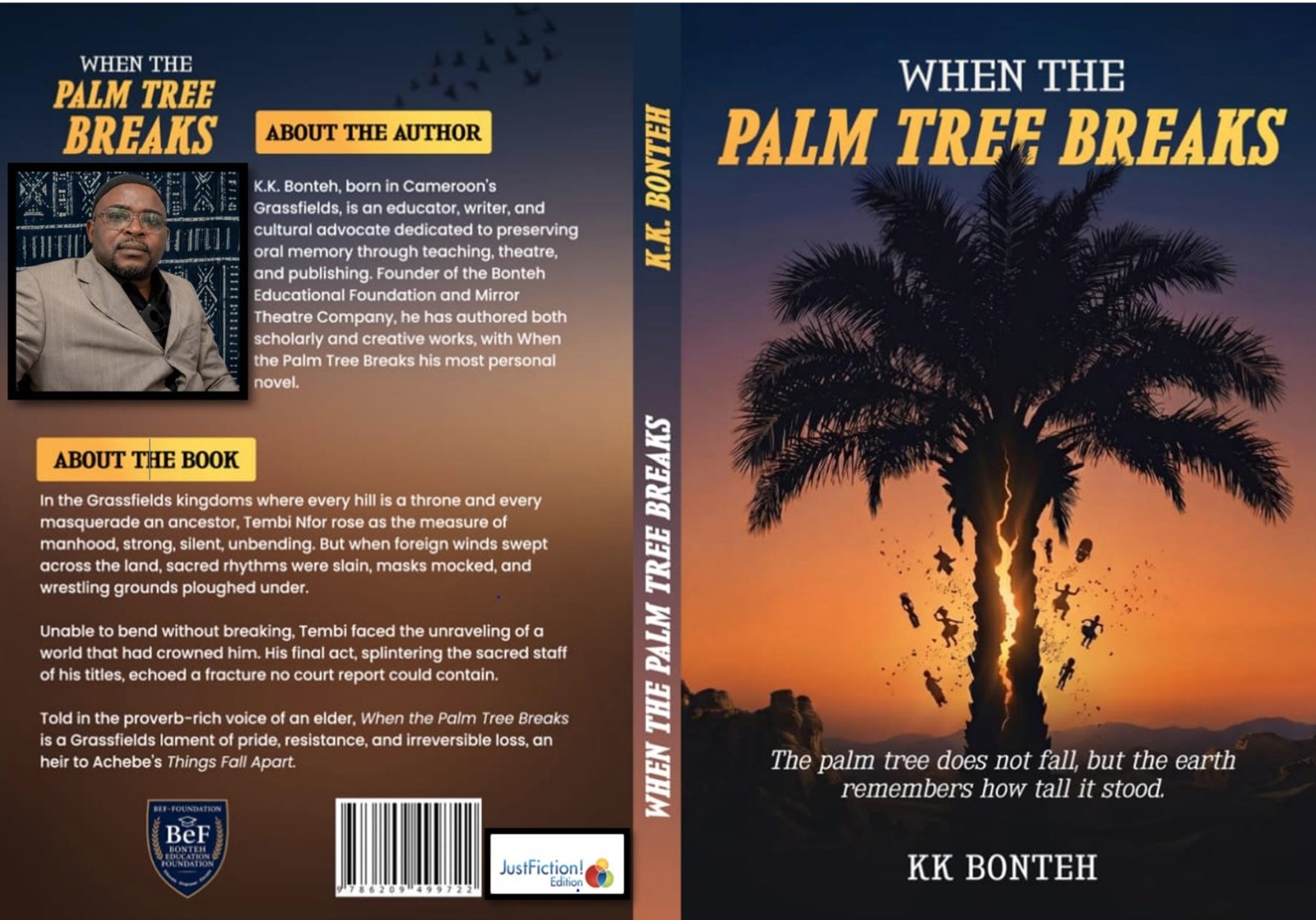
When the Palm Tree Breaks is the Grassfields novel critics are already calling a worthy heir to Achebe’s Things Fall Apart. Set in the Grassfields kingdoms of Cameroon, where every hill is a throne and every masquerade an ancestor, K. K. Bonteh traces the unraveling of Tembi Nfor, a man crowned by tradition and undone by its collapse.
Why This Grassfields Novel Echoes Achebe
Like [link “Things Fall Apart” to https://en.wikipedia.org/wiki/Things_Fall_Apart], this Grassfields novel asks what happens to a man, and a culture, when the rules that defined greatness suddenly stop applying. Tembi Nfor rose as the measure of manhood: strong, silent, unbending. When foreign winds swept across the land, sacred rhythms were silenced, masks mocked, and wrestling grounds ploughed under. Unable to bend without breaking, he faces the unraveling of a world that had once crowned him.
A Proverb-Rich Voice from the Grassfields
Bonteh tells the story in the voice of an elder, rich with proverb and ritual drawn from the [link “Grassfields” to https://en.wikipedia.org/wiki/Western_High_Plateau] tradition, capturing a fracture no court report could ever contain. It’s a novel that reads like inherited memory, not just narrative.
Pride, Resistance, and Irreversible Loss
This Grassfields novel doesn’t offer easy resolution. It sits with loss, with pride that refuses to bend, and with the cost of a world built on permanence meeting a force it was never built to survive. Readers looking for tidy endings should look elsewhere. Readers looking for truth will find it here.
Who Should Read This Book
Fans of Chinua Achebe, readers of African literature and postcolonial fiction, and anyone drawn to stories of cultural collision will find this Grassfields novel impossible to put down. It pairs naturally with other titles in BEF Academy Publications’ book collection
Available now from BEF Academy Publications for 5,000 FCFA. The palm tree does not fall, but the earth remembers how tall it stood.
BefAcademy –
Your re𝗧𝗵𝗲 𝗟𝗮𝗻𝗴𝘂𝗮𝗴𝗲 𝗼𝗳 𝘁𝗵𝗲 𝗟𝗮𝗻𝗱: 𝗘𝗰𝗼𝗹𝗶𝗻𝗴𝘂𝗶𝘀𝘁𝗶𝗰𝘀 𝗮𝗻𝗱 𝗢𝗻𝗼𝗺𝗮𝘀𝘁𝗶𝗰𝘀 𝗶𝗻 𝗞.𝗞. 𝗕𝗼𝗻𝘁𝗲𝗵’𝘀 When the Palm Tree Breaks
Abstract
K.K. Bonteh’s When the Palm Tree Breaks constitutes an outstanding contemporary contribution to African literary discourse through its remarkable integration of ecolinguistics and onomastics. Beyond functioning as a historical novel or African tragedy, the text demonstrates how language, names, landscapes, flora, fauna, ritual spaces, and indigenous ecological knowledge interact to produce meaning. Set within the Grassfields of Cameroon during the transition from German to British colonial administration, the novel presents nature not merely as physical environment but as an active linguistic participant in cultural identity, historical memory, and spiritual continuity. Likewise, personal names, place names, ritual titles, animal symbolism, and institutional nomenclature constitute semantic systems through which social hierarchy, morality, cosmology, and resistance are articulated. This paper argues that Bonteh’s novel represents an exemplary African ecolinguistic text in which environmental discourse and indigenous naming traditions become inseparable components of narrative aesthetics. Through close textual analysis, the study demonstrates that ecological vocabulary and onomastic structures function simultaneously as literary devices, repositories of indigenous knowledge, and instruments of cultural preservation.
𝗜𝗻𝘁𝗿𝗼𝗱𝘂𝗰𝘁𝗶𝗼𝗻
Recent developments in literary criticism have witnessed increasing scholarly interest in ecolinguistics, the study of relationships between language and the ecological world (Stibbe, 2021), and onomastics, the scientific study of names and naming systems (Crystal, 2010).
African literature has traditionally embodied these disciplines long before they emerged as formal academic fields. African societies have always regarded language as inseparable from land, while names function not merely as labels but as repositories of history, spirituality, genealogy and communal philosophy.
K.K. Bonteh’s When the Palm Tree Breaks exemplifies this literary tradition with remarkable sophistication. The novel transforms the Grassfields landscape into a living discourse community where mountains speak, rivers remember, sacred groves judge, trees prophesy, animals communicate ancestral wisdom, and every personal or geographical name carries profound semantic significance.
Rather than employing nature as scenic decoration, Bonteh allows ecological elements themselves to become participants in the unfolding tragedy of colonial disruption. The novel therefore deserves recognition not merely as historical fiction but as an exemplary work of African ecolinguistic and onomastic literature.
𝗘𝗰𝗼𝗹𝗶𝗻𝗴𝘂𝗶𝘀𝘁𝗶𝗰𝘀 𝗮𝘀 𝘁𝗵𝗲 𝗡𝗮𝗿𝗿𝗮𝘁𝗶𝘃𝗲 𝗙𝗼𝘂𝗻𝗱𝗮𝘁𝗶𝗼𝗻
According to Arran Stibbe (2021), ecolinguistics investigates how language shapes humanity’s relationship with ecosystems.
Bonteh’s novel demonstrates this relationship throughout its narrative.
The very title,
When the Palm Tree Breaks
is itself an ecolinguistic statement.
The palm tree transcends botanical identity to become a metaphor for:
• civilisation;
• indigenous governance;
• masculinity;
• ancestral continuity;
• political stability;
• collective memory.
Its breaking symbolises ecological, cultural and historical collapse simultaneously.
This ecological metaphor governs the architecture of the entire narrative.
The recurring proverb,
“When the palm tree breaks, even the parrot that lives in its crown has nowhere to perch,”
illustrates ecological interdependence.
The destruction of one species automatically destabilises the survival of another.
Ecological balance becomes identical with social balance.
Language therefore constructs environmental relationships as moral relationships.
𝗧𝗵𝗲 𝗚𝗿𝗮𝘀𝘀𝗳𝗶𝗲𝗹𝗱𝘀 𝗮𝘀 𝗮 𝗟𝗶𝘃𝗶𝗻𝗴 𝗗𝗶𝘀𝗰𝗼𝘂𝗿𝘀𝗲
One remarkable ecolinguistic feature is the personification of landscape.
Throughout the novel,
• hills remember;
• rivers listen;
• trees witness;
• forests judge;
• wind carries history;
• mist conceals ancestral memory.
Nature possesses agency.
The opening chapters repeatedly describe the hills as speaking names back to their inhabitants, thereby transforming geography into language itself.
The narrator writes that
“the hills carried our names in their mouths.”
Such ecological personification reflects indigenous African cosmology where nature is neither object nor property but living relative.
𝗧𝗵𝗲 𝗦𝗮𝗰𝗿𝗲𝗱 𝗚𝗿𝗼𝘃𝗲 𝗮𝘀 𝗘𝗰𝗼𝗹𝗶𝗻𝗴𝘂𝗶𝘀𝘁𝗶𝗰 𝗦𝗽𝗮𝗰𝗲
The sacred grove functions simultaneously as:
• religious sanctuary;
• judicial institution;
• historical archive;
• educational classroom;
• ecological reserve.
Language surrounding the grove consistently evokes reverence rather than ownership.
Characters never “enter” casually.
They approach.
They receive permission.
They perform ritual.
This linguistic framing reflects indigenous conservation ethics.
The grove survives because language itself defines it as sacred.
𝗙𝗹𝗼𝗿𝗮 𝗮𝗻𝗱 𝗙𝗮𝘂𝗻𝗮 𝗮𝘀 𝗦𝘆𝗺𝗯𝗼𝗹𝗶𝗰 𝗟𝗲𝘅𝗶𝗰𝗼𝗻
Virtually every natural element acquires symbolic meaning.
Examples include:
Ecological Symbol Literary Meaning
Palm tree Cultural continuity
Python Ancestral authority
Eagle feathers Honour and leadership
Harmattan Spiritual barrenness
Locusts Colonial disruption
Mist Historical uncertainty
Red earth Identity and ancestry
Palm wine Community and covenant
Forest Spiritual threshold
Rather than functioning descriptively, these ecological lexemes become narrative vocabulary through which cultural philosophy is communicated.
𝗢𝗻𝗼𝗺𝗮𝘀𝘁𝗶𝗰𝘀 𝗶𝗻 𝘁𝗵𝗲 𝗡𝗼𝘃𝗲𝗹
Equally significant is Bonteh’s sophisticated deployment of names.
Onomastics recognises names as cultural texts rather than arbitrary labels.
African naming traditions especially encode biography, genealogy and social expectations.
Bonteh faithfully reproduces this tradition.
𝗣𝗲𝗿𝘀𝗼𝗻𝗮𝗹 𝗡𝗮𝗺𝗲𝘀 𝗮𝘀 𝗖𝘂𝗹𝘁𝘂𝗿𝗮𝗹 𝗦𝗶𝗴𝗻𝘀
Characters such as
• Tembi Nfor
• Nfor
• Nyuyfon
• Nzeke
• Manka Nfuancho
• Shey Lukong
• Pa Ndzu
• Fonjuh
are not randomly named.
Each reflects indigenous Grassfields linguistic structures.
Their phonological patterns immediately identify cultural origin while simultaneously reinforcing ethnic authenticity.
Names become markers of belonging.
𝗧𝗶𝘁𝗹𝗲𝘀 𝗮𝘀 𝗢𝗻𝗼𝗺𝗮𝘀𝘁𝗶𝗰 𝗜𝗱𝗲𝗻𝘁𝗶𝘁𝘆
Traditional titles further enrich the novel’s onomastic system.
Examples include:
• Fon
• Shey
• Kwifor
• Ngam
• Title-holder
• Medicine Man
These institutional names establish authority structures rooted in indigenous political organisation.
Unlike colonial titles,
these derive legitimacy from ancestral tradition rather than external administration.
𝗣𝗹𝗮𝗰𝗲 𝗡𝗮𝗺𝗲𝘀 (𝗧𝗼𝗽𝗼𝗻𝘆𝗺𝘆)
The fictional chiefdom of Ntambesi functions as far more than setting.
It represents:
• ancestral homeland;
• political centre;
• ecological identity;
• historical memory.
Other geographical names similarly preserve cultural geography.
Rather than employing generic “African village” descriptions, Bonteh creates linguistically authentic toponyms rooted in Grassfields phonology.
This enhances geographical realism while preserving indigenous spatial consciousness.
𝗥𝗶𝘁𝘂𝗮𝗹 𝗢𝗯𝗷𝗲𝗰𝘁𝘀 𝗮𝘀 𝗢𝗻𝗼𝗺𝗮𝘀𝘁𝗶𝗰 𝗦𝘆𝗺𝗯𝗼𝗹𝘀
Several ritual objects function almost as named characters.
Among them:
• the Ngam Staff;
• the Sacred Python;
• the Kwifor House;
• the Sacred Stream;
• the Palm Wine Calabash.
Each possesses a culturally recognised identity.
Their repeated naming constructs symbolic continuity across the narrative.
𝗘𝗰𝗼𝗹𝗶𝗻𝗴𝘂𝗶𝘀𝘁𝗶𝗰𝘀 𝗮𝗻𝗱 𝗢𝗻𝗼𝗺𝗮𝘀𝘁𝗶𝗰𝘀 𝗶𝗻 𝗗𝗶𝗮𝗹𝗼𝗴𝘂𝗲
Perhaps Bonteh’s greatest achievement lies in merging both disciplines.
Names emerge from ecology.
Ecology is interpreted through names.
Examples include:
• Palm Tree → civilisation.
• Python-Killer → identity through ecological encounter.
• The Root Remembers → botanical metaphor becoming historical philosophy.
• The Parrot Has Nowhere to Perch → ecological imagery expressing political exile.
• The Church That Swallowed the Sacred Python → ecological destruction signalling religious conquest.
Thus, names and environmental symbols operate as a single semantic network.
𝗜𝗻𝗱𝗶𝗴𝗲𝗻𝗼𝘂𝘀 𝗞𝗻𝗼𝘄𝗹𝗲𝗱𝗴𝗲 𝗮𝘀 𝗘𝗰𝗼𝗹𝗶𝗻𝗴𝘂𝗶𝘀𝘁𝗶𝗰 𝗗𝗶𝘀𝗰𝗼𝘂𝗿𝘀𝗲
The novel also preserves indigenous ecological knowledge.
Readers encounter traditional understandings concerning:
• medicinal plants;
• sacred forests;
• wildlife symbolism;
• agricultural seasons;
• ritual ecology;
• environmental ethics;
• ecological taboos.
Such knowledge is embedded naturally within narrative rather than presented ethnographically.
Consequently, literature becomes a repository of environmental heritage.
𝗖𝗼𝗹𝗼𝗻𝗶𝗮𝗹𝗶𝘀𝗺 𝗮𝘀 𝗟𝗶𝗻𝗴𝘂𝗶𝘀𝘁𝗶𝗰 𝗮𝗻𝗱 𝗘𝗰𝗼𝗹𝗼𝗴𝗶𝗰𝗮𝗹 𝗗𝗶𝘀𝗿𝘂𝗽𝘁𝗶𝗼𝗻
Colonialism in the novel does not merely occupy territory.
It renames.
It reclassifies.
It desacralises.
The sacred python becomes superstition.
The sacred grove becomes wasteland.
The Ngam Staff becomes curiosity.
Traditional names lose official legitimacy.
This renaming represents ecological violence.
Language itself becomes an instrument of colonial domination.
Bonteh therefore demonstrates that environmental destruction and linguistic imperialism proceed together.
𝗦𝘁𝘆𝗹𝗶𝘀𝘁𝗶𝗰 𝗔𝗰𝗵𝗶𝗲𝘃𝗲𝗺𝗲𝗻𝘁
Stylistically, Bonteh employs:
• proverbial discourse;
• ecological metaphors;
• repetitive natural imagery;
• indigenous lexical borrowing;
• symbolic naming;
• ceremonial diction;
• oral narrative rhythm.
These stylistic choices reinforce both ecolinguistic and onomastic coherence.
The novel speaks with what may be called an ecological African voice, in which every linguistic choice reflects environmental consciousness.
𝗖𝗼𝗻𝗰𝗹𝘂𝘀𝗶𝗼𝗻
K.K. Bonteh’s When the Palm Tree Breaks should be recognised as one of the most significant recent examples of African ecolinguistic and onomastic fiction. Far beyond recounting the tragic encounter between indigenous Grassfields society and colonialism, the novel demonstrates that language, landscape, and naming practices constitute a unified cultural ecology. Trees, rivers, hills, animals, sacred spaces, ritual objects, and indigenous names function as repositories of memory and identity, revealing that the destruction of ecosystems is inseparable from the erosion of language and culture. By weaving ecological symbolism with culturally resonant naming systems, Bonteh not only preserves the linguistic heritage of the Cameroonian Grassfields but also enriches contemporary African literary scholarship. When the Palm Tree Breaks therefore stands as a compelling model for future studies in African ecocriticism, ecolinguistics, onomastics, ethnolinguistics, and indigenous literary studies, affirming that in African aesthetics, to name the land is to remember the people, and to remember the people is to preserve the land.
𝗦𝗲𝗹𝗲𝗰𝘁𝗲𝗱 𝗥𝗲𝗳𝗲𝗿𝗲𝗻𝗰𝗲𝘀
Bonteh, K. K. (2025). When the Palm Tree Breaks. BEF Academy / JustFiction Edition.
Crystal, D. (2010). The Cambridge Encyclopedia of Language. Cambridge University Press.
Fill, A., & Penz, H. (Eds.). (2018). The Routledge Handbook of Ecolinguistics. Routledge.
Nash, J. (2016). The Routledge Handbook of Language and Ecology. Routledge.
Stibbe, A. (2021). Ecolinguistics: Language, Ecology and the Stories We Live By (2nd ed.). Routledge.
Widdowson, H. G. (2004). Text, Context, Pretext. Blackwell.
Achebe, C. (1958). Things Fall Apart. Heinemann.
Ngũgĩ wa Thiong’o. (1986). Decolonising the Mind. James Currey.
Halliday, M. A. K. (2001). “New Ways of Meaning: The Challenge to Applied Linguistics.” In The Ecolinguistics Reader.
Hough, C. (Ed.). (2016). The Oxford Handbook of Names and Naming. Oxford University Press.
view