
From Oral Tradition to National Reconciliation: A Literary Analysis of The Twin Thrones as Docu-Historical Drama and a Blueprint for Peacebuilding in Contemporary Cameroon
By a Literary Analyst, Bonteh Education Foundation (BEF)
ABSTRACT
K. K. Bonteh’s The Twin Thrones: A Royal Dance Drama of Succession, Exile and Reconciliation in Djottin is a remarkable contribution to contemporary African dramatic literature, blending oral tradition, historical memory, ritual performance and political philosophy into a compelling docu-historical drama. Inspired by the oral traditions of the Noni people of Cameroon, the play reconstructs a succession crisis that threatens the unity of a kingdom but ultimately culminates in an innovative and peaceful solution. This paper examines the drama’s literary architecture, thematic concerns, characterisation, symbolism and stylistic features while paying particular attention to its nature as a docu-historical text. It further explores the play’s relevance to contemporary socio-political challenges in Cameroon and argues that Bonteh offers a culturally grounded model for dialogue, reconciliation and nation-building. The study concludes that The Twin Thrones transcends regional history to become a national and global meditation on peaceful coexistence.
Keywords: Docu-historical drama, Noni oral tradition, reconciliation, governance, conflict resolution, Cameroon, African theatre, nation-building.
INTRODUCTION
African literature has long served as a repository of communal memory and a vehicle for social reflection. From the ritual theatre of traditional societies to the political dramas of modern playwrights, African writers have consistently transformed historical experiences into artistic narratives capable of illuminating contemporary realities. In this tradition, K. K. Bonteh’s The Twin Thrones emerges as a significant cultural and literary intervention. Inspired by oral traditions associated with Djottin and the wider Noni cultural area, the play recounts a succession dispute between two royal brothers whose competing claims threaten the stability of a kingdom before wisdom ultimately triumphs over ambition.
The work recalls the historical consciousness found in Things Fall Apart, the ritual dimensions of Death and the King’s Horseman, and the political symbolism of The Trial of Dedan Kimathi. Yet Bonteh’s drama remains distinct in its emphasis on reconciliation rather than tragedy, making it both culturally specific and universally relevant.
PLOT SYNOPSIS
The drama unfolds in the prosperous kingdom of Djottin, where the ageing Fon, Ngam Kinengti, presides over a stable and flourishing society. Beneath the apparent tranquillity, however, signs of an approaching crisis emerge. The Fon recognises that his life is drawing to a close and worries about the future of the kingdom, particularly because his rightful heir, the elder prince Ngam Nfonti, remains far from home beyond the mountains.
When the Fon eventually dies, the kingdom is confronted with a constitutional dilemma. The rightful successor is absent. The throne cannot remain vacant indefinitely. Faced with mounting uncertainty and pressure to preserve political stability, the kingmakers take a controversial decision: they install the younger prince upon the throne. Their action is motivated not by malice but by necessity. Nevertheless, it creates a situation in which legitimacy and authority become separated.
The crisis intensifies when Ngam Nfonti finally returns and discovers that the throne of his ancestors is occupied. The kingdom now faces a potentially catastrophic conflict. Yet in one of the most remarkable moments in the drama, the elder prince refuses to plunge his people into civil war. Instead, he chooses exile and sacrifice, placing communal peace above personal ambition.
The consequences of the unresolved succession crisis soon manifest themselves symbolically and materially. The rains fail. Crops wither. Fear spreads throughout the kingdom. Bonteh presents nature itself as participating in the moral disorder of society. The drought becomes a metaphor for division and unresolved grievance.
As suffering deepens, the women of Emmamm, the Council of Elders, the Chief Priest and other traditional institutions intervene. Through dialogue, reflection and sacred consultation at La Diam, the kingdom seeks guidance from both wisdom and tradition. Eventually, a solution emerges that preserves both legitimacy and stability: the creation of a second fondom, Nfonti, under the leadership of the elder prince.
What began as a succession dispute culminates in a political innovation. Two thrones emerge where previously there had been one. Yet rather than dividing the people, this arrangement restores harmony. The twin coronation, the covenant of brotherhood and the return of rain symbolise the triumph of reconciliation over rivalry.
The drama concludes with a powerful epilogue in which the Griot addresses contemporary Cameroon and the wider world, reminding audiences that the story of Djottin is ultimately the story of every society confronted with the choice between division and peace.
THE PLAY AS DOCU-HISTORICAL DRAMA
Perhaps the most distinctive feature of The Twin Thrones is its identity as a docu-historical drama. Bonteh explicitly states that the work is inspired by oral traditions preserved by the people of Djottin and Noni rather than by written archives alone. The play occupies a productive space between history, legend, memory and theatrical imagination.
Unlike conventional historical dramas that attempt strict factual reconstruction, docu-historical drama seeks to dramatise the deeper meanings embedded within historical memory. Bonteh acknowledges that some scenes, dialogues and characters have been imaginatively reconstructed, yet the spirit of the historical narrative remains intact. The result is a dramatic text that preserves indigenous knowledge while rendering it accessible to contemporary audiences.
In this respect, the playwright performs an act of cultural preservation. Oral histories that might otherwise remain confined to local memory are transformed into a literary artefact capable of entering classrooms, theatres and scholarly discourse. The drama thus becomes both archive and performance, history and interpretation.
HISTORICAL BACKGROUND AND CULTURAL CONTEXT
The setting of the play is the traditional polity of Djottin within the Noni cultural area of Cameroon. The kingdom is presented as a sophisticated society governed through institutions such as the Fon, kingmakers, councils of elders, ritual authorities and women’s organisations. These structures reveal an indigenous political system that challenges simplistic assumptions about precolonial African governance.
The succession crisis begins when the ageing Fon, Ngam Kinengti, dies before the return of his rightful heir, Ngam Nfonti. Faced with uncertainty, the kingmakers crown the younger brother. When the elder prince eventually returns, the kingdom becomes trapped between legitimacy and practicality, tradition and necessity. This tension drives the entire dramatic action.
Historically, succession disputes have destabilised kingdoms across Africa, Europe and Asia. Bonteh’s genius lies in demonstrating how indigenous institutions developed creative mechanisms for conflict resolution long before the emergence of modern constitutional systems.
THEMATIC CONCERNS
The dominant theme is reconciliation. Unlike many succession dramas that culminate in warfare, Bonteh’s narrative moves toward dialogue, compromise and coexistence.
Another important theme is leadership and responsibility. The play repeatedly insists that authority exists to serve the people rather than the reverse. The dying Fon’s declaration that “the throne exists for the people” becomes a guiding principle for the drama’s moral universe.
The themes of legitimacy, sacrifice, memory, peacebuilding, community, and nation-building also run throughout the text. The drought that afflicts the kingdom symbolises social fragmentation, while the return of rain signifies restored harmony.
CHARACTERISATION
Bonteh’s characters function simultaneously as individuals and symbols.
Ngam Nfonti
The elder prince embodies restraint, dignity and sacrifice. Rather than initiate civil war, he chooses exile, becoming a symbol of statesmanship and moral courage.
Ngam Kinengti II
The younger brother represents duty and responsibility. Though crowned under controversial circumstances, he remains committed to the welfare of the kingdom.
The Queen Mother
She functions as the emotional and moral centre of the play, embodying wisdom, compassion and continuity.
Dikang
One of the most memorable figures, Dikang resembles Shakespeare’s Fool. Through humour and satire, he exposes uncomfortable truths. His wit recalls the Fool in King Lear, whose apparent foolishness conceals profound insight.
The Women of Emmamm
These women emerge as powerful agents of peace, demonstrating the crucial role of women in conflict transformation and communal healing.
STYLE AND DRAMATIC TECHNIQUES
Bonteh employs a rich blend of dramatic modes.
The prose is elevated and ceremonial, particularly during royal speeches and council debates. Poetry emerges during coronations, prophecies and invocations, giving the drama an epic quality.
The play also integrates:
- Proverbs;
- Aphorisms;
- Choral songs;
- Ritual performance;
- Dance narratives;
- Symbolic imagery.
The recurring proverb, “When brothers quarrel, strangers inherit the harvest,” encapsulates the central warning of the text.
The use of dance is particularly significant. Traditional forms such as NDA, Mungaka and Emmamm are not decorative additions but narrative devices that communicate history, identity and communal values.
CONTEMPORARY RELEVANCE TO CAMEROON
Perhaps the greatest achievement of The Twin Thrones lies in its contemporary relevance.
Cameroon continues to grapple with challenges relating to national integration, identity, governance, social cohesion and conflict resolution. Without reducing the play to political allegory, it is difficult to ignore the parallels between the divisions represented in Djottin and the tensions experienced in modern societies.
The kingdom’s crisis arises because different groups insist upon competing truths. Yet peace becomes possible only when all parties acknowledge one another’s legitimacy and create space for coexistence.
This lesson is profoundly relevant to Cameroon today.
Bonteh suggests that sustainable peace cannot emerge from victory alone. It requires inclusion, dialogue and imagination. The creation of Nfonti alongside Djottin demonstrates an indigenous model of constitutional innovation in which competing interests are reconciled without violence.
In this sense, the play offers more than literary enjoyment; it offers a framework for civic reflection.
A CALL TO ACTION
At a time when many societies remain trapped in cycles of division, The Twin Thrones reminds us that peace is neither accidental nor passive. It is a deliberate act of wisdom.
Educators should teach it.
Students should study it.
Theatre groups should perform it.
Policymakers should reflect upon its lessons.
Community leaders should engage with its message.
Most importantly, citizens should recognise that reconciliation remains one of humanity’s greatest achievements.
The story of Djottin belongs to Noni.
Its wisdom belongs to Cameroon.
Its lesson belongs to the world.
ABOUT THE AUTHOR
K. K. Bonteh
K. K. Bonteh is a Cameroonian educator, playwright, researcher, cultural advocate and literary innovator. He serves as Regional Pedagogic Inspector for the Teaching and Promotion of Bilingualism and is the Founder and Executive Director of the Bonteh Education Foundation (BEF) and BEF Academy. His work spans education, literature, theatre, peace studies, language development and cultural preservation.
Drawing extensively upon indigenous knowledge systems, oral traditions and African performance cultures, Bonteh has dedicated much of his scholarship and creative writing to documenting and promoting Cameroon’s cultural heritage while advancing contemporary conversations on education, leadership and nation-building.
PRE-ORDER INFORMATION
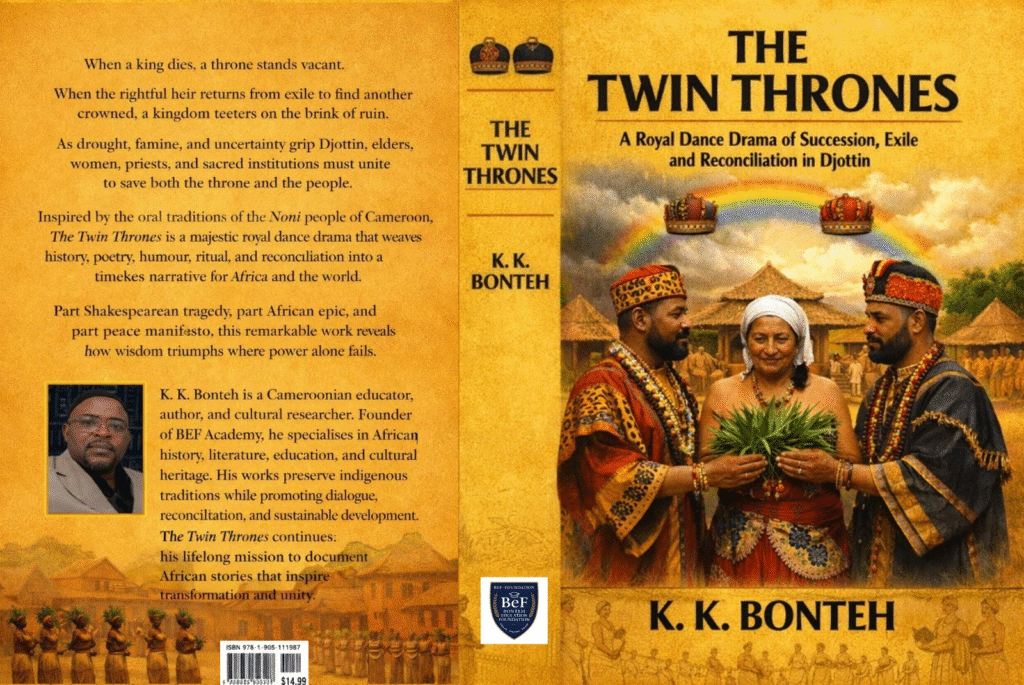
The Twin Thrones
A Royal Dance Drama of Succession, Exile and Reconciliation in Djottin
Readers, schools, libraries, universities, cultural institutions and theatre companies may pre-order print copies under BEF Academy Publications’ Print-on-Demand (POD) Programme.
For institutional orders, academic adoption, performance rights enquiries and distribution partnerships, contact:
BEF Academy Publications
P.O. Box 31772, Yaoundé, Cameroon
Email: info@befacademy.org
Email: kkbonteh@befacademy.org
Tel/WhatsApp: +237 677 53 42 47
WORKS CITED
Things Fall Apart. London: Heinemann, 1958.
Bonteh, K. K. The Twin Thrones: A Royal Dance Drama of Succession, Exile and Reconciliation in Djottin. Yaoundé: BEF Academy Publications, 2026.
Death and the King’s Horseman. London: Methuen, 1975.
King Lear. London: 1608.
The Trial of Dedan Kimathi. London: Heinemann, 1976.
Turner, Victor. From Ritual to Theatre: The Human Seriousness of Play. New York: PAJ Publications, 1982.
Schechner, Richard. Performance Theory. New York: Routledge, 2003.
Finnegan, Ruth. Oral Literature in Africa. Cambridge: Open Book Publishers, 2012.