
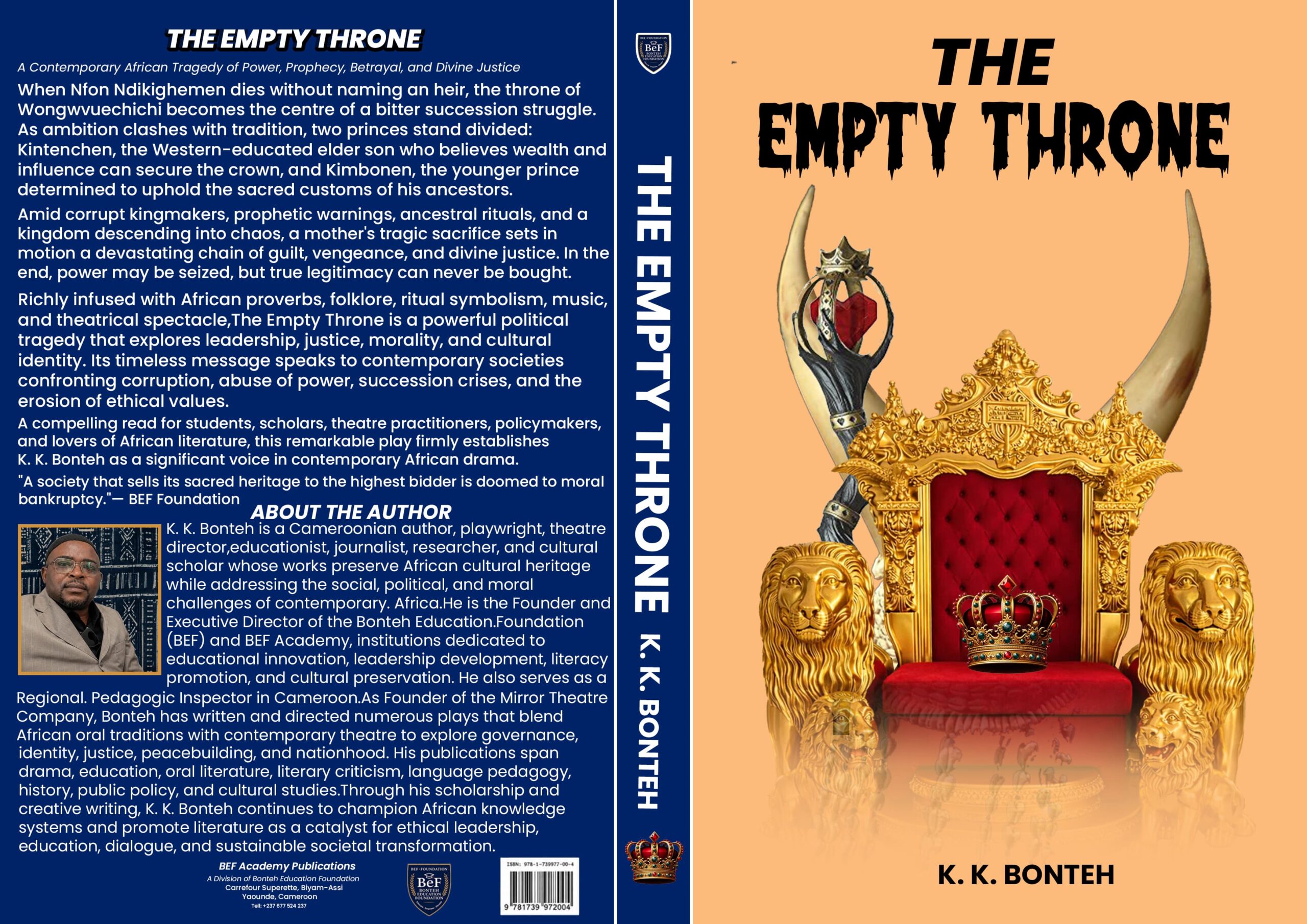
Description
African political tragedy book by K K Bonteh presents a powerful story that explores leadership, tradition, and the consequences of power in an African setting. From the opening pages, this African political tragedy book draws readers into a world shaped by prophecy, cultural expectations, and political ambition.
This African political tragedy book focuses on the realities of governance and the impact of corruption on society. It reflects situations that many African communities understand, where leadership decisions shape the lives of ordinary people. The story connects traditional values with modern political struggles, creating a narrative that feels both authentic and relevant.
One of the defining elements of this African political tragedy book is its exploration of leadership and legitimacy. It raises important questions about what happens when power is taken without moral authority. Through its characters, the story shows how ambition and disregard for cultural values can lead to conflict and eventual consequences.
Readers who enjoy African literature will find strong cultural depth in this African political tragedy book. Tradition plays an important role in shaping events and guiding decisions. The story shows that culture is not separate from leadership but deeply connected to it, and ignoring it can lead to disorder.
Justice is another key theme in this African political tragedy book. The narrative makes it clear that actions have consequences, and that even those in power are not beyond accountability. This creates tension and keeps readers engaged as the story develops.
This African political tragedy book is also ideal for readers interested in political storytelling. It offers insight into leadership challenges, ethical dilemmas, and the balance between power and responsibility. It is a story that goes beyond entertainment and speaks to real societal issues.
As a digital edition, this African political tragedy book is available for instant access. Readers can download it immediately after purchase and begin reading without delay. This makes it convenient for students, professionals, and anyone interested in African stories.
If you are looking for a meaningful and engaging story, this African political tragedy book by K K Bonteh is a strong choice. It combines culture, politics, and storytelling in a way that feels real and impactful.
BefAcademy –
Your reviewINTRODUCTION
Review of KK Bonteh’s The Empty Throne
A) Overall critical perspectives
In recent years, the most recurrent subjects in contemporary African drama have gradually changed from conflict between the western culture and the African culture to the conflict between men and their ancestors and gods perpetuated by greedy and corrupt kingmakers against the background of a morally decaying society. Such is the decry of Peter Chesami in his play titled And The People Cried, “The Kwifor Must Go!” , in Bole Butake’s two plays titled And Palm Wine Will Flow and Family Saga, in Ola Rotimi’s play titled The Gods Are Not To Blame, and in Kofon Killian Bonteh’s play titled The Empty Throne. Apart from the celebration of African tradition and ancestry, other modern African plays deal with socio-political and economic subjects like Wole Soyinka’s The Strong Breed, Ayang Frederick’s A Woman Spoke, Oscar Chenyi Labang’s The Trial of Bate Besong, Takwi Mathew’s Gaining The Game, Anne Tanyi Tang’s Ewa and other Plays, Elime Musinga’s The Tragedy of Mr. No Balance and Babila Mutia’s Before This Time Yesterday.
This notwithstanding, the greatest challenge of contemporary African playwrights in general and of Anglophone Cameroonian playwrights in particular is for them to take their audience away from their respective places of birth and entertain them with landscapes and experiences in a completely different environment like Shakespeare does in one of his plays titled The Merchant of Venice which is set in Italy rather than in Britain where he was born and bred. Travelling without and within enriches and enlarges artistic beauty.
B) Executive summary of the play The Empty Throne
K.K Bonteh’s The Empty Throne is about the double-edged malediction which befalls a mother (Winto) and one of her sons (Kintenchen) being the aftermath of the latter’s self-enthronement as the wrongful heir to the empty throne of Wongwvuechichi. The former Nfon; Nfon Ndikighemen makes the fatal error of dying without naming his next of kin. This sows the seeds of discord between his two sons; Kimbonen the younger and Kintenchen the elder. The latter is more educated than the former, and has lived and studied abroad for a long time. Although not conversant with the culture, custom and tradition of his land, Kintenchen imposes himself as the heir to the throne by using all means possible. He bribes one of the kingmakers; Tanto Kinlesen to speak on his behalf, forward his ‘candidature’ and persuade the other kingmakers to enthrone him. When they consult the Chief-Priest of Nyo-mbom; Ejise-Wong to tell them who is the rightful heir to the throne, he speaks in parables. Reading the fortune-teller’s message between the lines, it is understood that the rightful heir is Kimbonen, and his elder brother’s malignant ambition will lead to the tragic deaths of a male and a female in the land.
When the kingmakers finally proclaim Kimbonen as king, Kintenchen is mad with anger and fury. He chases them away and crowns himself as the king of Wongwvuechichi; an imaginary Fondom in Cameroon. His mother forewarns him to step down but he refuses. She commits suicide, and his younger brother charges him with matricide. While Kinlesen lavishes praises on the pseudo-king, his fellow kingmakers condemn him in very strong terms. An instant malediction befalls Kintenchen – his stomach swells to bursting point, and he dies. The chorus accuses Kinlesen for killing the self-crowned king. Four months later, the people crown their rightful king; Kimbonen amidst thunderous applause and festive jubilation. In his enthronement speech, the new king promises lasting peace in the land, and solicits a good harvest and blessings from the ancestors and gods of Wongwvuechichi.
C) African cultural background resources in the play
Perhaps the most peculiar characteristic of African drama which distinguishes it from western drama is the exceeding use of proverbs and wise saying by the playwright. K. K Bonteh’s The Empty Throne is baptised with proverbs and wise sayings, and one of the longest and most attractive of all is the following extract from the prophesies of Nyo-mbom:
It is not height that rules,
For if it were height,
Trees and mountains
Would have been kings over men.
It is not size that rules,
For if it were size,
Elephants and whales
Would have been kings over men.
It is not book that rules,
For if it were book,
Encyclopedias and dictionaries
Would have been kings over men.
But it is common sense that rules,
That is why lions and tigers
Have failed where tortoises have succeeded. (P. 3)
Similarly, when one of the kingmakers; Nkene is describing the choice of the heir to the empty throne, he says:
It is not just as easy as swallowing pounded cocoyams with okru-soup, but as difficult as eating fish with too many bones in it. (P. 26)
Also, when Nseisi removes a cola nut from his bag in the same situation above and shares it round to his colleagues, he says:
Our elders used to say, any man who carries
a calabash of wine to a death ceremony
and does not take with him cola nut
is like the man who wants a woman
without a house (P. 27)
Another unique peculiarity of African drama is the consultation of fortune-tellers. In Ola Rotimi’s The Gods Are Not To Blame, the Oracle at the Shrine of Orunmila is consulted to tell the cause of the curse in the land. Similarly, in K. K Bonteh’s The Empty Throne, the kingmakers consult the Chief-Priest of Nyo-mbom to tell them the rightful heir to the throne of Wongwvuechichi.
D) Thematic resources in the play
The theme of bribery and corruption which has eaten into the fabric of present-day African society reigns supreme in The Empty Throne. On the one hand, Kintenchen has returned from abroad with a heavy bank account while on the other hand, Kinlesen is a greedy and hungry kingmaker who is out to betray his colleagues in exchange for money. With his pockets full of new bank notes from this crooked source, he is the first person to proclaim Kintenchen the rightful heir to the throne. Against this manipulation, Ejise-Wong laments:
Because of ambition, materialism and duplicity,
Wongwvuechichi throne is going
to be stained with human blood.
Because of blackmail, bribery and corruption,
Wongwvuechichi throne is going to witness hotter deaths. (P. 50)
The practice of libation which Bole Butake echoes in his play titled Betrothal Without Libation is one of the most predominant in traditional African drama. In The Empty Throne, the Nfon uses libation to evoke peace, and to give benediction to the women as seen in the following citation:
They dance and dance and dance.
Nfon collects the “Nkeng”
and a bowl of water.
He drinks from it,
passes the bowl round
until it comes back to him.
He uses the “Nkeng” and the remaining liquid
to bless the women and their hoes.(P. 85)
E) Strategic advantages of the play
This play has myriads of strategic advantages. It is short; a five acts play, and can be performed in about two hours. The setting is traditional African antiquity, which greatly attracts global attention. The décor and costuming are sophisticated, and the props are in conformity with the setting. The Empty Throne is credited for its first performances in 1996 and 1997 when the Yaounde University Theatre and The Flame Players long led by Lieutenant Ayang Frederick Enoh and Dr. Fai Donatus Tangem were at their peak. Having been produced by the Catholic Students’ Theatre Association under the sponsorship of Franco-Cameroonian Alliance Bamenda, this play has a brighter future for similar performances at home and abroad.
Thank you very much.
Professor Samuel Atechi,
English Language & Linguistics
University of Yaoundé I
BefAcademy –
Your 𝗛𝗘 𝗘𝗠𝗣𝗧𝗬 𝗧𝗛𝗥𝗢𝗡𝗘
A Timeless African Political Tragedy of Power, Tradition, and Divine Justice
Written in 1996, The Empty Throne stands as one of the earliest contemporary African dramatic responses to the succession disputes and chieftaincy crises that shook parts of Cameroon, particularly the North West and South West Regions. Drawing inspiration from these realities, K. K. Bonteh transformed history into a compelling theatrical masterpiece that examines the timeless struggle between legitimate authority and the corrupt pursuit of power.
The play was first staged in 1996 and 1997 before local audiences in Nkor and Din, Noni Sub-Division, to validate its cultural authenticity. Its grand première production came in 1998, when it was sponsored by the Franco-Cameroonian Alliance, Bamenda, and produced by the Catholic Students Theatre Association (CASTA) during the CASTA Summit. The production was widely acclaimed for its powerful performances, authentic portrayal of African enthronement rites, and outstanding artistic direction by the playwright himself.
The play was first published in 2011, making it available to a wider readership of students, scholars, theatre practitioners, and lovers of African literature. In 2017, a revised second edition was released, featuring a comprehensive scholarly review by Professor Samuel Atechi of the University of Yaoundé I, who praised the play for its artistic merit, rich use of African oral traditions, profound thematic concerns, and immense value for literary scholarship and theatrical performance.
To commemorate its growing legacy, The Empty Throne was staged again on 26 March 2017, on the eve of World Theatre Day, at the Amphitheatre Hervé Bourges of ESSTIC/ASMAC, University of Yaoundé I. The production brought together university staff, students, officials of the Ministry of Arts and Culture, and theatre enthusiasts in a memorable celebration of Cameroonian dramatic excellence.
Now, in 2026, BEF ACADEMY Publications proudly presents both the premium hardcover and digital editions of The Empty Throne, making this celebrated African tragedy more accessible than ever to readers, researchers, libraries, educational institutions, theatre companies, and the global literary community.
Richly woven with African proverbs, ritual symbolism, folklore, music, and dramatic spectacle, The Empty Throne remains a powerful meditation on leadership, justice, corruption, succession, morality, and cultural identity. Its message transcends the fictional Fondom of Wongwvuechichi, speaking directly to contemporary societies where the abuse of power, political manipulation, and moral decay continue to threaten peace and good governance.
Some thrones may be seized by force, but only truth, justice, and tradition can confer legitimate authority.
Available worldwide in Premium Hardcover and Digital Editions from BEF ACADEMY Publications.review
BefAcademy –
Your revie𝗟𝗔𝗡𝗚𝗨𝗔𝗚𝗘, 𝗟𝗔𝗡𝗗𝗦𝗖𝗔𝗣𝗘 𝗔𝗡𝗗 𝗜𝗗𝗘𝗡𝗧𝗜𝗧𝗬
An Ecolinguistic and Onomastic Reading of K. K. Bonteh’s The Empty Throne
Abstract
While The Empty Throne has often been appreciated as a political tragedy of succession, legitimacy, and justice, its deeper literary value lies in its remarkable integration of ecological consciousness and indigenous naming traditions. Through an intricate network of sacred landscapes, ritual ecology, symbolic flora, ancestral spaces, and culturally meaningful names, K. K. Bonteh constructs a dramatic universe in which language, nature, spirituality, and identity exist in constant dialogue. This paper argues that the play provides fertile ground for both Ecolinguistic and Onomastic studies, demonstrating how African ritual theatre preserves ecological knowledge and cultural memory through language.
𝗘𝗰𝗼𝗹𝗶𝗻𝗴𝘂𝗶𝘀𝘁𝗶𝗰𝘀: 𝗪𝗵𝗲𝗻 𝗡𝗮𝘁𝘂𝗿𝗲 𝗦𝗽𝗲𝗮𝗸𝘀
Ecolinguistics examines the relationship between language and the environment. In The Empty Throne, nature is neither decorative nor passive. Rather, it functions as an active participant in the dramatic action, communicating values, warning against moral decay, and legitimising traditional authority.
The Shrine of Nyo-mbom is more than a religious sanctuary. It is the spiritual heart of Wongwvuechichi, where the visible and invisible worlds converge. It embodies the ecological philosophy that sacred landscapes are repositories of communal wisdom and moral authority. The oracle’s pronouncements emerge from this sacred environment, illustrating that truth itself is rooted in harmony between humanity, nature, and the ancestors.
Similarly, the sacred forest is not merely a geographical location. It represents mystery, purification, ancestral presence, and the moral boundaries of society. Within many African cosmologies, forests are living archives where memory, spirituality, and ecological stewardship intersect. Bonteh’s play preserves this worldview through dramatic symbolism.
The Nkeng peace plant occupies an equally profound position. It is not simply vegetation but a linguistic and cultural symbol of reconciliation, blessing, continuity, and social harmony. Whenever the Nkeng appears, it communicates meanings that transcend words, demonstrating how indigenous ecological symbols become powerful vehicles of social communication.
Libation further reinforces this ecological philosophy. The act of pouring liquid onto the earth symbolises communion between the living, the ancestors, and the environment. The soil becomes an active witness to covenants, justice, and reconciliation, reminding audiences that human existence remains inseparable from the natural world.
Even the numerous proverbs embedded throughout the play derive their imagery from animals, rivers, mountains, trees, seasons, and agricultural life. These expressions reveal how ecological knowledge is encoded within language itself, allowing each generation to inherit environmental ethics alongside cultural wisdom.
Thus, in The Empty Throne, the environment functions not as scenery but as a sophisticated semiotic system through which nature continually communicates moral, spiritual, and political truths.
𝗢𝗻𝗼𝗺𝗮𝘀𝘁𝗶𝗰𝘀: 𝗧𝗵𝗲 𝗟𝗮𝗻𝗴𝘂𝗮𝗴𝗲 𝗼𝗳 𝗡𝗮𝗺𝗲𝘀
Equally remarkable is Bonteh’s careful deployment of names. Onomastics—the study of names and naming—reveals that virtually every significant character and place in the play functions symbolically.
The imaginary kingdom of Wongwvuechichi transcends geography. It becomes a metaphorical landscape representing many traditional African societies confronting questions of legitimacy, governance, succession, and cultural continuity.
The sacred name Nyo-mbom evokes not merely a shrine but an entire spiritual institution whose authority surpasses political ambition. It represents ancestral justice, divine order, and communal conscience.
The principal characters likewise embody ideological positions rather than existing merely as fictional individuals. Kintenchen personifies unrestrained ambition and the desire to acquire authority through wealth and manipulation. Kimbonen represents legitimate succession, cultural continuity, humility, and respect for ancestral institutions.
The Queen Mother, Winto, becomes the moral conscience of the kingdom, while Ejise-Wong, the Chief Priest and Diviner, symbolises spiritual discernment, prophetic wisdom, and institutional memory.
Even the kingmakers possess names that reinforce their social functions within the dramatic structure. Through naming, Bonteh transforms language into an archive of cultural identity and philosophical meaning.
These names therefore operate as linguistic signs whose meanings extend far beyond individual identity. They preserve worldview, encode moral values, and sustain indigenous systems of knowledge.
𝗧𝗵𝗲 𝗠𝗲𝗲𝘁𝗶𝗻𝗴 𝗼𝗳 𝗘𝗰𝗼𝗹𝗶𝗻𝗴𝘂𝗶𝘀𝘁𝗶𝗰𝘀 𝗮𝗻𝗱 𝗢𝗻𝗼𝗺𝗮𝘀𝘁𝗶𝗰𝘀
Perhaps the greatest achievement of The Empty Throne lies in the intersection between ecology and naming. The names emerge naturally from the cultural landscape, while the landscape itself acquires meaning through language.
The sacred forest cannot be separated from Nyo-mbom.
The Nkeng peace plant cannot be separated from reconciliation.
The throne cannot be separated from the palace.
The palace cannot be separated from ancestral memory.
Language continually interprets the environment, while the environment continually gives meaning to language.
This dynamic interaction demonstrates that African ritual theatre functions simultaneously as literature, cultural history, ecological philosophy, and linguistic archive.
𝗖𝗼𝗻𝗰𝗹𝘂𝘀𝗶𝗼𝗻
Viewed through the complementary lenses of Ecolinguistics and Onomastics, The Empty Throne emerges as far more than a political drama. It becomes a profound act of cultural preservation, documenting the intimate relationship between language, landscape, ritual, spirituality, and identity within African society.
Through sacred places, ecological symbols, indigenous naming systems, ritual language, and proverbial discourse, K. K. Bonteh demonstrates that African literature does not merely tell stories—it preserves civilizations.
Ultimately, The Empty Throne reminds us that every sacred landscape speaks, every culturally significant name remembers, and every ritual performance transmits a worldview from one generation to the next. In preserving these linguistic and ecological treasures, the play stands as a significant contribution to African literary scholarship, indigenous knowledge systems, and the documentation of the cultural heritage of the Cameroon Grassfields.
BefAcademy –
𝗧𝗛𝗘 𝗧𝗛𝗥𝗢𝗡𝗘 𝗡𝗘𝗩𝗘𝗥 𝗗𝗜𝗘𝗦
The Sacred Symbolism of Kingship in K. K. Bonteh’s The Empty Throne
One of the most profound cultural messages embedded in The Empty Throne is that the throne is far greater than the individual who occupies it. While many readers are captivated by the succession struggle between Princes Kintenchen and Kimbonen, the play ultimately celebrates something much deeper: the sacredness, permanence, and institutional authority of the throne itself.
Within the Noni tradition—and similarly in many kingdoms of the Cameroon Grassfields—the throne is not merely a chair. It is the visible embodiment of the kingdom, the ancestors, the people’s identity, and the continuity of legitimate authority. The throne belongs neither to the reigning Fon nor to any prince. Rather, every Fon belongs to the throne, serving only as its temporary custodian for the benefit of present and future generations.
This philosophy explains why, in traditional understanding, a Fon never dies; he “gets missing.” The individual ruler passes into the realm of the ancestors, but the institution of kingship remains alive. The throne is never buried with the ruler, never abandoned, and never destroyed. It patiently awaits the rightful successor, passing from one genealogy to another and preserving the unbroken continuity of the kingdom.
The reverence accorded the throne is deeply reflected in everyday cultural practice. Upon entering the palace courtyard and beholding the throne, one respectfully claps three times and proclaims “Mbe!” This salutation is not directed merely to an absent ruler; it is an act of homage to the enduring authority and sacred dignity of the institution itself. Whether occupied or vacant, the throne commands honour because it symbolizes the living soul of the kingdom.
The symbolism extends even further. Wherever the Fon carries the throne, that place immediately assumes the character of a royal palace. Wherever he spreads his royal mat and occupies his seat, that place becomes the seat of legitimate authority. Kingship is therefore not confined to palace walls; it travels with the sacred symbols that embody the institution. The throne transforms ordinary space into sacred space.
This cultural philosophy forms the moral foundation of The Empty Throne. Prince Kintenchen’s greatest offence is not simply his desire to become king. His gravest transgression is that he attempts to appropriate a sacred institution through personal ambition. By crowning himself outside the recognised procedures of the kingmakers, the oracle, and ancestral tradition, he mistakes possession of the throne for legitimate authority.
Bonteh therefore reminds his audience that one may sit on the throne without ever becoming its rightful occupant. Legitimacy flows not from personal desire but from the recognised customs, institutions, and sacred processes that have safeguarded kingship across generations.
This distinction offers an important lesson beyond traditional governance. In constitutional democracies, public offices are institutions that outlive the individuals elected or appointed to occupy them. Presidents, ministers, judges, and legislators are temporary custodians of offices created by constitutions and sustained by the trust of the people. Just as the sacred throne in the play cannot rightly be claimed through self-coronation, modern public institutions derive their legitimacy from lawful procedures rather than personal ambition.
The comparison is not intended to equate traditional kingship with modern democracy. Rather, it highlights a shared principle: institutions endure, while individuals come and go. Whether in a palace or a republic, the health of a society depends on respect for legitimate processes of succession and the preservation of institutions that transcend individual personalities.
In an age when many cultural traditions face erosion through globalization and rapid social change, The Empty Throne also serves another noble purpose: the documentation and preservation of African indigenous knowledge. Through its dramatic representation of enthronement rituals, palace protocol, royal symbolism, oral traditions, ancestral beliefs, proverbs, music, and ritual performance, the play becomes an enduring archive of cultural memory.
Ultimately, The Empty Throne teaches that kingdoms survive not because of extraordinary rulers but because they preserve extraordinary institutions. Kings may come and go. Generations may rise and pass away. Yet the throne remains—the silent guardian of history, identity, justice, continuity, and the collective soul of the people.
The king is mortal; the throne is immortal. The ruler serves for a season, but the institution endures for eternity.
It is this timeless philosophy that makes The Empty Throne not only a powerful African tragedy but also an enduring tribute to the sacred institutions that preserve the dignity, identity, and continuity of African civilization.
BefAcademy –
𝗧𝗛𝗘 𝗘𝗠𝗣𝗧𝗬 𝗧𝗛𝗥𝗢𝗡𝗘 𝗔𝗦 𝗔 𝗠𝗘𝗧𝗔𝗣𝗛𝗢𝗥 𝗙𝗢𝗥 𝗣𝗢𝗟𝗜𝗧𝗜𝗖𝗔𝗟 𝗨𝗦𝗨𝗥𝗣𝗔𝗧𝗜𝗢𝗡 𝗜𝗡 𝗖𝗢𝗡𝗧𝗘𝗠𝗣𝗢𝗥𝗔𝗥𝗬 𝗔𝗙𝗥𝗜𝗖𝗔
Reading K. K. Bonteh’s The Empty Throne Beyond the Stage
“Power seized without legitimacy is an empty throne occupied by an empty conscience.”
At first reading, K. K. Bonteh’s The Empty Throne appears to be a compelling tragedy centred on the succession crisis that follows the disappearance (death) of a traditional ruler. Yet beneath its dramatic spectacle lies one of the most profound political metaphors in contemporary African literature.
The empty throne is far more than an abandoned royal seat. It symbolizes political authority awaiting legitimate transfer. It represents the sacred covenant between leadership, tradition, justice, and the collective will of the people. Until the rightful successor is identified through established custom, the throne remains politically and morally vacant.
Bonteh deliberately presents the throne as an institution greater than any individual. In the play, the death of Nfon Ndikighemen creates a constitutional vacuum within Wongwvuechichi. Rather than allowing the recognised kingmakers, the oracle, and ancestral law to determine succession, Prince Kintenchen crowns himself and forcefully occupies the throne. His self-enthronement violates every accepted principle of legitimacy.
This act transforms the throne into a powerful metaphor for political usurpation.
Across Africa and elsewhere, history has witnessed leaders who have sought to acquire or retain political power by circumventing constitutional norms, suppressing electoral competition, manipulating legal institutions, extending presidential term limits, or relying on military intervention rather than transparent and broadly accepted democratic processes. While the historical circumstances differ from country to country, the underlying pattern resembles Bonteh’s dramatic warning: the occupation of power without unquestioned legitimacy creates instability, division, resistance, and moral crisis.
In The Empty Throne, Kintenchen believes that wealth, foreign education, influence, and political manipulation can replace legitimacy. He bribes a kingmaker, ignores ancestral injunctions, dismisses prophetic warnings, and crowns himself. Yet despite physically sitting on the throne, he never truly becomes king.
Bonteh therefore distinguishes between possession of power and legitimacy of power.
This distinction remains one of the greatest challenges facing many political systems. A leader may occupy the presidential palace, command the military, or control state institutions; yet if citizens question the legitimacy of the process through which authority was obtained or maintained, the political “throne” remains symbolically empty. Authority imposed through coercion, corruption, or manipulation often struggles to command genuine public trust.
The play also exposes the dangerous role of compromised institutions. Tanto Kinlesen, the corrupt kingmaker, becomes the embodiment of officials who betray the public trust for personal gain. Instead of protecting constitutional order, he enables political illegitimacy. Bonteh reminds readers that democracies and traditional institutions alike depend not only on leaders but also on principled custodians who refuse to sacrifice integrity for reward.
The tragedy equally demonstrates that legitimacy cannot be manufactured through propaganda or force. Even after Kintenchen crowns himself, neither the oracle, the ancestors, nor the community recognise his authority. His reign ends not in triumph but in destruction, reinforcing the timeless lesson that political power detached from justice ultimately consumes itself.
The metaphor extends beyond traditional kingship. The empty throne represents every office of public trust—presidencies, parliaments, courts, traditional councils, religious institutions, and even corporate leadership. Whenever individuals place personal ambition above lawful succession, ethical governance, and institutional integrity, they symbolically occupy an “empty throne.”
Perhaps this explains why The Empty Throne, though written in 1996, remains remarkably relevant today. It is not merely a story about a fictional Cameroonian fondom. It is a universal reflection on governance, constitutionalism, accountability, and the moral foundations of leadership.
Bonteh ultimately argues that leadership derives its legitimacy not from force, wealth, inherited privilege, or political manipulation, but from justice, lawful succession, institutional credibility, and the consent of those being governed.
The central warning of the play therefore transcends theatre:
Every throne occupied without legitimacy is, in reality, still empty.
That enduring metaphor makes The Empty Throne not only an African tragedy but also a timeless political commentary on leadership, democracy, constitutional order, and the enduring struggle between ambition and justice.